29 Countries Just Signed a Rival AI Governance Body Into Existence
In Shanghai, the 2026 World Artificial Intelligence Conference and High-Level Meeting on Global AI Governance opened at the Grand Halls.





Twenty-nine countries signed the World AI Cooperation Organization into existence on the eve of Shanghai's summit, and Xi Jinping opened the conference in person for the first time in eight years. The United States has spent three years building an AI governance regime out of export controls. China just proposed one built out of membership — and it already has founding members.
For six weeks, the AI industry has been circling July 17 on the calendar for one reason: Gemini 3.5 Pro was supposed to land. That is not the story of the day. The story of the day is that a rival architecture for global AI governance stopped being a talking point and became an intergovernmental organization with a signed founding agreement, a headquarters, and twenty-nine founding member states.
The Two Hemispheres of July 17
In Shanghai, the 2026 World Artificial Intelligence Conference and High-Level Meeting on Global AI Governance opened at the Grand Halls. President Xi Jinping attended the opening ceremony in person and delivered the keynote — his first in-person appearance at the event since it launched in 2018. The South China Morning Post noted that Xi had previously delegated the event to Premier Li Qiang, who opened it in both 2024 and 2025. The delegation stopping is the signal.
In Mountain View, Google DeepMind's Gemini 3.5 Pro was targeted for general availability. As of four days ago, TechTimes reported that no model card, no pricing page, and no gemini-3.5-pro listing appeared in the public Gemini API documentation. Every specification circulating — the 2-million-token context window, the Deep Think reasoning tier, the ground-up architectural rebuild — traced back to third-party reporting rather than a Google announcement.
The West spent the week arguing about a context window. The East spent it founding an institution.
WAICO: What Was Actually Signed
On Thursday, July 16 — the eve of the conference — twenty-nine countries signed an agreement in Shanghai establishing the World Artificial Intelligence Cooperation Organization (WAICO). Xinhua reported that WAICO will be an independent intergovernmental international organization headquartered in Shanghai. Chinese Foreign Minister Wang Yi, a member of the Politburo, signed on behalf of the Chinese government.
The founding members
The founding signatory list, per Xinhua and Reuters reporting relayed by PYMNTS, includes:
- Kazakhstan, Laos, Pakistan, Russia and Indonesia among the named signatories
- Belarus, Serbia, Cuba, Brazil and Venezuela per the Reuters accounting
- Ten African nations and twelve Asian nations across the full list
- United Nations Secretary-General António Guterres present at the signing ceremony as an observer
- No major United States technology firm represented at the summit
That last line is the one worth sitting with. This is not a fringe gathering. The UN Secretary-General was in the room. Twenty-nine sovereign governments put their names on a founding charter. And the companies that build the frontier models the entire argument is about were not there.
The stated mandate
The agreement frames WAICO as upholding the purposes of the UN Charter, committed to extensive consultation and joint contribution for shared benefit, and adhering to a people-centered approach. PYMNTS characterised the stated mission as promoting beneficial, safe and fair AI development.
Read that language carefully. It is deliberately unobjectionable. Nothing in it is a policy anyone would publicly oppose. That is the point of a founding charter — it is a container, not a policy. The policy comes later, from whoever ends up holding the pen at the Shanghai headquarters.
The idea itself is not new. China first proposed a global AI cooperation body in July 2025, and Xi restated the proposal at the APEC meeting in October 2025. What changed on July 16 was that a proposal acquired signatures.
Xi's Keynote: The Offer to the Global South
Xi's address was titled around building a just and equitable system for global AI governance. The Associated Press, via NPR, reported that he argued development and governance of AI should be a global effort, that AI should not be dominated by any single nation, and that he reiterated China's objection to what he characterised as the overstretching of national security concerns.
Bloomberg reported that Xi framed AI development as something closer to an orchestral collaboration than a solo act by one country, while noting that safety risks must be contained. He also used the platform to highlight China's progress on low-cost AI.
The concrete commitments
Rhetoric is cheap. The commitments attached to it are not. CNBC reported the following from the keynote:
- 5,000 AI training and seminar opportunities for developing countries over the next five years
- International AI application cooperation centres to be developed with ASEAN, the League of Arab States, and the African Union
- Access for 30 countries to a Chinese-developed AI meteorological system providing early warning capability
- More than 1,100 companies and 1,400 guests participating across the four-day conference
Notice the shape of that offer. It is not benchmarks. It is not context windows. It is training programmes, regional cooperation centres, and a weather early-warning system for thirty countries. It is capacity-building diplomacy, aimed precisely at the countries that have been told for three years that the frontier is a members-only club they were not invited to join.
The United States built a governance regime out of restriction. China is building one out of invitation. For a country choosing between them, one of those is an easier phone call to take.
This is the through-line I flagged after the Geneva UN Summit on July 6, and it has now hardened into institutional form in eleven days. Geneva was 169 countries talking. Shanghai is 29 countries signing.
Huawei's Atlas 950 SuperPoD Leaves the Slide Deck
Diplomacy without hardware is a press release. Huawei supplied the hardware. On July 16, at the Shanghai World Expo Exhibition Centre, Huawei publicly displayed the physical Atlas 950 SuperPoD for the first time — described as the industry's largest AI computing supernode system.
A supernode is a large-scale computational unit built from many physical machines that behave as a single logical machine. The engineering problem it solves is coordination overhead: past a certain cluster size, adding servers stops adding throughput because the machines spend their time talking to each other rather than computing.
The specifications on the table
- Up to 8,192 Ascend NPUs linked through Huawei's proprietary UnifiedBus interconnect protocol
- Rated at up to 8 exaflops FP8 performance, and 16 exaflops at lower precision
- A claimed 6.7x the computing power of Nvidia's NVL144
Above the SuperPoD sits the SuperCluster. TechTimes reported that sixty-four interconnected SuperPoDs form the Atlas 950 SuperCluster — a system incorporating more than 520,000 Ascend 950DT chips, with availability stated from the fourth quarter of 2026.
The honest caveat
The 6.7x figure is a vendor claim, made in a vendor venue, against a competitor's product configuration that the vendor selected. Treat it accordingly. Nobody outside Huawei has run an independent comparison. Peak exaflops and effective training throughput are different numbers, and the gap between them is where most supercomputing marketing lives.
But the claim is not the point. The exhibit is the point. Huawei displayed a physical unit at a summit opened by the head of state, three years into an export control regime designed to make exactly this impossible. Whether the system is 6.7x an NVL144 or 0.4x an NVL144 matters far less than the fact that it exists, it is real silicon, and it has a Q4 2026 availability date attached.
I have written before about the memory and compute cost crisis reshaping automation economics. A credible non-Nvidia supernode entering the market at scale is one of the few structural forces that could bend that curve — not because Huawei will win, but because Nvidia will have to price as though it might.
Nvidia's Foreclosure Admission
Buried in the same CNBC coverage of the summit is a line from Nvidia's own filing language that deserves more attention than it is getting. As reported, the company stated that as of the end of fiscal year 2026 it was effectively foreclosed from competing in China's data centre compute market, and that this foreclosure helped its competitors build larger developer and customer ecosystems to challenge it worldwide.
The stated theory of export controls was that denying China frontier compute would slow Chinese AI development. The market participant with the most to lose from being wrong is now saying, on the record, that the controls built a competitor ecosystem instead — and that the competitor ecosystem is not confined to China.
Export controls were designed to create a moat. Nvidia's own filing says they created a rival. That is not a Chinese talking point. That is an American company's disclosure to its own regulators.
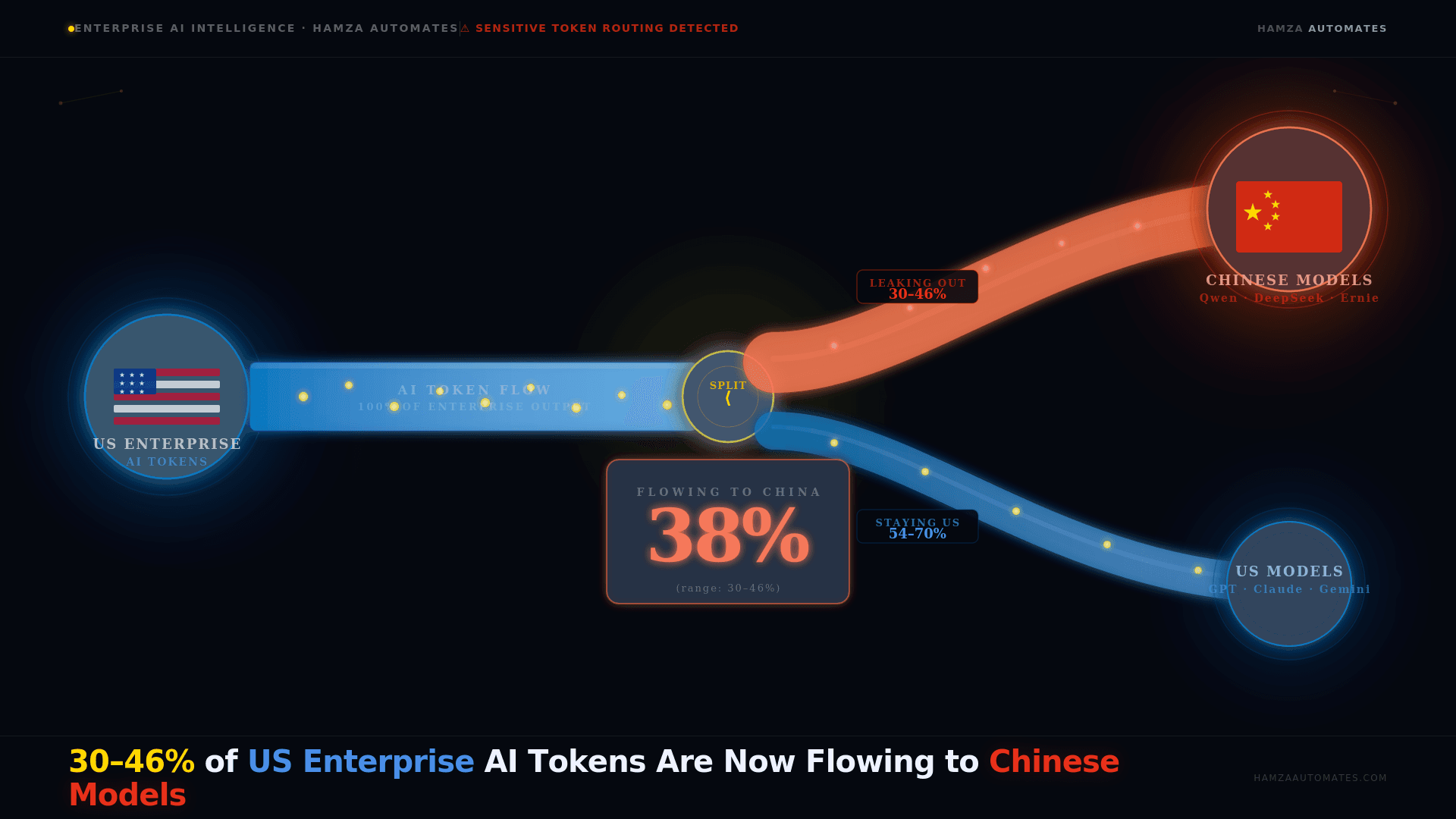
This connects directly to the number I covered on July 10: CNBC confirmed that 30 to 46 percent of US enterprise API tokens are now flowing to Chinese models. Not Chinese enterprise tokens. American ones. That number did not happen because American developers made a geopolitical choice. It happened because a model was cheaper and good enough, and the routing layer does not have a passport.
And it sits alongside the reclassification story from July 13, when the UAE moved to A:5 licence-free status for AI chip exports. The map of who can buy what is being redrawn in both directions at once.
Meanwhile: Gemini 3.5 Pro
Google's flagship was supposed to own this news cycle. Let me be precise about what is known and what is not, because the gap is unusually wide for a launch of this profile.
What is confirmed
- Gemini 3.5 Pro was announced at Google I/O on May 19, 2026, as the flagship of the 3.5 family
- Gemini 3.5 Flash shipped that same day with a full benchmark set at $1.50 input / $9 output per million tokens
- Sundar Pichai told the I/O audience to give the team until the following month; June came and went
What is reported but not confirmed
Per TechTimes' pre-launch audit, every headline specification traces to Geeky Gadgets and HackerNoon rather than a Google model card:
- A 2-million-token context window — roughly double the current frontier field
- A Deep Think extended reasoning mode, reportedly gated behind an Ultra subscription tier
- A ground-up architectural rebuild after engineers found structural failures in recursive tool-calling and SVG generation
- API pricing estimates ranging wildly across outlets — from roughly $1.25/$10 to $15/$60 per million tokens
That pricing spread is not a rounding error. It is a twelve-fold difference on input. When credible outlets covering the same launch are that far apart on the number that determines whether you can afford to run the model, nobody actually knows the number.
The part that matters for your stack
Here is my read, and it is unglamorous: a 2-million-token context window is a specification, not a capability. The question is never whether a model accepts a 2-million-token prompt. The question is whether reasoning quality holds across the full range.
Gemini 3.1 Pro showed measurable accuracy degradation past roughly 120,000 to 150,000 tokens in third-party testing. Earlier Gemini models degraded past 200,000 to 500,000. If 3.5 Pro accepts two million tokens and reasons reliably across four hundred thousand of them, the headline number is marketing and the effective number is what you architect against.
This is precisely the trap I described in Stop Chasing the Biggest Model. The spec sheet is the vendor's argument. The effective-recall curve is your reality. Wait for Artificial Analysis and independent long-context retrieval benchmarks before you route a single production workload.
What This Actually Changes for Your Automation Stack
Most coverage of today will treat it as geopolitics — interesting, distant, someone else's problem. That reading is wrong, and here is why.
1. Governance just became a procurement question
For three years, the question of which jurisdiction governs your model layer had one answer: American, by default, because that is where the models were. WAICO does not change that today. But it establishes a second answer, with a headquarters and founding members, and it will start issuing standards.
If you are running client automation across multiple jurisdictions — and at Hexona we run across six continents — you are now facing a world where 'compliant' is not a single answer. This is what I meant when I argued that governance-first architecture is a competitive advantage rather than a tax. The teams that abstracted their model layer six months ago are about to find out why that was worth the effort.
2. The two-bloc world makes task-model matching mandatory, not optional
When there was one frontier, chasing it was at least a coherent strategy. Wrong, but coherent. In a world where 30 to 46 percent of US enterprise tokens already route to Chinese models, where a Chinese supernode has a Q4 availability date, and where two governance regimes are competing for membership, 'just use the best model' is not a strategy. It is not even a sentence with a stable meaning.
Task-model matching stops being an optimisation and becomes an architectural requirement. You need to know, per workflow, what the task actually demands. Then you route. The advisor model pattern — cheap open-weight model as the default, frontier model as an escalation exception — is not a cost hack anymore. It is how you stay portable while the ground moves.
3. Minimum complexity is now also a geopolitical hedge
I have argued that most tasks need a rule, not an agent. The four-category classification — Rule-Based, AI-Enhanced, Agentic, Autonomous — exists because complexity you do not need is risk you cannot justify.
Today adds a dimension to that argument. Every workflow you built as a rule instead of an agent is a workflow that does not care which model family is available next quarter, which jurisdiction just issued a standard, or which vendor's pricing tripled. Rule-based automation is jurisdiction-agnostic by construction. That is not why I recommend it. But today, it is a bonus that just got more valuable.
It also connects to the security case. The Five Eyes warning about offensive AI capability arriving in months rather than years and the finding that 74 percent of agent deployments get rolled back are two views of the same failure: complexity deployed ahead of the ability to govern it.
4. Your Automation Ratio does not have a nationality
None of today's news changes the only metric that predicts whether your AI investment returns anything: the Automation Ratio — the percentage of AI-assisted outputs that ship without human correction.
A model trained in Hangzhou and a model trained in Mountain View both produce outputs that either ship clean or do not. WAICO does not change your ratio. Gemini 3.5 Pro does not change your ratio unless you measure it before and after, on your actual workflows, with your actual data.
Eighty percent of executives report no measurable AI ROI. Not one of them has that problem because they picked the wrong governance bloc. They have it because they never measured what shipped clean.
What I Would Do This Week
Concrete, in order, and none of it requires you to have an opinion about great-power competition.
- Do not migrate anything to Gemini 3.5 Pro this week. Wait for the official model card, the published rate card, and at minimum one independent long-context retrieval benchmark. Migrating on launch week is how you find production bugs on behalf of the vendor.
- Pull your actual token volumes now, before you evaluate anything. If you do not know your current input/output split per workflow, no launch price means anything to you.
- Audit your model layer for portability. Count how many workflows would break if a specific model string disappeared tomorrow. That number is your exposure, and today it went up.
- Re-run the rule-versus-agent classification across your top ten workflows. Anything that survives as a rule is a workflow that does not care about any of this.
- Measure your Automation Ratio per workflow, not in aggregate. Aggregate hides which processes actually work.
And keep the pricing calendar in view: Sonnet 5 introductory pricing expires August 31, standard pricing plus the tokeniser multiplier lands September 1, and the Fable 5 grace period ends September 30 before credits-only pricing begins October 1. Those dates will hit your invoice harder than anything that happened in Shanghai today.
The Bottom Line
July 17 was supposed to be a model launch. It turned out to be an institutional launch.
Twenty-nine countries signed a founding charter for a governance body headquartered in Shanghai. A head of state showed up in person for the first time in eight years and offered training programmes, regional cooperation centres and a weather system to the countries that export controls left out. Huawei put physical silicon on a table with a Q4 availability date. And Nvidia told its own regulators, in writing, that the strategy of the last three years built the competitor it was meant to prevent.
Meanwhile, the model everyone was waiting for arrived — or is arriving — with a spec sheet nobody has verified and a price nobody can name to within a factor of twelve.
Boring, disciplined moves compound. Headline-chasing does not. Today produced an enormous number of headlines and almost no reasons to change what you shipped yesterday.
That is not cynicism. It is the discipline that separates the teams generating returns from the 80 percent reporting none. Two governance blocs, three frontier labs, and a supernode with 520,000 chips do not change the question you should be asking on Monday morning: what percentage of what my systems produced last week shipped without a human fixing it first?
Frequently Asked Questions
What is WAICO and who founded it?
The World Artificial Intelligence Cooperation Organization is an independent intergovernmental body established by an agreement signed in Shanghai on July 16, 2026, by twenty-nine founding member states, and headquartered in Shanghai. Per Xinhua, Chinese Foreign Minister Wang Yi signed for China; named founding signatories include Kazakhstan, Laos, Pakistan, Russia and Indonesia, with Reuters reporting that Belarus, Serbia, Cuba, Brazil and Venezuela also signed, alongside ten African and twelve Asian nations. UN Secretary-General António Guterres attended the ceremony. The concept was first proposed by China in July 2025 and restated at APEC in October 2025.
Did Gemini 3.5 Pro actually launch on July 17?
July 17 was the widely reported target date for general availability, but as of the most recent pre-launch audits by TechTimes, Google had published no official model card, no pricing page, and no public gemini-3.5-pro model ID. The 2-million-token context window, the Deep Think mode and the architectural rebuild all trace to third-party reporting rather than Google announcements. Until Google publishes a model card and rate card, treat every specification as unverified — and do not route production workloads against a leak.
Should I move my automation stack off Chinese models given the governance split?
The wrong framing. The right question is which workflows require which capability tier, and whether your model layer is abstracted enough that the answer can change without a rewrite. Roughly 30 to 46 percent of US enterprise API tokens already route to Chinese models — most teams running them did not make a geopolitical decision, they made a price decision. Audit your portability first; make the jurisdiction call second, with your compliance obligations in front of you rather than a news cycle.
Is Huawei's Atlas 950 SuperPoD a genuine Nvidia competitor?
The 6.7x-versus-NVL144 claim is a vendor claim made in a vendor venue against a configuration the vendor selected, and no independent verification exists. But the physical unit was displayed publicly at WAIC, the SuperCluster configuration with 520,000+ Ascend 950DT chips carries a stated Q4 2026 availability, and Nvidia itself has stated it was effectively foreclosed from China's data centre compute market. Credible enough to affect pricing pressure; unproven on independent throughput. Both things are true.
Does any of this change what model I should be using?
Probably not this week. The pricing calendar will affect your costs far more than the governance news: Sonnet 5 introductory pricing expires August 31, standard pricing and the tokeniser multiplier land September 1, and Fable 5 moves to credits-only October 1. Apply task-model matching against those dates and your real token volumes. The advisor model pattern — cheap open-weight default, frontier escalation as the exception — remains the right default architecture regardless of which bloc wins which argument.
What is the single number I should watch instead of today's headlines?
Your Automation Ratio: the percentage of AI-assisted outputs that ship without human correction, measured per workflow rather than in aggregate. It is the only metric that has predicted ROI across every client engagement I have run. Eighty percent of executives report no measurable AI ROI, and 74 percent of agent deployments get rolled back — neither statistic has anything to do with which model or which jurisdiction. Both have everything to do with unmeasured output quality.
What are the next dates that actually matter?
Four: Alphabet's Q2 earnings on July 28, the NSA/CISA classified frontier model benchmarking framework deadline on August 1, the Sonnet 5 pricing change on September 1, and Cloudflare AI bot management becoming default for all new domains on September 15. WAIC runs through July 20, so expect more announcements — and watch the enterprise platform moves more closely than the keynotes.
Related Reading
Continue the analysis:
1. CNBC Confirms 30–46% of US Enterprise Tokens Flowing to Chinese Models — the number that made today's governance split a procurement problem.
2. The Geneva UN AI Governance Summit: 169 Countries, One Unresolved Question — the multilateral attempt that preceded WAICO by eleven days.
3. Stop Chasing the Biggest Model — why a 2-million-token context window is a specification, not a capability.
4. You Don't Need an Agent, You Need a Rule — the four-category classification that makes your stack jurisdiction-agnostic.
5. The Automation Ratio: The Metric That Predicts Survival — the number none of today's news changes.
6. The Five Eyes AI Agent Security Guide — offensive capability in months, not years, and what governance-first architecture actually means.
7. Gartner's $206 Billion AI Agent Spending Forecast for 2026 — the money that will flow regardless of which bloc writes the standards.
About the Author
Hamza Baig is the founder of Hexona Systems, an AI automation agency operating across six continents, and the AI Automation Institute, where he has trained more than 40,000 entrepreneurs in practical AI systems design.
He has been featured in the GHL Top 50, Yahoo Finance and Brainz Magazine. His work focuses on the gap between what AI can do in a demo and what it reliably ships in production — the Automation Ratio, task-model matching, and governance-first architecture.
Read more analysis on the Hamza Automates blog, get in touch about your automation stack, or follow @hamza_automates on Instagram for daily breakdowns.
Sources: Xinhua, CNBC, Bloomberg, Associated Press via NPR, South China Morning Post, PYMNTS, TechTimes, Huawei Central, and the official readout of the 2026 World AI Conference opening ceremony. All benchmark and pricing claims attributed to third-party reporting remain unverified pending official publication.
About
Hamza Baig is the founder of Hexona Systems—an automation agency and softwareplatform that helps thousands of entrepreneurs and business owners implement AI-powered workflows at scale.