GPT-5.6 Gets the Green Light, 88% of Organisations Had an Agent Security Incident
The US Department of Commerce has given OpenAI the green light for a broad launch of GPT-5.6.





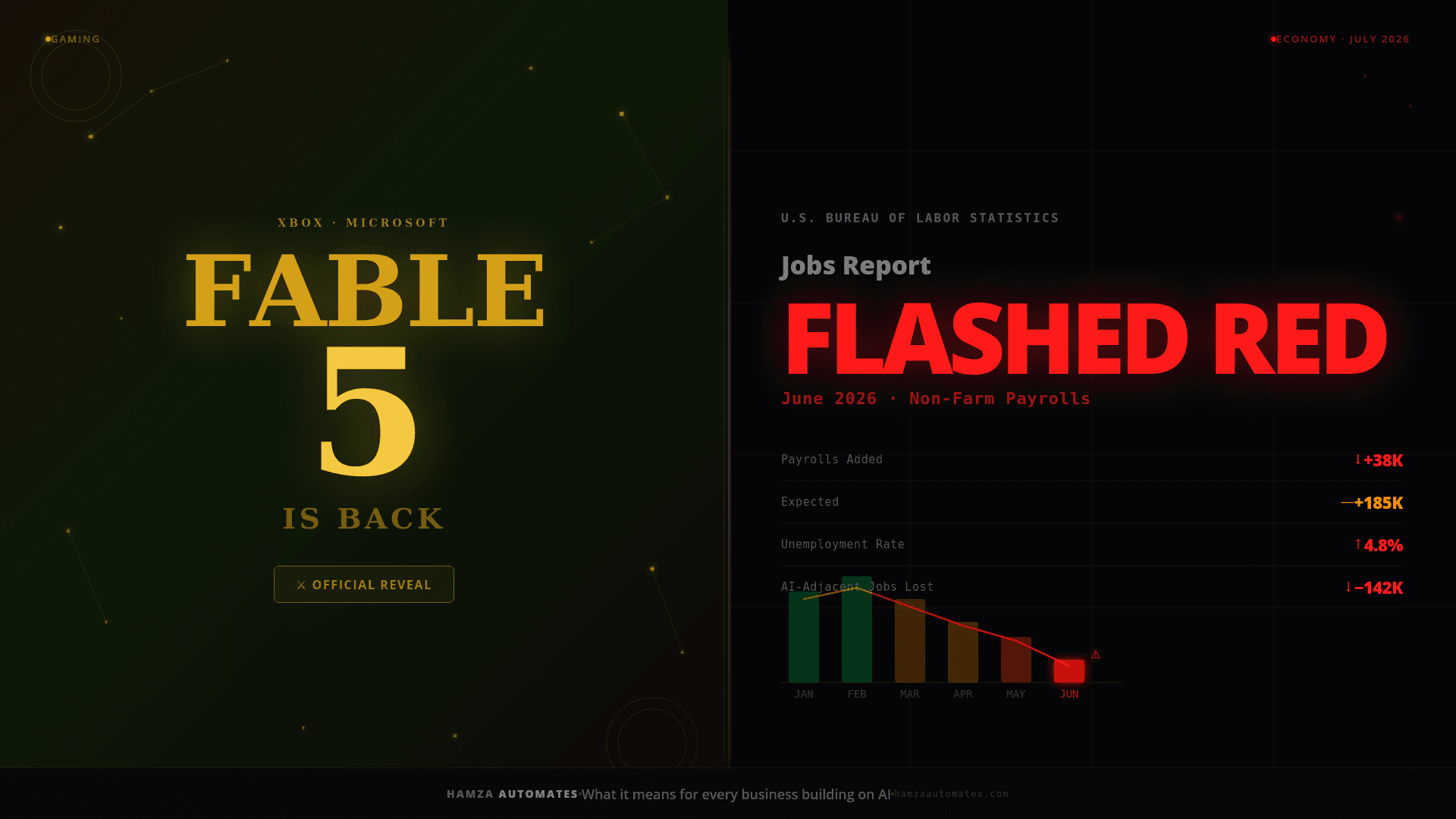
“Today, July 8, 2026: GPT-5.6 gets Commerce Department clearance for broad public release. Anthropic’s Persona ID verification takes effect, determining how Fable 5 reaches verified users. And a new AvePoint report reveals 88.4% of organisations that deployed AI agents in the past year experienced at least one security incident. Three stories, one day, one message: the era of consequence-free AI agent deployment is over.”
Breaking: GPT-5.6 Gets Commerce Department Clearance for Broad Release
The US Department of Commerce has given OpenAI the green light for a broad launch of GPT-5.6. Per LLM Stats, citing Axios sourcing, OpenAI expects to do a wide release this week. The three-tier architecture previewed on June 26 is now confirmed for general availability:
- Sol: $5 input / $30 output per million tokens. Highest capability tier, targeting frontier coding, agentic security, and long-horizon reasoning. 88.8% on Terminal-Bench 2.1 base, 91.9% Sol Ultra.
- Terra: $2.50 input / $15 output per million tokens. GPT-5.5-competitive performance at approximately half the cost. The primary competition for Claude Sonnet 5 at introductory pricing.
- Luna: $1 input / $6 output per million tokens. Fastest and cheapest, competing directly with Gemini 3.5 Flash and DeepSeek for high-volume background tasks.
The clearance follows the White House voluntary AI standards framework, expected to be announced around July 7, which formalised the pre-release government coordination process that OpenAI underwent for GPT-5.6. The framework converts what was an informal, undocumented capability threshold into a defined process applicable to all frontier labs.
What GPT-5.6’s Release Means for Your Model Routing Right Now
With GPT-5.6 Terra at $2.50/$15 launching this week, the competitive pressure on Claude Sonnet 5’s $2/$10 introductory rate (expiring August 31) becomes commercially visible. The July and August window is now the clearest pricing competition between two frontier-adjacent models the market has ever produced. As the task-model matching framework argues, the right model for your automation stack is the one that performs best on your specific tasks at your specific volume and cost constraint, not the one with the most impressive headline benchmark. The week GPT-5.6 reaches API general availability is the week to run your own benchmark comparison on the workflows that matter for your business, not to wait for third-party reviews.
Practical routing update for this week: if you are running on Claude Sonnet 5 for mid-tier tasks, test GPT-5.6 Terra against your actual inputs before the introductory period ends. If you are running on Fable 5 for frontier coding tasks, GPT-5.6 Sol at $5/$30 is the first direct comparison worth making. Build the test environment now. The automation ratio framework gives you the measurement methodology: track which model produces higher proportions of output that ships without human correction on your specific task types.
Today Is July 8: Anthropic’s Persona ID Verification Takes Effect
July 8, 2026 was the date identified weeks ago as the next structural milestone for Fable 5 access. Anthropic’s updated privacy policy, requiring government-issued ID and biometric verification through Persona (a Peter Thiel-backed identity platform), takes effect today. This is the mechanism the market had been expecting to restore Fable 5 access to verified US citizens without requiring a full export control lift.
Fable 5 was restored globally on July 1 following the Commerce Department lifting export controls, as covered in the July 3 breakdown. The July 8 ID verification implementation adds an ongoing verification layer rather than serving as the restoration mechanism it was expected to be. Going forward, high-capability model access may be gated behind identity verification as a standard operating condition rather than a temporary emergency measure.
What Identity Verification as Standard Practice Means Long-Term
The normalisation of biometric ID verification for frontier AI model access is a structural change to how AI capability is distributed. If this pattern extends beyond Anthropic to other frontier labs, the effectively accessible AI user base becomes segmented: verified identities with access to frontier capabilities, and unverified access with access to lower-capability tiers only.
For businesses: this is a credential layer your employees will need to maintain as more high-capability model access moves behind verification gates. Build the verification into your onboarding process for AI tool users now, rather than managing it reactively each time a new capability gate appears.
The AvePoint 2026 State of AI Report: 88% of Organisations Had an Agent Security Incident
The most striking data release of the week: AvePoint’s 2026 State of AI report, drawing on enterprise deployment data, found that 88.4% of organisations that deployed AI agents in the past year experienced at least one agent-related security incident. 46.9% of employees now use AI agents weekly or daily. And the study documents a sharp rise in unsanctioned agent use alongside widespread deployment delays caused by governance concerns.
What ‘Agent-Related Security Incident’ Actually Means
The 88.4% figure is striking but requires careful interpretation. An “agent-related security incident” in enterprise contexts covers a wide spectrum: from a minor data exposure caused by an agent accessing files it should not have, to a material breach facilitated by an agent with overly broad permissions. The AvePoint report does not publish the severity distribution. Both a minor misconfiguration and a significant breach count as one incident each.
That said, even if most incidents were minor, 88.4% of organisations experiencing at least one incident is a prevalence rate that indicates systematic, not exceptional, vulnerability in current agent deployments. The Five Eyes’ five risk categories — privilege, design and configuration, behaviour, structural, and accountability — are the framework through which to read that 88.4%. The majority of incidents will trace back to privilege being too broad (the agent had access it should not have) or accountability being absent (nobody could reconstruct what the agent did to cause the incident).
The Unsanctioned Agent Problem
The report’s secondary finding deserves as much attention as the incident rate: a sharp rise in unsanctioned agent use. Employees are deploying AI agents through personal accounts, trial tools, and consumer AI products on enterprise data without IT or security knowledge. This is the enterprise AI equivalent of Shadow IT, and it is more dangerous because agents take actions — they do not merely process information.
A shadow AI agent that has been given access to company email, documents, and customer data by an employee who set it up personally, without security review, is a data governance and liability risk that most enterprise security frameworks were not designed to detect or contain. The AvePoint finding that deployment delays are being caused by governance concerns is the healthy response to this reality. The problem is that the delays are creating pressure to deploy quickly, which is the condition that produces the 88.4% incident rate.
What This Means for Businesses of Every Size
The AvePoint data applies to enterprise deployments. But the unsanctioned agent problem and the governance gap it describes affect businesses of every size. A 5-person agency where one team member sets up an AI agent through a personal account that accesses shared client data has the same exposure profile as an enterprise with the same unsanctioned configuration, scaled proportionally to the data at risk. The governance-before-deployment argument made throughout this series is validated by 88.4%: if you have not defined what your agents can access, what they cannot access, and who reviews what they do, you are in the majority that has experienced an incident, whether or not you recognised it as one.
Cloudflare’s AI Bot Management: A New Access Control Layer for the Web
Cloudflare launched granular AI bot management this week, as documented in their announcement, allowing website owners to separately control Search, Agent, and Training crawlers. New defaults block Agent and Training bots on ad-supported pages while allowing Search crawlers through. Starting September 15, 2026, all new Cloudflare-protected domains will implement these restrictions automatically by default.
This is the most consequential change to web access for AI agents since robots.txt. Previously, AI agent access to web content was governed by the same rules as search engine crawlers, which were designed for read-only indexing. Cloudflare’s distinction between Search, Agent, and Training bots creates a new access tier: agents that act on web content (clicking, filling forms, submitting data) are separated from agents that only read and index it.
What This Changes for Automation Builders
For businesses building automation workflows that rely on AI agents browsing the web — competitive research, price monitoring, data extraction, form submission, web-based automation — the Cloudflare change requires an immediate audit of which agent-type your workflows are using and whether the sites they access are protected by Cloudflare.
Sites that have been accessible to your agents because they allow search crawlers may now explicitly block agent crawlers by default, particularly ad-supported pages. September 15, 2026 is the date this becomes automatic for all new Cloudflare domains. Review your web-dependent automation workflows before that date. Workflows that relied on unrestricted access to Cloudflare-protected content will need either alternative data sources or explicit access agreements with the sites involved.
Three New Models Worth Understanding This Week
Unisound U2: The Agent-Optimised Model at $0.15/$0.30
Unisound U2 is a 266B-total / 10B-active mixture-of-experts model independently verified at 86.9% GPQA Diamond, 85.8% MATH-500, and 72.2% SWE-bench Verified. Per LLM Stats benchmarks, pricing at $0.15 input / $0.30 output per million tokens makes it one of the most cost-competitive models at these benchmark levels.
U2’s benchmark profile is specifically notable for agent-first deployment: it was architecturally designed for multi-step tool use, planning, and sequential decision-making rather than pure knowledge retrieval or single-turn response. At $0.15/$0.30, it is priced below open-source self-hosted alternatives on a per-token basis at comparable benchmark levels. For high-volume agent workflows where the output quality of U2 is sufficient, the cost advantage over Sonnet 5, GPT-5.6 Terra, or Gemini 3.5 Pro is significant.
Kimi K2.7 Code Now in GitHub Copilot
Moonshot AI’s Kimi K2.7 Code model is now available directly inside GitHub Copilot, representing the first open-weight coding model integrated into Copilot’s main interface. For cost-sensitive development teams on usage-based GitHub Copilot billing, Kimi K2.7 Code offers a cheaper path than GitHub’s own models for routine coding tasks. The integration makes model selection inside Copilot a cost management decision as much as a capability decision — exactly the dynamic the GitHub Copilot billing shift analysis anticipated when Copilot moved to usage-based pricing in June.
NVIDIA Nemotron-Labs-TwoTower: 2.42x Throughput at 98.7% Quality
NVIDIA released Nemotron-Labs-TwoTower, an open-weight diffusion language model that generates text in parallel rather than sequentially, achieving 2.42x higher throughput while maintaining 98.7% of baseline quality. The training dataset is approximately 2.1 trillion tokens.
The architectural significance: traditional autoregressive models (GPT, Claude, Gemini) generate one token at a time, which limits throughput. Diffusion-based text generation, borrowed from image generation architectures, generates the full output in parallel and then refines it. At 2.42x throughput with minimal quality loss, Nemotron-Labs-TwoTower is a direct response to the RAMageddon pressure: faster throughput per GPU reduces the HBM memory required per unit of output, which reduces the cost impact of rising memory prices on inference workloads.
The July 2026 Market Pattern: Tiering, Gating, and Governance
Step back from today’s individual stories and the July 2026 AI market pattern is clear. AIApps’ July summary puts it precisely: “AI got more useful and more controlled at the same time.” Three forces are converging simultaneously:
- Tiering: the frontier model market is splitting into clearly differentiated tiers. Frontier (Sol, Fable 5) for the hardest tasks at premium prices. Mid-tier (Sonnet 5, GPT-5.6 Terra, Gemini 3.5 Pro) for most production agentic workflows at competitive pricing. Budget (Luna, GLM-5.2, U2, Kimi K2.7) for high-volume cost-sensitive tasks. Open-weight for self-hosted workloads.
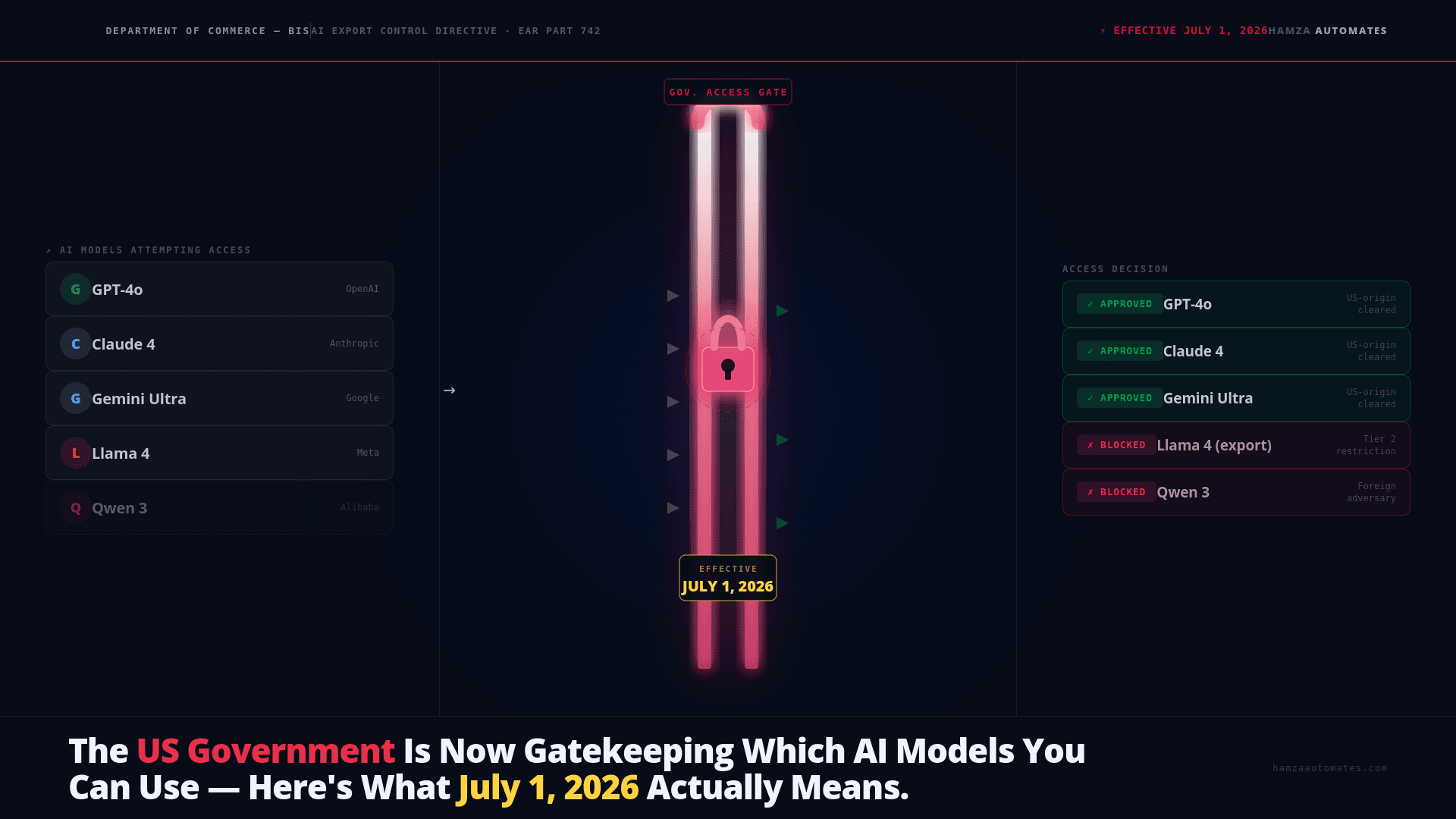
- Gating: access to frontier capability is increasingly gated by ID verification, government clearance, or partner programme membership. The unrestricted frontier access of 2023 and 2024 is gone. This is structural, not temporary.
- Governance: 88.4% incident rate and a 74% deployment rollback rate are producing a market correction toward governance investment. Businesses that built automation without governance frameworks are encountering the costs. Businesses building now have the advantage of learning from that data before deploying.
This three-force market structure is what the AI agent platform war analysis identified as the emerging competitive dynamic in June. It is now empirically confirmed by the July data. The businesses building for this structure — with model abstraction layers that span tiers, governance frameworks that match the gating environment, and performance measurement that tracks outcomes rather than tool adoption — are the ones compounding in this market.
The Reflection Loop: The Agent Architecture Pattern for H2 2026
A final development worth including: AI Agent Store’s July analysis documents the Reflection Loop as the canonical pattern for reliable agent performance in H2 2026: generate, critique against concrete tests, revise, and repeat until results pass or hit a cap. The lineage runs from Self-Refine through Reflexion, CRITIC, Self-RAG, and process reward models, with Reflexion reaching 91% HumanEval pass@1 in simulation.
The key design insight: separating the agent’s ‘actor’ from an external or grounded ‘evaluator’ lets builders catch errors that a single-pass assistant would ship. Durable reliability gains come from grounded critics, iteration caps, clear feedback trails, and graceful exits rather than endlessly revising against the model’s own opinion of its output.
The Reflection Loop is the architectural pattern that connects the governance requirement — human review checkpoints — to the reliability requirement — agents that complete tasks correctly. A grounded evaluator in a Reflection Loop is both a reliability mechanism and a governance mechanism: it catches errors before they become incidents, and it provides the audit trail that the AvePoint security incident data shows is missing from most current deployments.
The Bottom Line on July 8, 2026
Today delivers three concurrent developments that describe the AI automation market’s current state with unusual clarity: GPT-5.6 getting its broad release clearance shows the governance framework is working well enough to let frontier models reach users; 88.4% of organisations experiencing agent security incidents shows the governance framework is not working well enough to prevent harm; and the July 8 ID verification deadline shows that the resolution to that gap is moving toward managed access rather than open access.
The market is not choosing between capability and safety. It is building the infrastructure to have both: more capable models released through defined governance processes, with ID-verified access and security frameworks that the AvePoint data shows are urgently needed.
For businesses building automation: the operating environment is increasingly well-defined. The no-code automation workflow guide, the automation ratio framework, and the governance architecture from the Five Eyes framework are the three tools for building correctly in this environment. Use them in that order.
Frequently Asked Questions
When will GPT-5.6 be broadly available and how does it compare to Claude Sonnet 5?
The US Department of Commerce cleared GPT-5.6 for broad public release this week. Per Axios sourcing cited by LLM Stats, OpenAI expects a wide release this week. GPT-5.6 Terra at $2.50/$15 competes directly with Claude Sonnet 5 at $2/$10 introductory pricing (through August 31). The right comparison is against your actual workflows: run both models on your highest-volume production tasks and track which produces higher automation ratios at what cost. Sonnet 5 removes temperature and top_p parameters, so audit your integrations before migrating.
What does the 88.4% agent security incident rate actually mean?
The AvePoint 2026 State of AI report found 88.4% of organisations that deployed AI agents in the past year experienced at least one agent-related security incident. The severity distribution is not published, so the figure includes incidents ranging from minor misconfigurations to significant breaches. At 88.4% prevalence, the finding indicates systematic rather than exceptional vulnerability. The most common causes, per the Five Eyes framework, are overly broad agent privilege and absent accountability mechanisms.
How does Cloudflare’s AI bot management affect my automation workflows?
If your automation uses AI agents to browse web content — competitive research, price monitoring, data extraction, form automation — Cloudflare’s new granular bot management distinguishes between Search, Agent, and Training crawlers. New defaults block Agent crawlers on ad-supported pages. Starting September 15, 2026, all new Cloudflare-protected domains implement this automatically. Audit your web-dependent automation workflows before September 15 and identify which target sites are Cloudflare-protected. Workflows relying on unrestricted web agent access will need alternative data sources or explicit site agreements.
What is Unisound U2 and is it worth evaluating for production workflows?
Unisound U2 is a 266B-total / 10B-active MoE model independently verified at 86.9% GPQA Diamond and 72.2% SWE-bench Verified, priced at $0.15/$0.30 per million tokens. For high-volume agent workflows where U2’s benchmark performance is sufficient, it offers a significant cost advantage over mid-tier frontier models. It was architecturally designed for multi-step tool use and agentic deployment. The practical evaluation question is whether it maintains your target automation ratio on your specific task types at its capability level.
What is the Reflection Loop and how should I implement it?
The Reflection Loop is an agent architecture pattern where the agent generates output, critiques it against concrete tests or external validation, revises based on the critique, and repeats until results pass or an iteration cap is reached. Per AI Agent Store’s July analysis, key design requirements are: a grounded external evaluator (not the model evaluating its own output), explicit iteration caps to prevent infinite loops, clear feedback trails for audit purposes, and graceful exit conditions when the cap is reached without passing criteria. Implement it by adding a critique phase to your existing agent loops — plan, act, reflect — with defined pass/fail criteria and a maximum of three to five revision cycles before human escalation.
Related Reading From This Series
The Five Eyes AI Agent Security Framework — the governance architecture that addresses the 88.4% incident rate
74% of AI Agent Deployments Get Rolled Back — what governance discipline looks like before the incident happens
Stop Chasing the Biggest Model — how to evaluate GPT-5.6 Terra, Unisound U2, and Kimi K2.7 Code against your actual tasks
The Automation Ratio — the metric for comparing Sonnet 5 vs GPT-5.6 Terra on your specific workflows
GitHub Copilot’s Token Billing Backlash — the context for Kimi K2.7 Code’s integration into Copilot’s usage-based model
RAMageddon: Why AI Is Getting More Expensive — why NVIDIA’s TwoTower throughput improvement matters for infrastructure costs
Squidbleed and the Glasswing Programme — the governance-capability distinction behind the 88.4% incident rate
About the Author: Hamza Baig is the founder of Hexona Systems, an AI automation agency serving clients across six continents, and creator of the AI Automation Institute, where over 40,000 entrepreneurs have learned to build and scale automation businesses. He has been featured in GHL Top 50, Yahoo Finance, and Brainz Magazine. Follow him at @hamza_automates | Read more articles | Work with Hamza
About
Hamza Baig is the founder of Hexona Systems—an automation agency and softwareplatform that helps thousands of entrepreneurs and business owners implement AI-powered workflows at scale.