You Don’t Need an Agent. You Need a Rule.
Trigger-action automations are being repackaged as agents. Expensive LLM calls that replace a simple conditional are being marketed as agents. Most of my clients would have better results





“The word ‘agent’ has been so badly abused in 2026 that it now means almost nothing. Chatbots are being sold as agents. Trigger-action automations are being repackaged as agents. Expensive LLM calls that replace a simple conditional are being marketed as agents. Most of my clients would have better results, lower costs, and more reliable systems if they had never used the word at all and just asked, "What does this task actually require?”
I want to say something that will sound counterintuitive from someone who runs an AI automation agency: most of the automations I build for clients are not agents. They are rules.
Not because agents are bad. Because rules are more often the right tool, and the distinction between them has been so thoroughly obscured by marketing that most founders are spending 10x more on AI than the problem requires.
What an Agent Actually Is — and What It Is Not
A real AI agent has five properties. I say ‘real’ because the marketing category of ‘agent’ products has expanded to include almost anything that uses an LLM. Real agents have:
- Goals: a target state they are trying to reach, not a fixed set of instructions to follow
- Memory: the ability to retain and use context across multiple steps or sessions
- Tool access: the ability to take actions in systems, not just produce text
- Decision capacity: the ability to choose between different approaches based on what they observe
- Escalation logic: the ability to recognise when a situation exceeds their defined scope and hand off to a human
If a system does not have all five of these properties, it is not a real agent. It is either a sophisticated automation, a conditional trigger, or a well-prompted LLM call. All of those are useful. None of them require an ‘agent’ architecture.
Here is the test I run on every client request for an ‘agent’: can I describe what success looks like with a rule? If I can say ‘when X happens, do Y’ with sufficient specificity, the right answer is automation, not an agent. An agent is the right answer when the range of situations the system needs to handle is genuinely too diverse for rules to capture without becoming unmanageably complex.
Why This Distinction Matters More in July 2026 Than It Did a Year Ago
The AvePoint 2026 State of AI report finding that 88.4% of organisations experienced agent-related security incidents is partially a governance story. It is also a scoping story. A significant portion of those incidents are attributable to organisations deploying real agents — systems with goals, memory, and tool access — for tasks that could have been handled by simple, governed automations. Simple automations have smaller attack surfaces, fewer failure modes, and more predictable behaviour than agents. Misclassifying an automation problem as an agent problem creates unnecessary security exposure.
The 74% agent deployment rollback rate is partially the same story from a different angle. Deployments that get rolled back are frequently ones where the complexity of the agent architecture was not justified by the complexity of the task. A Salesforce two-step automation that stalls halfway through is not an agent problem. It is a workflow design problem that someone added an LLM to without the right architecture. Sonnet 5 completing that workflow end-to-end, as Zapier’s engineer noted, is not evidence that agents are better. It is evidence that the workflow was always simple enough to complete with well-designed automation, and Sonnet 5’s production reliability improvements made the automation reliable.
The Four Categories of AI Automation — And When to Use Each
I use a four-category framework when I evaluate what a client actually needs. Most of the time, the right answer is in the first two categories, not the last two.
Category One: Rule-Based Automation (No AI Required)
When X happens, do Y. No variation. No judgment. Completely predictable inputs and outputs.
Examples: send a confirmation email when a form is submitted. Create a CRM entry when a deal closes. Add a row to a spreadsheet when a payment is received. Notify Slack when a support ticket is opened.
The right tool: Make, Zapier, n8n, or any trigger-action platform. No LLM required. No agent required. These are the cheapest, most reliable, most maintainable automations you can build. A surprising number of the ‘AI automations’ I am asked to build fall into this category. The client wants AI. What they actually need is a well-designed trigger-action workflow.
Category Two: AI-Enhanced Automation (LLM as One Step in a Rule-Based Workflow)
A rule-based workflow where one or more steps requires language understanding, generation, or classification that cannot be expressed as a deterministic rule.
Examples: form submitted → AI classifies the request type → route to correct team. New email received → AI extracts key details → populate CRM fields. Weekly report data collected → AI generates narrative summary → send to inbox.
The right tool: the same trigger-action platforms with an LLM API call at the specific step that requires language capability. The rest of the workflow remains rule-based and deterministic. This is the most underrated category in AI automation, and it is where the vast majority of business value lives for most companies.
Category Three: Agentic Automation (LLM with Tool Use and Memory Across Multiple Steps)
Tasks where the specific steps required to complete them cannot be predetermined, because the right approach depends on what the system finds along the way. The system needs to plan, execute, observe the result, and adjust.
Examples: research a topic across multiple sources and produce a structured report. Debug code by reading error messages, identifying root causes, writing fixes, running tests, and iterating. Conduct a technical interview and evaluate responses against defined criteria.
The right tool: Claude Code, AutoGPT, or similar systems with genuine tool access, memory, and planning capability. This is where real agents belong. It is also where the security risk and reliability investment requirement is highest, because a system that can plan and take varied actions is also a system that can take wrong actions in varied ways.
Category Four: Autonomous AI Systems (Multi-Agent Coordination for Complex Goals)
Multiple agents coordinating to pursue a complex, long-horizon goal where the work can be parallelised across specialised sub-agents. Currently the frontier of production AI deployment for most organisations.
Examples: a software development pipeline where a planner agent decomposes a feature request into tasks, specialised coding agents implement each task in parallel, a test agent validates each implementation, and a reviewer agent checks the assembled result. An AI-driven research pipeline where data collection, analysis, synthesis, and quality assurance run as parallel agent workflows.
The right tool: purpose-built multi-agent orchestration frameworks with full governance architecture. The 74% rollback rate and the 88.4% incident rate are concentrated here, because this category is where the gap between capability and governance maturity is largest. Most organisations attempting Category Four are not ready for it.
The Most Expensive Mistake I See Repeatedly
The single most expensive mistake in AI automation, and the one I see most frequently, is Category One and Two problems being treated as Category Three or Four problems.
Someone needs to classify customer support tickets into 12 categories. The correct solution is a well-prompted LLM call with the 12 categories and a few examples. Category Two. Simple, cheap, reliable, high automation ratio.
They build an agent with memory, tool access, and a planning loop. Category Three. Expensive, complex, fragile, low automation ratio, significant security surface. The same task, achieved with a system that costs 10x more to run and 20x more to maintain, with lower reliability on the specific task.
Why does this happen? Because ‘agent’ sounds more impressive than ‘trigger-action workflow with an LLM call at step 3.’ Because the marketing ecosystem around AI automation celebrates agent deployments and treats simple automation as unsophisticated. Because founders and engineers feel more accomplished building something complex than something simple, even when the simple thing is demonstrably better.
The Governance Implication Nobody Is Saying Clearly
The JADEPUFFER autonomous ransomware disclosure this week demonstrated what a real Category Four autonomous agent looks like when deployed adversarially. It had goals, memory, tool access, decision capacity, and escalation logic. It was highly effective.
Here is the governance implication that connects JADEPUFFER to everyday business automation: every property that makes a real agent capable of doing complex work also makes it capable of causing complex harm if it is compromised, misdirected, or poorly scoped. An agent with tool access to your CRM, email, and file system is a system that can do a lot of good. It is also a system that, if it takes wrong actions, can do a lot of damage.
The appropriate governance response is not to avoid Category Three and Four automation. It is to only deploy real agents when the task genuinely requires them — and to handle Categories One and Two with simpler, more constrained systems that have smaller attack surfaces and more predictable behaviour. Minimum complexity is a security principle, not a capability limitation.
How to Classify Any Automation Request in Five Minutes
When a client or team member comes to me with an automation request, I run through five questions in order. I stop as soon as I have enough to classify the task.
Question 1: Can I describe every step of this workflow in advance?
If yes, it is not an agent task. It is Category One or Two. Map the workflow and decide which steps need language capability. Build the trigger-action automation with LLM calls at those steps only.
Question 2: Does this task require language understanding or generation?
If yes to Question 1 and yes to this question: Category Two. If no to Question 1: continue.
Question 3: Does the approach need to change based on what the system finds along the way?
If yes: the task may genuinely require planning and decision capability. Continue to Question 4. If no: reconsider whether you can express this as a more complex rule set before going to Category Three.
Question 4: What is the blast radius if the agent takes a wrong action?
This is the question most people skip. If the agent can delete files, send emails, modify database records, or take financial actions, the blast radius of a wrong decision is significant. Before building a Category Three or Four system, define what actions are in scope, what requires human approval, and what the rollback procedure is. If you cannot answer these questions before building, you are not ready to build the agent.
Question 5: Does this require multiple agents working in parallel?
If yes: you are in Category Four territory. Make sure your governance architecture, rollback procedures, and human oversight mechanisms are in place before deploying. If no: you are in Category Three. Build the single-agent version first, get it working reliably, and evaluate whether parallelisation adds enough value to justify the added complexity.
What Actually Drives Automation Ratio in Practice
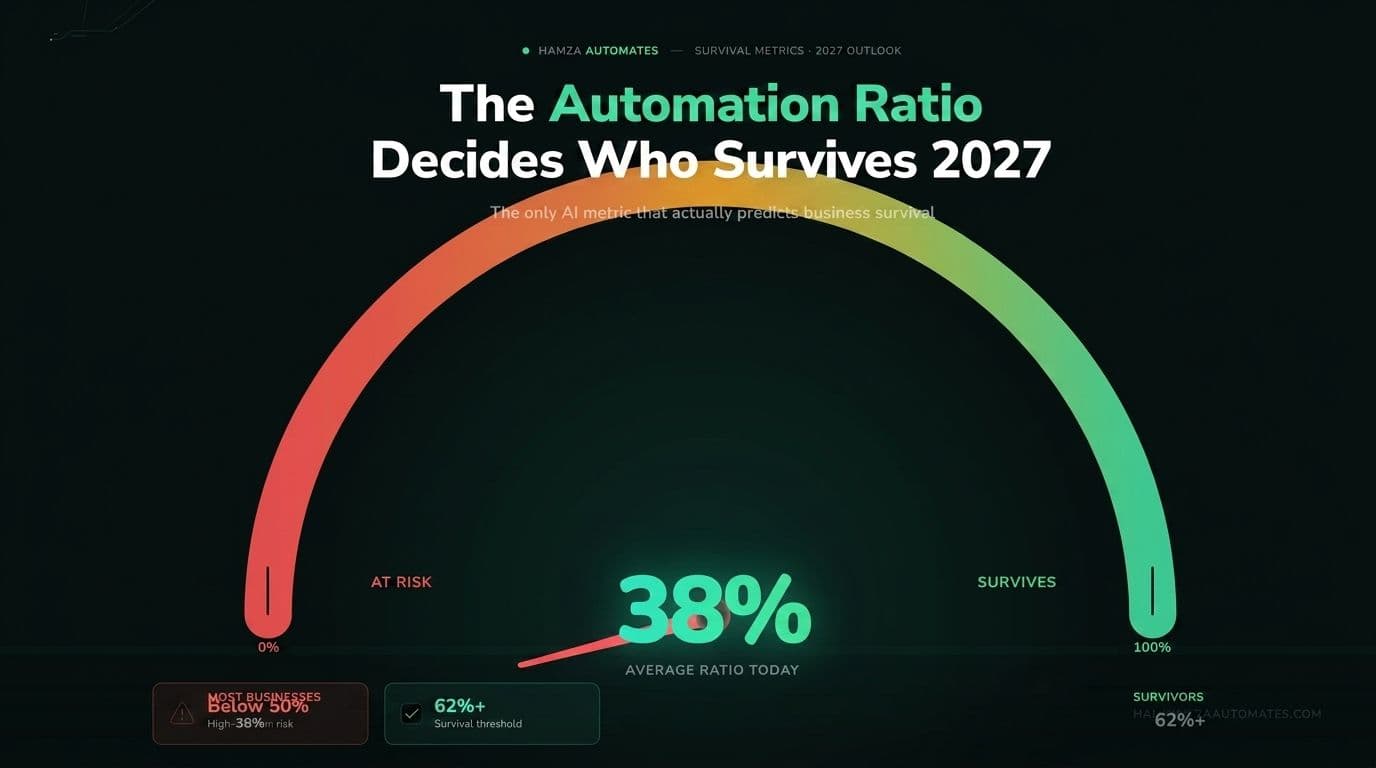
The automation ratio framework I introduced earlier in this series — the percentage of AI-assisted outputs that ship without human correction — is directly affected by task classification. The highest automation ratios I see in client deployments are always in Category Two: well-designed trigger-action workflows with narrowly scoped LLM calls at specific steps. The lowest automation ratios are in Category Three deployments where the task did not require agent complexity but got it anyway.
The reason is structural. A Category Two system has deterministic control flow with an LLM call at a well-defined decision point. The range of outcomes from that LLM call is constrained by the specific prompt and context the rule-based workflow provides. When the LLM gets it wrong, the error is isolated to that one step.
A Category Three agent has non-deterministic control flow where the agent decides its own next steps. When the agent makes a wrong decision early in the sequence, subsequent steps compound that error. The final output may require significant rework not because any individual step was bad, but because the overall sequence was poorly directed. This is why the automation ratio for agent systems is characteristically lower than for equivalent rule-based systems on the same underlying task.
The Honest Answer to ‘Should I Use an Agent?’
The honest answer, after four years of building automation systems at Hexona Systems across clients in every industry: use an agent when the task genuinely requires autonomous decision-making across a variable range of situations. Use everything else when it does not.
The majority of business automation value is in Category One and Two. It is unsexy. It is not what people write about on LinkedIn or present at conferences. It is what produces the highest automation ratios, the lowest costs, the most maintainable systems, and the least governance risk.
Agents are genuinely transformative for the tasks that require them. They are also genuinely over-used for tasks that do not. The founders and operators who understand this distinction are building automation stacks that are more reliable, less expensive, and more defensible than the ones chasing the most sophisticated architecture available.
Start with the simplest solution that achieves your target automation ratio. Add complexity only when you can demonstrate that the simpler solution cannot achieve the ratio you need at the accuracy level your business requires. That is the discipline that produces systems that work.
The Bottom Line
The word ‘agent’ has become meaningless in AI marketing. A chatbot, a trigger-action automation, a well-prompted LLM call, and a genuine autonomous agent with goals, memory, tool access, and escalation logic are all being sold under the same label. They are not the same thing. They have different costs, different reliability profiles, different maintenance requirements, and different security implications.
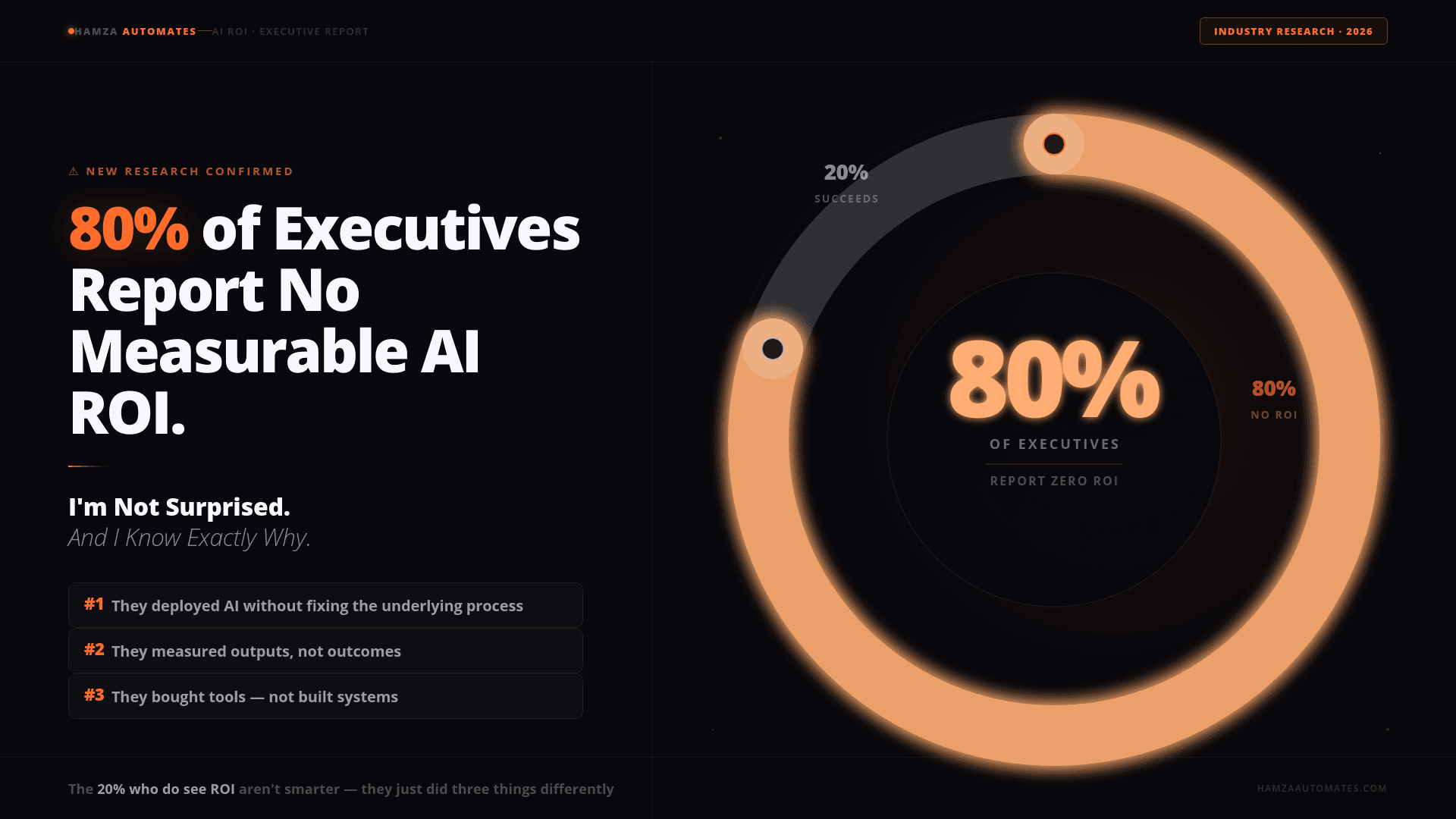
Your job as a business owner or automation builder is to match the right tool to the actual task, not to the most impressive-sounding solution. Most tasks require Category One or Two. A few require Category Three. Fewer still require Category Four. Treating everything as Category Three or Four is what produces the 74% rollback rate, the 88% incident rate, and the ‘AI doesn’t work for our business’ conclusion that 80% of executives reported.
You probably do not need an agent. You probably need a rule. Find out which, and build the right one.
Frequently Asked Questions
What is the difference between an AI agent and an AI automation?
An AI automation (Categories One and Two) follows a predefined sequence of steps, with AI handling specific steps that require language capability. The control flow is deterministic. An AI agent (Categories Three and Four) can plan its own sequence of steps based on what it observes, take actions through tool access, retain memory across steps, and escalate to humans when needed. Agents are more capable for genuinely variable, open-ended tasks. Automations are more reliable, cheaper, and easier to maintain for tasks with predictable workflows.
When should I use an agent instead of a simpler automation?
Use an agent when: the specific steps required to complete the task cannot be predetermined because they depend on what the system finds along the way; the range of situations the system must handle is too diverse for rules to capture without unmanageable complexity; and the task genuinely benefits from planning, memory, and adaptive decision-making. For everything else, use the simplest system that achieves your target automation ratio.
Why is my automation ratio lower when I use agents than when I use simple automations?
Agent systems have non-deterministic control flow where the agent decides its own next steps. Early wrong decisions compound through subsequent steps, reducing the proportion of final outputs that need no human correction. Rule-based workflows with LLM calls at specific steps constrain the range of possible errors to those specific steps, which are often easier to tune and more consistent. The automation ratio framework is the diagnostic tool for identifying which category is producing a lower ratio than expected.
Is JADEPUFFER relevant to how I think about deploying AI agents in my business?
Yes, indirectly. JADEPUFFER demonstrated that the same properties that make real agents capable of autonomous complex work — goals, memory, tool access, decision capacity — also make them capable of autonomous complex harm if deployed adversarially. For legitimate business automation, this translates to: deploy real agents (Categories Three and Four) only for tasks that genuinely require them, with minimum-privilege tool access, full audit logging, and human review checkpoints. Categories One and Two have smaller attack surfaces and should be used wherever possible.
What is the simplest way to start building the right category of automation for my business?
Start by mapping your target workflow step by step in plain language before touching any tool. The no-code automation workflow guide covers this mapping process in detail. Once you have the map, run through the five classification questions in this article to determine whether each step requires AI capability and whether the overall workflow needs agent properties. Build the simplest system that achieves your target automation ratio. Add complexity only when you can measure that it improves the ratio on your specific workflow.
Thought Leadership Series — All Six Pieces
You Don’t Have an AI Problem. You Have a Systems Problem. — why most businesses automate the wrong thing first
Stop Chasing the Biggest Model. — why task-model matching beats frontier model selection every time
Your Automation Ratio Is the Only Metric That Matters. — the number that tells you whether your AI investment is actually compounding
80% of Executives Report No Measurable AI ROI. — why tool adoption without workflow redesign produces no results
The ‘AI Business’ Advice Is Wrong. — why process ownership beats tool delivery in a maturing AI market
JADEPUFFER and the Autonomous AI Security Crisis. — why the agent-vs-automation distinction is also a security distinction
74% of AI Agent Deployments Get Rolled Back. — the governance and scoping failures behind the rollback rate
Hamza Baig is the founder of Hexona Systems, an AI automation agency serving clients across six continents, and the creator of the AI Automation Institute, where over 40,000 entrepreneurs have learned to build and scale automation businesses. He has been featured in GHL Top 50, Yahoo Finance, and Brainz Magazine. Follow him at @hamza_automates | Read more articles | Work with Hamza
About
Hamza Baig is the founder of Hexona Systems—an automation agency and softwareplatform that helps thousands of entrepreneurs and business owners implement AI-powered workflows at scale.