The Five Eyes Just Published a Joint AI Agent Security Guide. Every Business Running Agents Needs to Read It.
The cybersecurity and intelligence agencies of the United States, Australia, Canada, New Zealand, and the United Kingdom





The cybersecurity and intelligence agencies of the United States, Australia, Canada, New Zealand, and the United Kingdom, the Five Eyes intelligence alliance, have jointly released a guidance document titled ‘Careful Adoption of Agentic AI Services.’ The document addresses security risks in agentic AI systems deployed in critical infrastructure and defence environments.
Joint publications from the Five Eyes are rare and significant. This alliance shares intelligence across its member agencies and publishes joint guidance only when it has identified threats or vulnerabilities that cross national boundaries and affect multiple sectors simultaneously. A joint Five Eyes document specifically about AI agent security is the intelligence community’s signal that agentic AI risks have moved from theoretical to observed.
The guidance identifies five categories of risk and outlines best practices across the full AI agent lifecycle. It applies directly to critical infrastructure and defence, but the risk categories described are not unique to those sectors. They are the same categories that affect any business deploying agents with real authority over systems, data, and actions.
The Five Risk Categories, Explained for Business Owners
Risk Category One: Privilege
AI agents are frequently given broader system access than any individual human operator would have, because the agent needs to span multiple systems to complete its tasks. That breadth of privilege creates a large attack surface: an agent that can read your CRM, write to your database, send emails, and update your billing system is an agent that, if compromised or manipulated, can do significant damage across all of those systems simultaneously.
The Five Eyes guidance is specific: agents should operate with the minimum privilege needed to complete their defined tasks. Privilege should be scoped by task, not granted broadly once at deployment. An agent handling customer support does not need billing system write access. An agent generating reports does not need CRM update permissions. Scope the access to the task, not to the agent’s broadest potential use case.
Risk Category Two: Design and Configuration
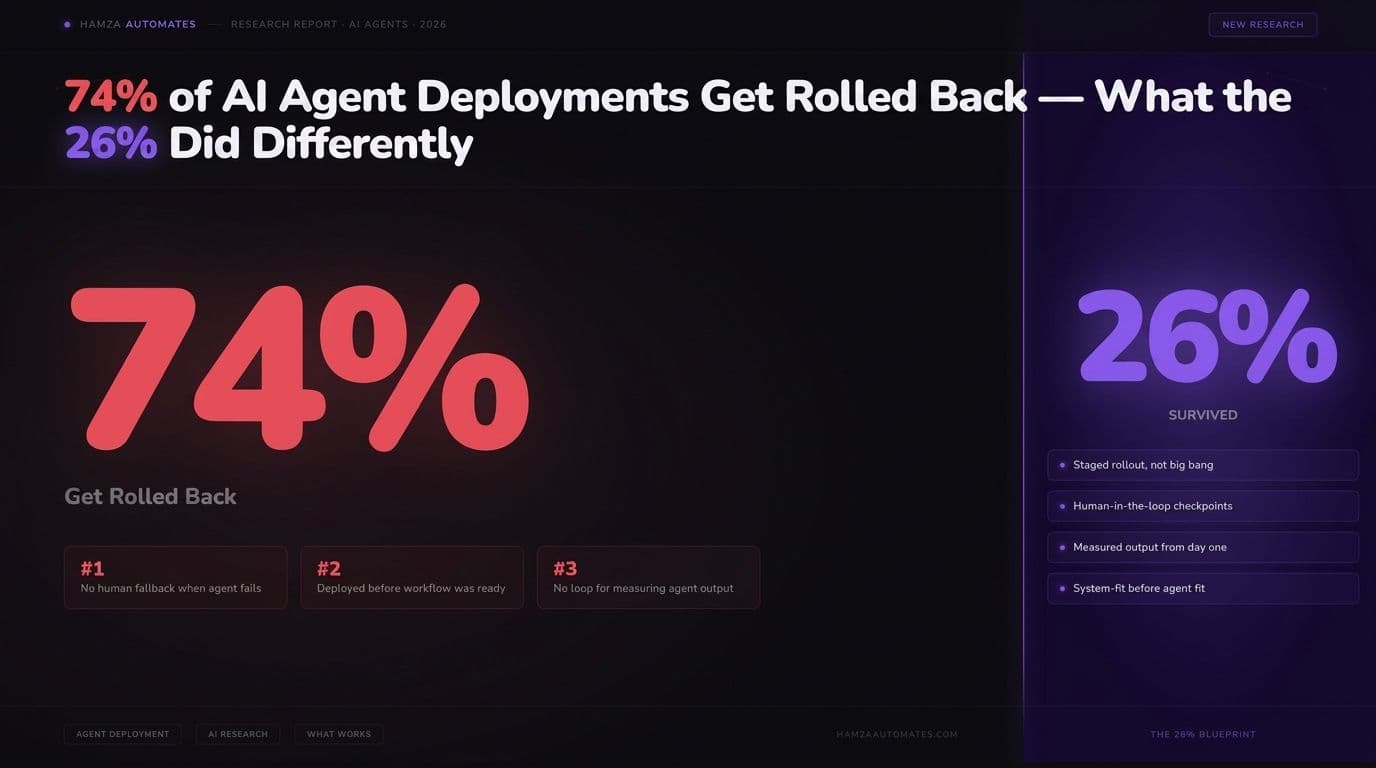
The guidance identifies poorly designed agent architectures and misconfigured deployments as a primary risk category. This encompasses the failure modes identified in the GSPANN analysis of the 74% rollback rate: agents launched without rollback criteria, without sufficient logging, and without clearly defined scope boundaries.
It also specifically addresses the prompt-versus-architecture distinction I have discussed previously: instructions embedded in prompts are a weaker control than restrictions enforced through system design and access controls. The Five Eyes guidance is consistent with this position: security controls should be architectural, not advisory. An agent that is told in its prompt not to access certain data is less secure than an agent that architecturally cannot access that data.
Risk Category Three: Behaviour
Agentic AI systems can produce unexpected behaviour at the boundaries of their defined tasks, when encountering novel inputs, or when operating in multi-agent environments where the combined behaviour of coordinated agents differs from the expected behaviour of each agent individually. This is exactly the composition risk the Pliny jailbreak illustrated at the frontier model level.
The Five Eyes guidance recommends incremental deployment specifically to address behaviour risk: deploy agents in narrow, well-understood contexts first, observe their behaviour under real conditions before expanding scope, and maintain human oversight over agent outputs until confidence in behaviour stability is established. This is the rollout discipline that separates the 26% of successful deployments from the 74% that get rolled back.
Risk Category Four: Structural
Structural risks arise from dependencies on third-party AI model providers, third-party tool integrations, and the infrastructure supporting agent deployment. The Fable 5 export control ban is a structural risk. An API provider changing pricing, deprecating an endpoint, or going offline is a structural risk. An agent that depends on a specific third-party tool that gets acquired and shut down is a structural risk.
The guidance recommends maintaining awareness of and contingency plans for critical dependencies. This is the portable architecture principle applied to the intelligence community context: do not build agentic systems that are a single dependency away from complete failure. The businesses that have built fallback model configurations and documented their third-party dependencies are structurally less exposed than those running tightly coupled, single-provider deployments.
Risk Category Five: Accountability
The accountability risk category addresses what happens when an agent takes an action that causes harm or produces an error: can you determine what the agent did, why it did it, and who or what is responsible? Without comprehensive audit trails and clear decision-logging, accountability for agent actions becomes legally and operationally ambiguous.
The German court ruling holding Google liable for AI Overview false information is the clearest current example of how accountability questions translate into legal exposure. The Five Eyes guidance is consistent with emerging legal frameworks: if an agent takes an action that harms someone, the organisation that deployed and operated that agent bears accountability for it. Audit trails and human oversight mechanisms are not just governance best practice. They are the evidentiary foundation for demonstrating accountability when things go wrong.
The White House AI Executive Order: 30-Day Deadlines Landing Today
Alongside the Five Eyes guidance, the White House published an executive order on June 2, 2026 on AI innovation and security whose 30-day action deadlines fall today, June 26. The order’s stated purpose is to promote AI innovation while addressing national security considerations, with a specific framing: the US refuses to stifle AI innovation with overly burdensome regulation while simultaneously recognising that advanced AI capabilities introduce new national security considerations requiring coordinated action.
The specific actions triggered by today’s 30-day deadlines:
- The Committee on National Security Systems must prioritise cyber defence of National Security Systems
- The Secretary of the Treasury, in coordination with the NSA and CISA, must form an AI cybersecurity clearinghouse for voluntary collaboration with the AI industry on vulnerability scanning and remediation
- The Director of OMB must determine whether federal grant programmes have available funding for AI vulnerability detection development
The AI cybersecurity clearinghouse is the most directly relevant item for businesses operating in or selling to the US government. A voluntary collaboration structure between the government and the AI industry on vulnerability scanning means that AI vulnerabilities are now being coordinated at the national security infrastructure level, not just disclosed informally through security researcher channels.
What Both Documents Mean for the Businesses Building Automation Right Now
The Governance Standard Is Being Set From the Top Down
The Five Eyes guidance and the White House executive order together represent something that has not existed before in AI: a coordinated, multi-government framework for what responsible AI agent deployment looks like, published at a level of specificity that businesses can actually implement against.
The risk categories in the Five Eyes document are not abstract. Privilege, design and configuration, behaviour, structural, and accountability are the exact categories I use when auditing client automation stacks at Hexona Systems. The fact that the intelligence agencies of five countries have converged on the same framework independently, and published it jointly, is significant validation that this framework reflects observed real-world risk rather than theoretical concern.
The Timeline on Regulatory Formalisation Is Compressing
The pattern this month has been consistent: governance frameworks that started as enterprise best practice are becoming regulatory expectation faster than most businesses are anticipating. US banking regulators intensified AI governance scrutiny in June. The EU AI Act enforcement window opened. Germany’s court ruled Google liable for AI answer accuracy. The Five Eyes published a joint security framework. The White House established a national AI cybersecurity clearinghouse.
None of these individually requires a small business to change its operations immediately. Together, they describe a regulatory environment that is building toward formal requirements at a pace that is faster than the three-to-five-year timelines most businesses use when thinking about regulatory risk. Businesses that build governance frameworks now are building ahead of requirements. Businesses that wait for formal requirements will be building reactively, at higher cost and with less time.
The Five Practical Actions to Take This Week
Mapped directly from the Five Eyes risk categories to actions a business can take regardless of size:
- Audit privilege: review every AI agent deployment and map which systems each agent has access to. Remove access to any system not required for the agent’s defined task.
- Review design controls: identify which of your agent’s behavioural constraints are enforced architecturally (the agent cannot access this system) versus advisory (the agent is told not to access this system). Move high-stakes constraints from advisory to architectural.
- Document behaviour baselines: for each production agent, define what normal output looks like and what would constitute anomalous behaviour. You cannot detect drift without a baseline.
- Map structural dependencies: list every third-party model provider, tool integration, and infrastructure component your agents depend on. Identify which dependencies have no fallback and plan contingencies for the two most critical ones.
- Establish audit trails: ensure every agent action in production is logged with sufficient detail to reconstruct what happened, why, and what data was involved. If you cannot answer an accountability question from your logs, your logging is insufficient.
The Bottom Line on June 26, 2026
The Five Eyes ‘Careful Adoption of Agentic AI Services’ guidance and the White House AI security executive order together mark a specific moment: the governance of AI agent deployment has moved from industry best practice to government-level policy framework. That shift does not produce immediate compliance requirements for most businesses. It does produce a clear signal about the direction of travel and the timeline.
The five risk categories in the Five Eyes document, privilege, design and configuration, behaviour, structural, and accountability, are the same categories that produced the 74% rollback rate in the GSPANN analysis, the Pliny jailbreak, the Agentjacking attack, and the Fable 5 export control action. They are not new risks invented by government agencies. They are observed risks that government agencies have now named, classified, and published frameworks for.
The businesses that read this framework and act on it this week are not being cautious. They are being early. There is a difference, and in this market, the difference compounds.
Frequently Asked Questions
What is the Five Eyes alliance and why does their AI guidance matter?
The Five Eyes is an intelligence-sharing alliance between the United States, United Kingdom, Australia, Canada, and New Zealand. Joint publications from this alliance are rare and reflect intelligence that has been validated across multiple national security agencies. Their AI agent security guidance matters because it is based on observed real-world threats, not theoretical risk modelling, and because it signals that agentic AI security has reached the level of national security concern that triggers coordinated multi-government response.
Do the Five Eyes AI guidelines apply to small businesses?
The guidance is specifically addressed to critical infrastructure and defence environments. However, the five risk categories it identifies, privilege, design and configuration, behaviour, structural, and accountability, apply to any agentic AI deployment where agents have real authority over systems, data, or actions. Small businesses deploying agents with access to customer data, financial systems, or external communications face the same categories of risk, even if the scale and regulatory context differ.
What is the White House AI cybersecurity clearinghouse?
The AI cybersecurity clearinghouse is a voluntary collaboration structure between the US government and the AI industry, mandated by executive order and operational as of June 26, 2026. It coordinates and deconflicts vulnerability scanning across AI systems, discovers and validates vulnerabilities, and prioritises remediation. Participation is voluntary for industry. The clearinghouse operates under the Treasury Department in coordination with the NSA and CISA.
How should I prioritise which of the five risk categories to address first?
Prioritise based on the potential impact of a failure in each category for your specific deployment. Privilege and accountability are typically the highest-priority starting points for most businesses: privilege because overly broad agent access creates the largest potential blast radius from any failure or compromise, and accountability because without audit trails you cannot diagnose or demonstrate the cause of any problem that arises. Address design controls next, then structural dependencies, then behaviour baselines.
About the Author: Hamza Baig is the founder of Hexona Systems, an AI automation agency serving clients across six continents, and creator of the AI Automation Institute, where over 40,000 entrepreneurs have learned to build and scale automation businesses. He has been featured in GHL Top 50, Yahoo Finance, and Brainz Magazine. Follow him at @hamza_automates.
About
Hamza Baig is the founder of Hexona Systems—an automation agency and softwareplatform that helps thousands of entrepreneurs and business owners implement AI-powered workflows at scale.