Gartner Just Confirmed What We Already Knew: AI Agent Spending Is Up 139% in a Single Year — Here’s How to Actually Capture That Growth
Gartner has released a forecast projecting AI agent software spending will reach $206.5 billion in 2026, up 139% from $86.4 billion in 2025.





“Gartner confirming $206.5 billion in AI agent software spending this year is not news to anyone who has been watching enterprise adoption closely. The real signal in their forecast is the warning buried underneath the headline number: buyers should negotiate flexible contracts instead of locking into long-term single-vendor stacks. That warning is more important than the number itself.”
The Gartner Number and What It Actually Tells You
Gartner has released a forecast projecting AI agent software spending will reach $206.5 billion in 2026, up 139% from $86.4 billion in 2025. That is the fastest year-over-year growth rate of any category in enterprise software spending on record.
The number itself is striking. But Gartner’s framing around the number is more useful. Their direct guidance to buyers: “Expect rapid tooling churn and negotiate flexible contracts instead of locking into long-term single-vendor stacks.”
I want to sit with that sentence for a moment, because it comes from a research firm that advises the enterprise purchasing decisions of the world’s largest organisations, and it is saying something that has significant practical consequences for any business making AI automation decisions right now.
Rapid tooling churn means the platforms and tools at the top of the market today are not reliably going to be the platforms at the top of the market in 18 months. The category is growing too fast, with too many well-funded competitors, for the current competitive ranking to be stable. Long-term single-vendor lock-in in this environment is not just a commercial risk. It is a strategic bet on which players win a race that has not been run yet.
What 139% Year-Over-Year Growth Actually Means on the Ground
Growth rates of this magnitude are typically associated with one of two conditions: either a genuinely new category is forming from a near-zero base, or an existing category is experiencing demand acceleration driven by a step-change in the underlying technology. AI agent software is experiencing both simultaneously.
At $86.4 billion in 2025, this was already a substantial market. Reaching $206.5 billion in a single year means the category doubled and then added half again in twelve months. That pace of demand growth is not sustainable indefinitely, but it signals that enterprise buyers have moved from evaluation to procurement. Pilots are becoming production deployments. Proof-of-concept budgets are becoming operational budgets. The market has crossed from ‘experimenting with’ to ‘spending on.’
Agentic AI Gets Its Own Gartner Hype Cycle Category
Alongside the spending forecast, Gartner has formally recognised Agentic AI as a distinct category in its 2026 Hype Cycle for Cloud Computing, naming XMPro as a sample vendor. The recognition matters beyond any single vendor.
Gartner Hype Cycle categorisation is the signal large enterprise purchasing teams use to time technology adoption. A new category in the Hype Cycle means: enterprise procurement teams now have a framework for evaluating agentic AI as a distinct investment class, not just an extension of existing RPA or workflow automation budgets. Dedicated budget lines for agentic AI, which have been ad hoc or tucked inside broader AI initiatives, will increasingly be formalised in 2026 and 2027 planning cycles.
XMPro’s recognition as a sample vendor in the Agentic AI category reflects the specific segment they address: industrial and operations teams deploying agents that monitor equipment, coordinate responses, and suggest interventions in real time. They describe themselves as an ‘agentic operations platform’ for asset-intensive and mission-critical industries. This vertical specificity, agents purpose-built for industrial operations rather than general knowledge work, is precisely the pattern I have discussed in the context of vertical AI outpacing general-purpose automation tools.
Qualcomm’s Device Play: AI Agents Moving to the Edge
Qualcomm has announced plans to support AI agents across more than 40 devices as part of its hardware roadmap. This is a significant architectural signal that has received less attention than the spending forecasts.
Cloud-based AI agents, the kind most businesses are currently building on Make, n8n, and similar platforms, depend on sending data to remote servers for processing and receiving responses. Edge AI agents, running on-device with no network dependency, process data locally, respond faster, and do not expose sensitive information to cloud infrastructure. For industries with latency requirements, privacy constraints, or unreliable connectivity, edge agents are not just a nice-to-have. They are the only viable deployment model.
Qualcomm’s commitment to 40+ devices means edge AI agent capability is moving into the standard hardware stack rather than remaining a specialised implementation. Microsoft’s Foundry Local, which reached general availability at Build 2026 for Windows, macOS Apple Silicon, and Linux, enables full AI inference and agent execution on-device with no cloud dependency and no per-token billing. These two announcements together describe the early stages of a second AI agent architecture emerging alongside the cloud-native model.
What Edge AI Agents Mean for Businesses Building Automation
For most small and mid-sized businesses, cloud-based AI agents are the practical choice today. The tooling is mature, the costs are predictable, and the deployment complexity is manageable. Edge agents remain more complex to configure and maintain.
The relevant planning consideration is this: as edge agent capability becomes standard hardware, the cost model for AI automation will bifurcate. Cloud agents, with usage-based billing that scales with every call, versus edge agents, with fixed hardware costs and no per-token billing for on-device workloads. The right choice will depend on your workload volume, latency requirements, and data sensitivity.
Businesses building heavy-volume, low-latency, or data-sensitive automation workflows should be aware this architecture is maturing rapidly. It is not the right choice for most businesses today. It will be a serious option for more businesses within 18 months.
How to Actually Capture the Growth This Forecast Describes
A $206.5 billion market growing at 139% creates opportunity at every level of the AI automation ecosystem. The businesses that capture it are not necessarily the ones that move fastest. Based on what I see across the Hexona client base and the broader AI automation industry, the pattern that produces durable returns is consistent: specificity over breadth, governance over growth, and flexible architecture over lock-in.
For Businesses Deploying AI Agents: Prioritise the 1 to 2 Workflows With Measurable ROI
Gartner’s specific guidance: “Benchmark ideas against the spend forecast to prioritise the 1 to 2 workflows where an autonomous agent can deliver measurable savings within 12 months.” That is the right framing. Not: how many workflows can we automate? But: which one or two deliver measurable return in the next 12 months, and what does that return look like in a number we can track?
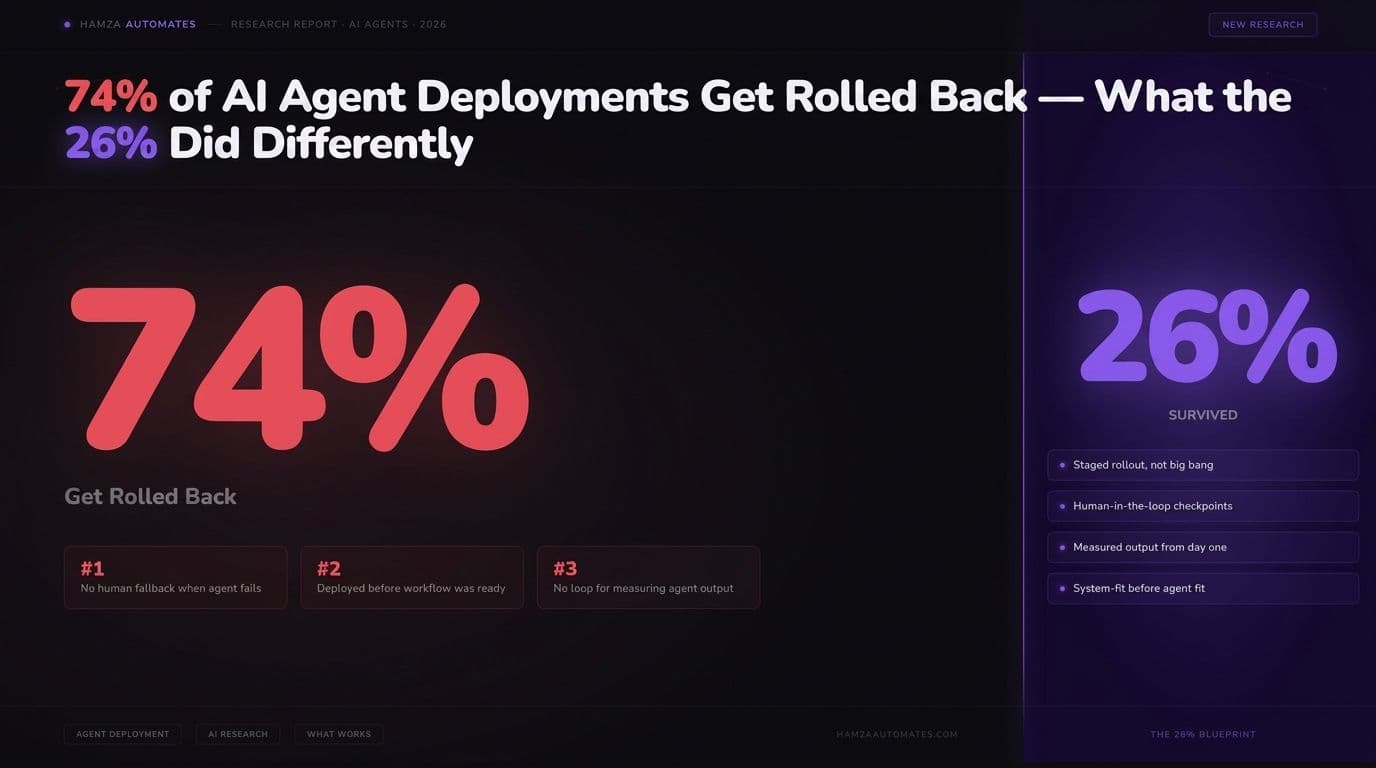
The 74% rollback rate reported in the GSPANN analysis this week is the consequence of organisations that did not apply this filter. They deployed broadly and found out later which workflows actually delivered return. The businesses with a 26% success rate defined the measurable outcome before deployment and built toward it.
For Agencies and Consultancies Building AI Practices: The Market Is Wide Open, But Lock-In Is a Trap
For automation agencies, the Gartner forecast is directly relevant to your commercial positioning. Enterprise AI agent software spend at $206.5 billion means the implementation market, the professional services and consulting fees attached to that spend, is significant and growing. The window to build credentialled implementation practices is still open.
The warning from Gartner about flexible contracts applies equally to agencies as to their clients: do not build your practice around a single vendor’s platform so deeply that tooling churn in the market forces you to rebuild your entire service offering. Agencies that build platform-agnostic workflow expertise, understanding the principles of agentic automation that apply across Make, n8n, enterprise platforms, and whatever emerges next, will outlast the agencies whose expertise is entirely tool-specific.
For Founders Building AI Agent Products: Vertical Specificity Is Your Moat
XMPro’s Gartner recognition as an agentic operations platform for asset-intensive industries illustrates the market dynamic I expect to repeat across every sector over the next 24 months. General-purpose agent platforms will face increasing commoditisation as the major cloud providers (Microsoft, AWS, Google) build agent capabilities into their existing infrastructure at scale. Vertical AI agents, purpose-built for specific industries with domain-specific data, terminology, and compliance requirements, will maintain defensible positions that general-purpose platforms cannot easily replicate.
The sectors most underserved by current agent tooling, and therefore most likely to produce successful vertical AI agent companies in the next 24 months: construction project management, legal document workflows, agricultural operations, maritime logistics, and healthcare revenue cycle management. All of these have complex, domain-specific workflows, high data volumes, and significant tolerance for automation cost if the ROI case is clear.
The Broader Context: Where the AI Agent Market Sits Right Now
Gartner’s $206.5 billion forecast lands in a week where the AI automation industry has produced an unusually clear picture of its current state.
On the technical side: the best available AI coding model is offline due to a government export ban, creating a 22-point capability gap between what is possible and what is currently accessible. Open-source models, Llama, Mistral, Qwen, and DeepSeek, are closing the gap with proprietary alternatives on many benchmarks while offering fine-tuning, self-hosting, and customisation options that cloud-only models cannot match. The edge AI architecture is maturing fast.
On the governance side: 74% of enterprise agent deployments still get rolled back due to preventable governance failures. 67% of organisations using AI coding tools have no governance framework for what those tools produce. The industry is growing the deployment count faster than it is growing the maturity of the deployments.
On the commercial side: two of the largest AI labs are approaching public markets at combined valuations near $1.8 trillion, with pricing pressures already reshaping the economics of the tools built on top of them.
The opportunity is real, large, and growing faster than any comparable technology transition in the last two decades. The risks are also real: governance gaps, vendor concentration, geopolitical access uncertainty, and the specific trap of locking into a single platform before the market has stabilised. The businesses that navigate this correctly, moving fast but with governance, capturing the growth but maintaining flexibility, will look back at 2026 as the year their AI automation advantage compounded. The businesses that optimise for speed alone will look back at a collection of rolled-back pilots and unexplained invoices.
The Bottom Line
$206.5 billion in AI agent software spending this year is not an invitation to buy everything available. It is confirmation that the market has arrived, which means the quality of your deployment decisions matters more now, not less. A growing market rewards the businesses that deploy correctly as much as it rewards the businesses that deploy first.
Gartner’s guidance is the right frame: find the one or two workflows where an autonomous agent delivers measurable savings within 12 months. Build governance before you scale. Negotiate flexible contracts. Do not lock into a single vendor in a market where tooling churn is the stated expectation of the leading research firm tracking that market.
The window to build AI automation advantage is open. The window to do it correctly, with governance, flexibility, and measurable ROI, is the same window. There is no reason to choose between speed and quality in this market. The businesses winning right now are doing both.
Frequently Asked Questions
What is driving the 139% growth in AI agent software spending?
Enterprise buyers have moved from pilot programmes to production deployments at scale. Proof-of-concept budgets are becoming operational budgets. The capability step-change delivered by large language models running as agents, able to reason, use tools, and execute multi-step tasks autonomously, has cleared the threshold for enterprise ROI in enough use cases to drive budget formalisation across procurement cycles. The shift from ‘experimenting with’ to ‘spending on’ is the structural driver behind the growth rate.
What does the Gartner Hype Cycle Agentic AI category mean for businesses evaluating agent platforms?
Gartner Hype Cycle categorisation formalises agentic AI as a distinct investment class in enterprise procurement frameworks. It means dedicated budget lines for agentic AI will increasingly appear in 2026 and 2027 planning cycles, and procurement teams will evaluate agent platforms using a structured framework rather than treating them as extensions of existing RPA or chatbot budgets. For businesses evaluating agent platforms, this signals increasing market maturity and more structured vendor selection processes ahead.
What is the difference between cloud-based and edge AI agents?
Cloud-based AI agents send data to remote servers for processing. Edge AI agents process data locally on-device, with no network dependency, no cloud data exposure, and no per-token billing for on-device workloads. Edge agents are faster, more private, and cost-stable at high volume, but require more complex configuration and hardware support. Qualcomm’s 40+ device commitment and Microsoft’s Foundry Local release signal the edge architecture is maturing rapidly. Most SMB automation use cases are best served by cloud agents today, with edge becoming a serious option for high-volume, latency-sensitive, or data-sensitive workloads within 18 months.
Why does Gartner recommend flexible contracts for AI agent software?
Gartner explicitly flags rapid tooling churn as a characteristic of the current AI agent software market, meaning the platforms and tools leading today are not reliably the platforms that will lead in 18 to 24 months. Long-term single-vendor lock-in in a market with this level of competitive churn creates switching costs that arrive at the worst time: when a better alternative is available and migration is expensive. Flexible contracts, with shorter terms, data portability provisions, and clear exit clauses, preserve the ability to respond to tooling changes without operational disruption.
About the Author: Hamza Baig is the founder of Hexona Systems, an AI automation agency serving clients across six continents, and creator of the AI Automation Institute, where over 40,000 entrepreneurs have learned to build and scale automation businesses. He has been featured in GHL Top 50, Yahoo Finance, and Brainz Magazine. Follow him at @hamza_automates.
About
Hamza Baig is the founder of Hexona Systems—an automation agency and softwareplatform that helps thousands of entrepreneurs and business owners implement AI-powered workflows at scale.