Your “Automation Ratio” Is the Only AI Metric That Actually Predicts Whether Your Business Survives 2027
There is a metric nobody is putting on their dashboard that I think matters more than almost anything else founders are tracking right now.





“Every founder I talk to can tell me their MRR, their churn, their CAC. Almost none of them can tell me what percentage of their AI-assisted output requires zero human review before it ships. That number, not the model they use, is the one that tells me whether their business is actually getting more profitable as it scales, or just busier.”
There is a metric nobody is putting on their dashboard that I think matters more than almost anything else founders are tracking right now. I am going to make the case for it directly, because I think most businesses building on AI are about to find out the hard way why it matters.
Call it the automation ratio: the percentage of AI-assisted work in your business that ships without a human needing to review, correct, or redo it.
Why This Number Matters More Than Which Model You Use
Here is the uncomfortable truth most AI automation marketing will not say directly: if your business requires significant human oversight for every single AI output, your margins are not actually expanding. You have just changed the shape of the labour. Instead of someone doing the task, someone is now reviewing and fixing the task. That is not nothing, review is usually faster than creation, but it is a long way from the “we scaled without adding headcount” story everyone is selling.
A business with an 85% automation ratio, where 85 out of every 100 AI-assisted outputs ship with zero human touch, is in a fundamentally different financial position than a business with a 30% automation ratio, even if both are using the exact same AI tools, the exact same models, and spending the exact same amount on subscriptions. One business is compounding. The other is treading water with better tools.
Why Most Businesses Don’t Know Their Own Number
I ask every new client at Hexona Systems what their automation ratio is before we touch a single workflow. Almost none of them know. They know roughly how much time AI has “saved” them, in the vague, unmeasured way most businesses talk about AI ROI. They cannot tell me, with any precision, what fraction of what AI produces for them actually ships untouched.
This is not a minor measurement gap. It is the difference between knowing whether your business is getting structurally more efficient, or just getting used to a slightly faster version of the same manual process. A founder who cannot answer “what is your automation ratio on lead follow-up emails” is a founder who genuinely does not know if their AI investment is paying off, no matter how confidently they talk about it.
The Three Things That Actually Move Your Automation Ratio
Task Specificity, Not Model Power
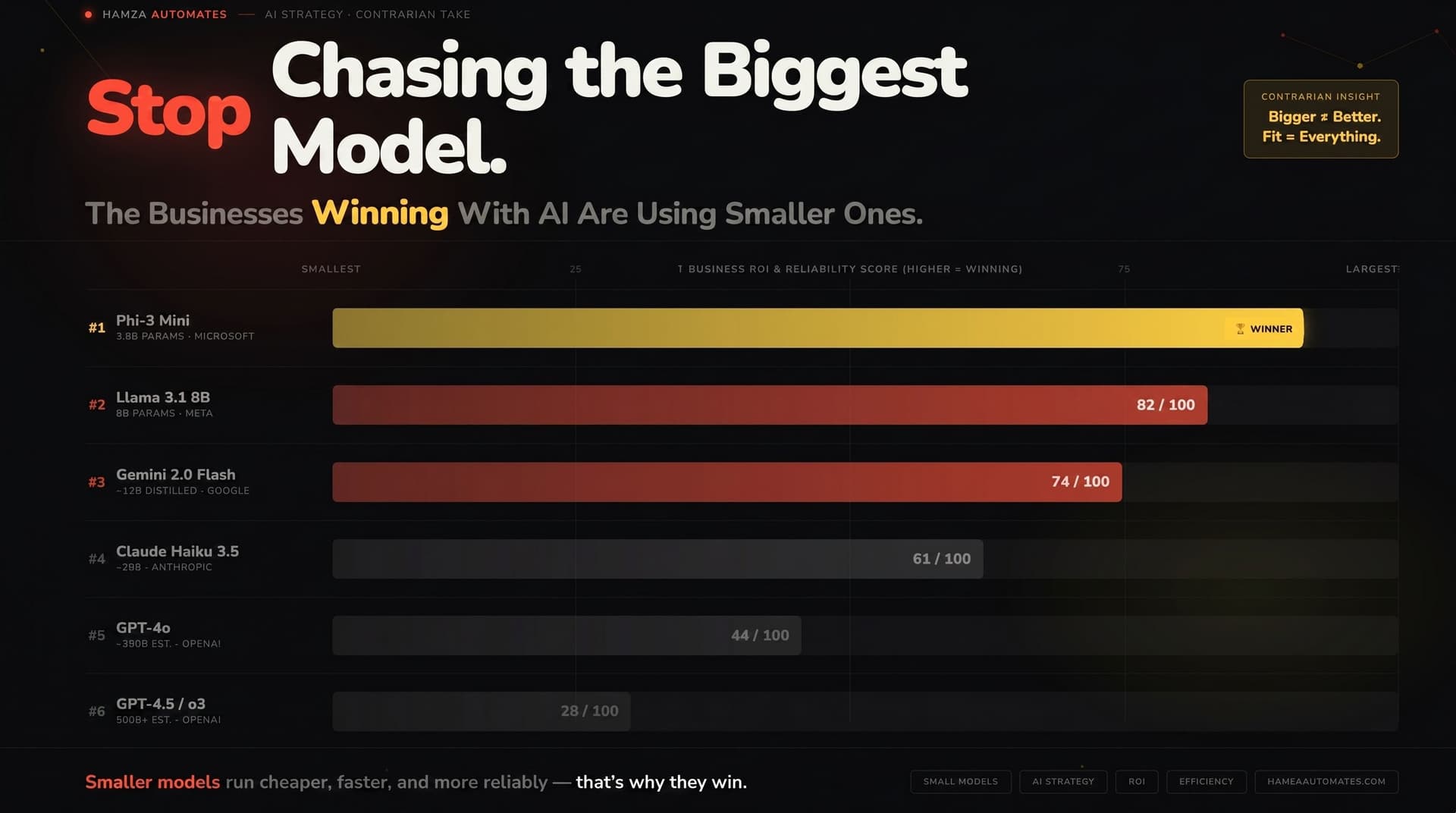
I have written before about why smaller, fine-tuned models often outperform frontier models on narrow business tasks. The automation ratio is exactly where that argument pays off in a number you can measure. A general-purpose frontier model answering a broad, loosely-defined prompt produces output that needs review more often than a narrowly-scoped model or workflow producing output against a tightly-defined task. The fix for a low automation ratio is almost never “upgrade to a better model.” It is almost always “narrow the task until the model cannot get it wrong in ways that matter.”
Your Own Data in the Loop
This is the same point Satya Nadella made in his viral essay this month about “token capital”: a model that has your business’s context baked in, through fine-tuning or a well-built knowledge base, produces output that needs less correction than the same model operating on generic training data. Every business I have moved from generic prompting to context-rich, retrieval-augmented prompting has seen its automation ratio jump, sometimes by 20 to 30 percentage points, without changing which model they are using at all.
Honest Tracking, Not Optimistic Guessing
You cannot improve a number you are not tracking. Most businesses are not tracking this because it requires an uncomfortable level of honesty: logging every time a human had to step in and fix what AI produced. Founders do not love doing this because it makes the gap between “AI does this for us now” and the actual reality visible in a way that is harder to wave away.
A Real Example From a Client
One Hexona client runs content production for a mid-sized e-commerce brand. When we started, their automation ratio on product description writing was, by their own honest estimate after we started measuring, around 35%. AI drafted descriptions, but two-thirds needed meaningful editing before they could publish, wrong tone, missed product details, generic phrasing that did not match their brand voice.
We did not switch their AI model. We built a structured product data feed that fed accurate specifications directly into the prompt, created a style guide encoded as explicit examples rather than vague instructions, and added a validation step that flagged outputs missing required fields before a human ever saw them. Three months later, their automation ratio on the same task was 78%. Same model. Completely different number, because the task got narrower and the context got richer.
That 43-point jump is the entire difference between “AI helps us write descriptions faster” and “AI writes our descriptions, and our team reviews the 22% that need it.” Those are two different businesses, running on the same subscription.
Why This Matters Even More Given Where Pricing Is Heading
This metric is about to matter more, not less. GitHub Copilot has already shifted to usage-based billing. OpenAI is reportedly considering pricing moves to compete with Anthropic. The flat-rate, unlimited-use era of AI subscriptions is ending across the industry. As pricing shifts toward usage-based models, every output your AI generates that gets discarded or heavily reworked by a human is not just wasted time. It is wasted spend on tokens that produced no usable result.
A low automation ratio in a flat-rate pricing world was an efficiency problem. A low automation ratio in a usage-based pricing world is a direct cost problem, and it is about to show up on an invoice in a way it never did before. Businesses that have not been tracking and improving this number are about to feel it in a line item, not just in a vague sense of “AI isn’t saving us as much time as we hoped.”
How to Start Measuring Your Own Automation Ratio This Week
Pick One Workflow
Do not try to measure this across your entire business at once. Pick the single AI-assisted workflow that runs most frequently, lead response emails, content drafts, support ticket replies, whatever it is for you.
Log Every Output for Two Weeks
For every single output that workflow produces, log one simple thing: did this ship as-is, or did a human have to change it before it went out? You do not need sophisticated tooling for this. A spreadsheet with a single yes/no column is enough to start.
Calculate the Number and Sit With It
Divide the shipped-as-is count by the total. That is your automation ratio for that workflow. If it is below 60%, you do not have an automation problem. You have a measurement problem you just solved, and now a clear target: narrow the task and enrich the context, the same two levers that took my client from 35% to 78%.
The Bottom Line
Every AI automation conversation in 2026 centres on model selection, feature comparisons, and pricing tiers. None of that matters nearly as much as a single, unglamorous number: what percentage of what your AI produces actually ships without a human fixing it.
That number tells you, with more honesty than any other metric available, whether your business is becoming structurally more efficient or just running a faster version of the same manual process with extra steps. As usage-based AI pricing becomes the industry standard, it is also about to become the number that determines whether your AI spend is an investment compounding in your favour, or a cost quietly eating your margin one discarded draft at a time.
Measure it this week. You will not like what you find at first. That is exactly why it is worth measuring.
Frequently Asked Questions
What is a good automation ratio to aim for?
It depends heavily on the task and the stakes of an error. For low-stakes, high-volume tasks like first-draft content or routine data classification, 80% or higher is a reasonable target once a workflow is mature. For high-stakes tasks involving financial decisions, legal content, or sensitive customer communication, a lower automation ratio with more human review is often the right and responsible choice, not a failure of the system.
How is automation ratio different from time saved?
Time saved measures whether a process is faster than the fully manual version, which is almost always true even with heavy human review involved. Automation ratio measures whether the AI output is actually trustworthy enough to skip human review entirely. A workflow can save significant time while still having a low automation ratio, meaning it is faster but not actually more autonomous, which matters a great deal once AI usage is billed per token rather than per flat subscription.
What is the fastest way to improve a low automation ratio?
The two highest-leverage changes are narrowing the scope of the task the AI is asked to perform, rather than asking for broad, open-ended output, and enriching the context the AI has access to, through structured data feeds, knowledge bases, or fine-tuning, rather than relying on generic prompting. Switching to a more expensive or more capable model is usually a less effective fix than these two changes.
Why does usage-based AI pricing make automation ratio more important?
Under flat-rate subscription pricing, generating extra AI outputs that get discarded or heavily reworked costs nothing additional beyond the subscription fee. Under usage-based pricing, every token spent on an output that a human later rewrites is wasted spend with no return. As more AI providers shift to usage-based billing, a low automation ratio translates directly into higher costs for lower-quality output, making it a financial metric, not just an efficiency metric.
Hamza Baig is the founder of Hexona Systems, an AI automation agency serving clients across six continents, and creator of the AI Automation Institute, where over 40,000 entrepreneurs have learned to build and scale automation businesses. He has been featured in GHL Top 50, Yahoo Finance, and Brainz Magazine. Follow him at @hamza_automates.
About
Hamza Baig is the founder of Hexona Systems—an automation agency and softwareplatform that helps thousands of entrepreneurs and business owners implement AI-powered workflows at scale.