TSMC Just Posted Its Biggest Quarter Ever. Anthropic Is Talking to Samsung About Custom Chips.
TSMC posted its biggest quarter in history. Anthropic is in talks with Samsung to build custom chips that would cut its $1.25 billion monthly compute bill.





“TSMC posted its biggest quarter in history. Anthropic is in talks with Samsung to build custom chips that would cut its $1.25 billion monthly compute bill. Google unveiled a governance-first enterprise AI platform. And today, July 15, China’s AI anthropomorphic law takes effect, shutting down agent features for 345 million Doubao users. The infrastructure and governance layers of AI are being built in real time, and the decisions being made this week will shape the cost and access conditions for AI automation for the next three years.”
TSMC’s All-Time Revenue Record: The AI Chip Spend Is Real and Compounding
Taiwan Semiconductor Manufacturing Company published its Q2 2026 earnings today. Per AIToolsRecap’s July 15 breakdown, the results are the largest in the company’s history:
- June 2026 revenue: up 68% year-over-year
- Q2 2026 revenue: $39.6 billion, an all-time quarterly record
- N3 (3-nanometre process node, used for the most advanced AI chips): sold out through year-end 2026
- N2 (2-nanometre, next generation): production ramp underway, with Apple and Nvidia as anchor customers
68% year-over-year revenue growth at a company that produces the physical silicon underlying every major AI system is not a leading indicator. It is a measurement of AI infrastructure spending that has already happened. TSMC receives orders well in advance of production, which means the $39.6 billion Q2 reflects decisions made months ago that are now being fulfilled. The N3 sold-out-through-year-end status means the AI chip demand that drove this quarter is not decelerating.
Why This Matters for AI Automation Costs
The chain from TSMC’s revenue record to your automation stack’s cost runs through several steps, but it is direct. TSMC produces the chips that go into Nvidia GPUs and Apple silicon. Those GPUs power the AI data centres that run the inference for every API call to Claude, GPT, and Gemini. When N3 is sold out through year-end and N2 is ramping, the available AI compute capacity is constrained by semiconductor manufacturing timelines, not by demand. As the RAMageddon analysis documented, this physical constraint is what drives the structural upward pressure on API pricing that is reshaping how businesses budget for AI automation.
TSMC’s record quarter also confirms the Bloomberg infrastructure-versus-software split: TSMC is infrastructure. Its $39.6 billion quarter is real revenue from real production, not projected revenue from expected AI adoption. The companies building on top of that infrastructure — the frontier AI labs, the cloud providers, the AI software companies approaching their IPOs — are software. The infrastructure is compounding faster than the software layer’s revenue in absolute terms, which is exactly the risk the Bloomberg dot-com parallel thesis flagged.
Anthropic in Talks With Samsung for Custom Claude Inference Chips
Anthropic is in early talks with Samsung Semiconductor for custom AI inference chips specifically designed for Claude model inference, per AIToolsRecap’s sourcing. The context: Anthropic pays SpaceX approximately $1.25 billion per month for compute — $15 billion per year to a single vendor — predominantly for Nvidia GPU-based inference. Custom inference silicon would allow Anthropic to run Claude at significantly lower marginal cost per token, because chips optimised for a specific model architecture are more efficient per inference than general-purpose GPU hardware.
The Strategic Logic: OpenAI’s Jalapeño Playbook
OpenAI’s Jalapeño custom inference chip, announced at Build 2026, is the template Anthropic is following. When a company processes enough inference volume that custom silicon’s upfront engineering cost is amortised over billions of daily requests, custom chips produce lower cost-per-token than renting general-purpose compute from third parties. At Anthropic’s scale and growth trajectory, the economics of custom silicon become compelling within 12 to 18 months.
Samsung is the natural partner for Anthropic rather than TSMC because Samsung operates as both a chip designer and a fabricator, which gives Anthropic a single relationship for chip design services and production. Samsung also has excess foundry capacity at some process nodes, which gives Anthropic potential negotiating leverage on production pricing that TSMC’s sold-out status would not provide.
What Custom Chips Mean for API Pricing
If Anthropic’s Samsung talks produce a custom inference chip that reduces its per-token compute cost by 40 to 60% — a plausible range based on Google’s TPU cost advantage over general-purpose GPUs for its own inference — the structural economics of Claude’s API pricing change significantly. Anthropic currently faces upward pricing pressure from rising HBM memory costs, a $15 billion annual compute bill, and pre-IPO margin improvement pressure from institutional investors. Custom silicon directly addresses the compute bill and creates room to either improve margins or lower API prices competitively.
For businesses planning AI automation budgets: the Samsung talks are an 18 to 24 month story, not a near-term pricing change. The August 31 Sonnet 5 introductory pricing expiry and the September 1 standard pricing are the near-term dates that matter. The advisor model architecture analysis remains the right framework for managing the current pricing environment regardless of what custom chips may eventually enable.
Google Gemini Enterprise: Governance-First AI at Cloud Next ’26
Google unveiled Gemini Enterprise at Cloud Next ’26, per AIToolsRecap’s coverage, positioning it explicitly as the governance-first answer to Claude Cowork and ChatGPT Work. Gemini Enterprise provides enterprise AI deployment with Google Workspace integration, admin controls, data residency guarantees, compliance certifications, and audit logging built into the architecture rather than added as optional features.
What Gemini Enterprise Adds That Standard Gemini Does Not
The enterprise-specific additions announced at Cloud Next:
- Data residency controls with guaranteed in-region processing for EU, US, and APAC data sovereignty requirements
- Enterprise Workspace integration with Google Drive, Docs, Sheets, and Gmail agent capabilities that respect existing Google Workspace permission structures
- Admin controls for model version locking, feature gating, and spend management at the organisation level
- Certified compliance for SOC 2 Type II, ISO 27001, HIPAA BAA, and EU AI Act documentation requirements
The governance-first positioning is Google’s direct response to the enterprise security incident data. With 88.4% of organisations experiencing agent-related security incidents per the AvePoint report, and 74% of agent deployments getting rolled back, the enterprise market is visibly willing to pay a premium for AI that comes with governance architecture pre-built. Google is betting that the enterprises who were burned by ungoverned AI in Q2 2026 will pay for governed AI in Q3 2026.
The Competitive Position Against Claude Cowork and ChatGPT Work
Gemini Enterprise’s competitive advantage is distribution: Google Workspace has approximately 3 billion users globally. An enterprise AI product pre-integrated into the tools those users already use daily has a lower adoption barrier than any standalone AI tool requiring a separate workflow change. The specific segment Google is competing for is the enterprise that already runs on Google Workspace and wants AI capabilities without a procurement decision for a new tool.
Claude Cowork’s advantage is capability depth on judgment-intensive tasks, validated by the Fable 5 Remote Labor Index score and enterprise user feedback on complex, multi-step reasoning. ChatGPT Work’s advantage is the brand recognition and developer ecosystem that OpenAI has built over three years of consumer-first distribution. These are genuinely different value propositions targeting different decision-maker profiles.
Today Is July 15: China’s AI Anthropomorphic Law Takes Effect
Today, July 15, 2026, China’s Interim Measures for the Administration of AI Anthropomorphic Interactive Services takes effect. As the Build Fast with AI July 6 analysis detailed, ByteDance’s Doubao (345 million monthly active users) and Alibaba’s Qwen are both pulling their humanlike agent features as of today.
What the Law Actually Requires
The regulation co-issued by the Cyberspace Administration of China requires AI services that simulate human personality to implement three specific controls that agent-architecture products cannot easily retrofit: anti-addiction systems that limit session lengths, mandatory usage notifications that break the illusion of a continuous relationship with an AI persona, and instant-exit mechanisms that allow users to immediately terminate AI interaction and return to a default non-AI state.
The instant-exit requirement is the technically decisive one. An AI agent managing persistent memory and context across sessions cannot implement an exit that genuinely terminates its ongoing work without losing the context that makes it useful. ByteDance and Alibaba both concluded that rebuilding from scratch in a compliance-first architecture was more practical than retrofitting compliance onto existing agent systems.
The Doubao Data Export Deadline
Users of Doubao’s agent features can view their configurations and conversation histories in read-only mode until October 15, 2026. After October 15, the data will be permanently inaccessible. Qwen has made no equivalent commitment. For any developer who built workflow integrations using Doubao or Qwen’s agent features: the active export window for Doubao data closes October 15. Export your agent configurations and conversation history now if that data has business value.
The Western Regulatory Contrast
China’s anthropomorphic AI law shares a specific characteristic with emerging Western governance frameworks: it focuses on disclosure, transparency, and user control rather than capability restriction. Users must be told they are interacting with AI. Addiction-promoting interaction patterns must be curtailed. Exits must be genuine. These are disclosure and autonomy obligations, not capability restrictions.
The Geneva AI governance dialogue and the US voluntary standards framework converging toward the same disclosure-and-transparency model suggests a potential baseline of global AI governance that emphasises user autonomy and transparency over capability restriction. That baseline is significant: it creates a governance pathway for powerful AI agent systems that does not require limiting their capabilities, only making their AI nature transparent and giving users genuine control.
Z.ai Founder Tang Jie’s Open AI Memo
Z.ai founder Tang Jie published a memo today arguing that AI should stay open, per AIToolsRecap’s coverage, as the clearest public pushback yet against China’s reported discussions of restricting overseas AI model distribution. The memo frames open AI development as both a competitive necessity and a principle: closed AI development concentrates capability and access in ways that disadvantage developing economies and smaller organisations globally.
Tang Jie’s timing is deliberate. Z.ai (Zhipu AI) released GLM-5.2 and LongCat-2.0 under MIT licences in June and July. Both became immediately significant in the global AI market, with GLM-5.2 growing 80x in customers on Vercel in its first week. If China restricts overseas distribution of AI model weights, those open releases would have been the last. Tang Jie is arguing, publicly, that this would be the wrong policy direction.
The geopolitical dimension of the memo runs directly through the Alibaba distillation attack analysis: Chinese AI labs are simultaneously open-sourcing models to build global adoption and, allegedly, extracting capabilities from Western models through systematic querying. Tang Jie’s open AI memo is the Chinese AI ecosystem’s public argument that the open-source release strategy is the right one — both for the technology and for China’s position in the global AI market.
The Broader Infrastructure Pattern: What July 15 Adds Up To
Today’s four stories — TSMC’s record quarter, Anthropic’s Samsung talks, Google’s Gemini Enterprise, and China’s AI law taking effect — are all infrastructure stories. Not model capability stories. Not benchmark releases. Infrastructure: the physical compute layer, the cost economics of running AI at scale, the governance architecture for enterprise AI deployment, and the regulatory framework for consumer AI interaction. The AITools Recap observation from July 15 captures it precisely: “All about the infrastructure and cost layer underneath the model headlines.”
This is the pattern of a maturing technology market. In the early phase of any technology transition, the model capability headlines dominate: each new release is a step-change improvement that reshapes what is possible. In the infrastructure phase, the operational and economic conditions for deploying that capability at scale become the dominant story. The frontier model race is real and continuing. But the infrastructure and governance decisions being made right now will determine the economic and regulatory environment that AI automation operates in for the next three to five years.
For businesses building AI automation: the infrastructure phase is the one where operational discipline compounds most effectively. The businesses that understand the cost structure, governance requirements, and geopolitical access conditions of the AI market are building on real foundations. The businesses still chasing the latest model release without addressing these conditions are building on assumptions that the infrastructure stories are actively rewriting.
The Bottom Line on July 15, 2026
TSMC’s record $39.6 billion quarter confirms the AI chip spend is real and compounding. Anthropic’s Samsung talks confirm that the economics of custom inference silicon are compelling at Anthropic’s scale, and that the $1.25 billion monthly compute bill has a solution being actively pursued. Google’s Gemini Enterprise confirms that governance-first enterprise AI is a premium market that Google is positioning to lead. And China’s AI law taking effect today is the first major national regulation of AI agent interaction at consumer scale to enter force, with 345 million users affected.
The no-code automation workflow guide and the Five Eyes governance framework remain the operational tools for this week. The infrastructure stories give them context: you are building in a market where compute costs are structurally constrained, where governance requirements are becoming mandatory rather than advisory, and where the geopolitical layer of AI access is active and consequential. Build accordingly.
Frequently Asked Questions
Why did TSMC post record revenue and what does it mean for AI?
TSMC posted its biggest quarter in history: $39.6 billion in Q2 2026, with June revenue up 68% year-over-year. Per AIToolsRecap, its N3 process node (used for advanced AI chips) is sold out through year-end. The record reflects AI chip orders that were placed months ago and are now being fulfilled at scale. It confirms that AI infrastructure spending is real, contracted, and compounding rather than speculative. The physical constraint of sold-out advanced process capacity is a direct driver of the infrastructure cost pressure that flows through to API pricing.
Why is Anthropic talking to Samsung about custom chips?
Anthropic pays approximately $1.25 billion per month for compute, predominantly Nvidia GPU-based inference. Custom inference chips designed specifically for Claude’s model architectures can run the same inference at significantly lower cost per token than general-purpose GPUs, because dedicated silicon eliminates the overhead of general-purpose flexibility. Samsung offers both chip design services and fabrication capacity, making it a single-relationship partner. The talks are early-stage; the timeline to production is 18 to 24 months if they proceed. The near-term impact on API pricing is minimal.
What is Gemini Enterprise and how does it differ from standard Gemini?
Gemini Enterprise is Google’s governance-first enterprise AI platform, unveiled at Cloud Next ’26. It adds to standard Gemini: data residency guarantees for EU/US/APAC, enterprise Workspace integration that respects existing permission structures, admin controls for model version locking and spend management, and compliance certifications including SOC 2, ISO 27001, HIPAA BAA, and EU AI Act documentation. The target customer is the enterprise already running on Google Workspace that wants AI capabilities with pre-built governance architecture rather than ungoverned general AI access.
What is China’s AI anthropomorphic law and who does it affect?
China’s Interim Measures for the Administration of AI Anthropomorphic Interactive Services, effective today July 15, requires AI services that simulate human personality to implement anti-addiction systems, mandatory AI disclosure to users, and instant-exit mechanisms that genuinely terminate AI interaction on demand. ByteDance’s Doubao (345 million monthly active users) and Alibaba’s Qwen have shut down their humanlike agent features. Doubao user data is accessible in read-only mode until October 15, 2026, after which it becomes permanently inaccessible. The law applies to all AI services operating in China that present AI as having human characteristics.
What is the Z.ai open AI memo and why does it matter?
Z.ai founder Tang Jie published a memo arguing that AI should remain openly distributable as a public good, released as a direct pushback against reported Chinese government discussions about restricting overseas distribution of Chinese AI model weights. The memo is significant because Z.ai released GLM-5.2 and LongCat-2.0 under MIT licences in June and July — models that have become important in the global enterprise market. GLM-5.2 grew 80x in customers on Vercel in its first week. If China restricts overseas open-weight distribution, those releases may have been the last from Chinese labs under permissive licences.
Related Reading From This Series
RAMageddon: Why AI Is Getting More Expensive — the memory shortage context that makes TSMC’s record quarter structurally significant for API costs
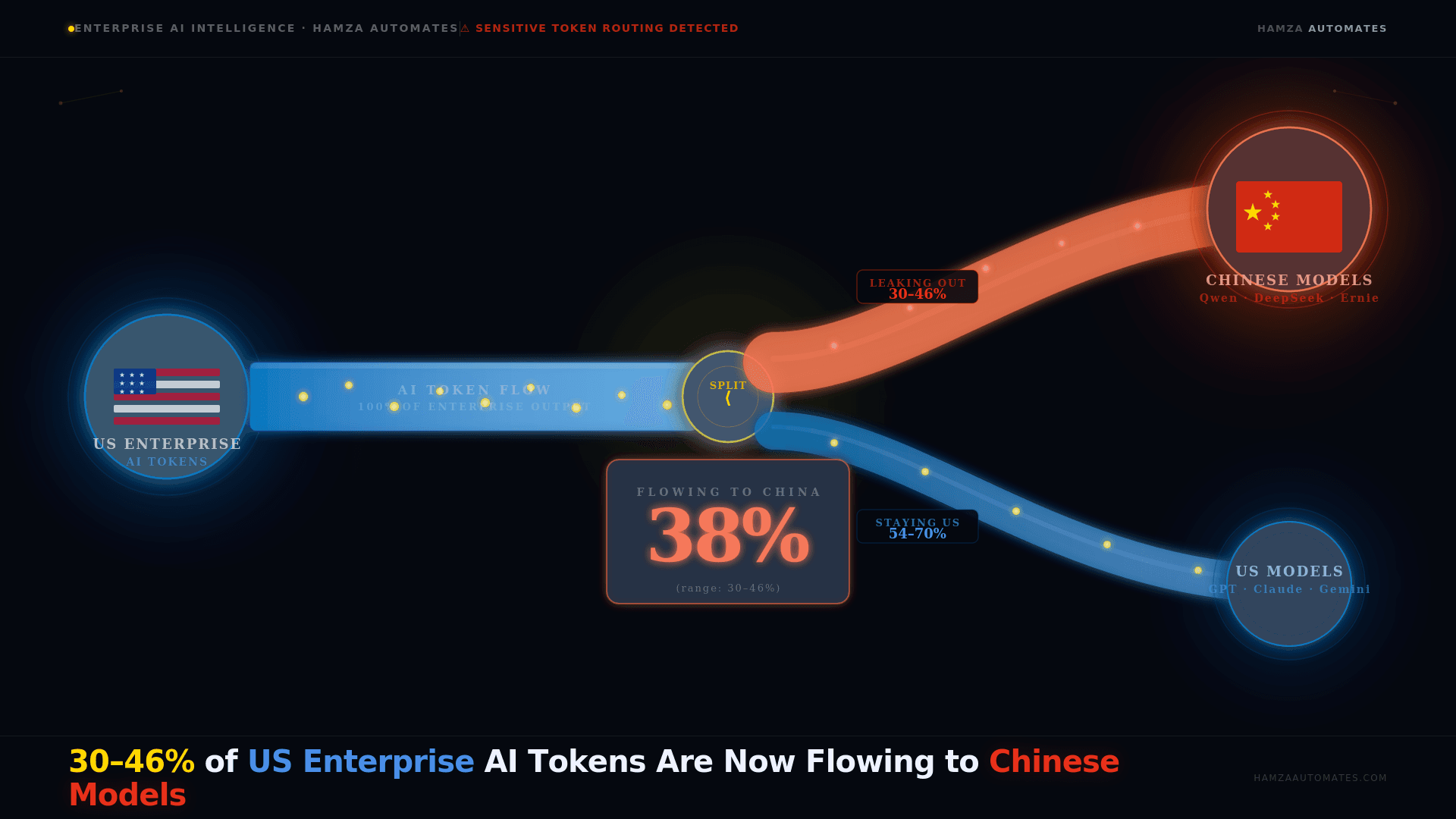
30-46% of Enterprise Tokens Flow to Chinese Models — the advisor model architecture for managing the current cost environment before custom chips arrive
Alibaba’s Distillation Attack — the geopolitical context for the Tang Jie open AI memo and Chinese model distribution
The Geneva UN AI Governance Summit — the multilateral framework context for China’s AI law and Gemini Enterprise’s compliance positioning
74% of AI Agent Deployments Get Rolled Back — why Gemini Enterprise’s governance-first architecture is a commercial, not just compliance, advantage
Bending Spoons: $2.57M Revenue Per Employee — the operating model that custom chips and governance infrastructure will enable at scale
You Don’t Need an Agent. You Need a Rule. — the classification framework that becomes more important as governance requirements formalise
About the Author: Hamza Baig is the founder of Hexona Systems, an AI automation agency serving clients across six continents, and creator of the AI Automation Institute, where over 40,000 entrepreneurs have learned to build and scale automation businesses. He has been featured in GHL Top 50, Yahoo Finance, and Brainz Magazine. Follow him at @hamza_automates | Read more articles | Work with Hamza
About
Hamza Baig is the founder of Hexona Systems—an automation agency and softwareplatform that helps thousands of entrepreneurs and business owners implement AI-powered workflows at scale.