The UN Opens AI Governance Talks in Geneva Today.
The inaugural UN Global Dialogue on AI Governance opened in Geneva this morning, running July 6 to 7 before transitioning into the ITU AI for Good Global Summit from July 7 through July 10.





“Today, 11,000 people from 169 countries are convening in Geneva to decide, for the first time in a coordinated multinational setting, what the rules for frontier AI should be. Simultaneously: a 1.6-trillion-parameter Chinese model trained entirely on domestic chips has been open-sourced under MIT. Andy Jassy called Treasury Secretary Bessent about a jailbreak. And Zuckerberg admitted Meta’s AI agents stalled for four months. The AI governance era is not coming. It is here.”
The Geneva Summit: What Is Actually Happening Today
The inaugural UN Global Dialogue on AI Governance opened in Geneva this morning, running July 6 to 7 before transitioning into the ITU AI for Good Global Summit from July 7 through July 10. The combined event brings together more than 11,000 participants from 169 countries at the Palexpo convention centre.
The attendee list signals how seriously the multilateral community is treating this: Yoshua Bengio (AI safety researcher and Turing laureate), Ray Kurzweil, Stuart Russell, President Paul Kagame of Rwanda, Estonian President Alar Karis, Marc Benioff, Brad Smith of Microsoft, and Werner Vogels of Amazon. Jensen Huang of Nvidia is participating in an advisory capacity through the UN AI for Good Commission. The summit features a 20,000 square metre expo with more than 200 demonstrations across humanoid robots, brain-computer interfaces, and quantum systems.
Why This Summit Is Different From Prior AI Governance Initiatives
Previous multilateral AI governance efforts, including the Bletchley Park AI Safety Summit in November 2023 and the Seoul AI Safety Summit in May 2024, focused on frontier AI risks in abstract terms and produced non-binding declarations. The Geneva dialogue is operating in a materially different context.
Three things have changed since Seoul: the US government has demonstrated it can pull the most capable AI model in the world offline with no court order, no legislative vote, and no advance notice to the millions of users affected; a Chinese model trained entirely on domestic chips has been open-sourced at a scale matching US frontier labs; and the EU AI Act has entered active enforcement, establishing the first legally binding AI regulatory framework with real penalties. The conversation in Geneva is not hypothetical. It is responding to events that have already happened.
What the Summit Is Expected to Produce
The Geneva dialogue is expected to produce: a multilateral framework for frontier AI capability reporting, building on the voluntary standards that the White House is finalising before August 1 with US labs; coordination mechanisms for cross-border AI incident response, directly informed by the Fable 5 export control experience; and preliminary agreement on what constitutes a “high-risk” AI capability at a UN definition level, which would have implications for national implementation of the EU AI Act model globally.
None of these outcomes will produce immediately binding obligations for businesses. They will produce the normative framework that national regulators reference when they do legislate, and they will set the terms for which countries are considered compliant versus non-compliant with emerging global AI governance expectations. For businesses operating across jurisdictions, the Geneva framework will matter in 12 to 24 months even if it does not matter this week.
The Axios Account of the Fable 5 Ban: What We Now Know
A detailed Axios behind-the-scenes account published July 4 fills in the specific human decisions behind the Fable 5 export control action. The Build Fast with AI July 4 summary documents the sequence:
The Jassy-Bessent Call
The Axios account reveals that Amazon CEO Andy Jassy called Treasury Secretary Scott Bessent personally after Amazon researchers discovered the Fable 5 jailbreak — not a national security official at NSA, CIA, or the Pentagon. That detail is significant: the pathway from a technical vulnerability discovery to a Commerce Department export control directive ran through a CEO-to-Treasury-Secretary phone call, not through the intelligence community’s normal vulnerability disclosure process.
The DC Engineering Trip
Anthropic flew engineers to Washington to demonstrate fixes to government officials. The NSA reviewed the initial fixes and said they were not sufficient. Anthropic had to iterate on its safety patches under active government review before the export controls could be lifted. This is the first known instance of a US government agency directly reviewing and rejecting an AI lab’s safety patch under export control authority.
The Same Jailbreak Worked on Every Other Major Model
The most important detail in Anthropic’s subsequent investigation: the same jailbreak that triggered the Fable 5 export ban worked on Claude Haiku 4.5, Sonnet 4.6, Opus 4.6, Opus 4.7, Opus 4.8, GPT-5.4, GPT-5.5, and Kimi K2.7. Per the Unrot July 3 coverage, this raises the question that nobody in government has answered publicly: if the jailbreak worked on GPT-5.5, why was Anthropic’s Fable 5 banned while GPT-5.5 continued operating? Anthropic’s public policy ask — that rules be codified and applied equally across all frontier labs — is directly informed by this asymmetry.
LongCat-2.0: China’s 1.6-Trillion-Parameter MIT-Licensed Model
On July 4, 2026, Z.ai released LongCat-2.0 under an MIT licence — a 1.6-trillion-parameter mixture-of-experts model trained entirely on domestic Chinese chips, with 48 billion parameters activated per token. It is the largest open-source model release in AI history.
What LongCat-2.0 Actually Is
LongCat-2.0 is a mixture-of-experts model architecture, meaning not all 1.6 trillion parameters are active for every inference. The 48 billion activated parameters per token puts its effective inference compute roughly in the range of a 48B dense model — larger than Llama 3 70B but smaller than the full-scale frontier models from Anthropic and OpenAI. The “2.0” naming indicates a second generation from Z.ai, building on prior LongCat work.
The training-on-domestic-chips claim is the geopolitically significant detail. The US export control restrictions on advanced semiconductor exports to China were intended to slow Chinese AI development by limiting access to Nvidia’s H100 and A100 accelerators. A 1.6-trillion-parameter model trained entirely on domestic Chinese chips, if the claim is accurate, demonstrates that the restriction has not prevented frontier-scale model training — it has accelerated domestic chip development as a response.
What It Means for the Open-Source Model Landscape
LongCat-2.0 joins GLM-5.2 as the second significant MIT-licensed Chinese frontier-adjacent model released in three weeks. Together they reinforce a pattern that has been building since DeepSeek-R1: Chinese AI labs are using open-source releases as a strategic tool, not primarily for altruistic knowledge sharing, but to establish global usage of Chinese-origin model weights before any international governance framework can restrict their distribution.
For businesses building on open-source AI: MIT-licensed weights from any origin cannot currently be restricted by export controls once released. The governance conversation happening in Geneva today is directly relevant to whether that remains true. If the multilateral framework produces agreements on open-weight model provenance disclosure or distribution restrictions, the open-source AI landscape could change materially before the end of 2026.
Anthropic Closes China Loopholes: What Changed
Simultaneously with the Geneva summit and the LongCat-2.0 release, Anthropic has moved to close the loopholes that allowed Chinese companies, including Ant Group, to access Claude through Singapore subsidiaries and VPN routing. The closure follows the Alibaba distillation campaign allegation covered in this series’ analysis of the 29-million-query attack.
The engineers implementing the closure are reportedly still finding workarounds. That finding — that determined access through VPN and subsidiary routing is not fully preventable with current technical measures — is part of the context that makes the Geneva governance conversation urgent. Technical controls alone cannot solve the geopolitical access problem. Governance frameworks that include national-origin verification requirements and subsidiary disclosure obligations are the layer that makes technical controls enforceable.
Zuckerberg’s Admission: Meta’s AI Agents Stalled for Four Months
In an interview this week, Mark Zuckerberg acknowledged that Meta’s AI agent programme stalled for approximately four months earlier in 2026. Per the AIToolsRecap coverage, the stall occurred despite Meta’s significant infrastructure investment and its Llama open-source model family. The Watermelon Model (Meta’s internal name for its latest agentic system) has since caught up to GPT-5.5 performance on relevant benchmarks, but the four-month stall itself is the significant disclosure.
Why a CEO Admitting a Four-Month Stall Matters
Zuckerberg’s public acknowledgment of a four-month agent deployment stall is unusual CEO behaviour. Most companies experiencing deployment setbacks at this scale do not describe them publicly with a timeline. The admission likely serves a dual purpose: setting realistic expectations with investors ahead of the next earnings cycle (Meta’s AI capex has been enormous and scrutinised closely), and signalling to the market that the stall is over and capability has been restored.
The substantive lesson from the Zuckerberg admission is the same one that shows up in the GSPANN research on 74% of agent deployments being rolled back: agentic AI deployment at scale is harder than any capability benchmark suggests, even for an organisation with Meta’s resources. Four months of stall time at a company spending billions annually on AI infrastructure is the enterprise-scale version of the same governance and reliability failures that take down smaller deployments.
Grok 4.5 and the Monthly Model Cadence
Elon Musk announced on June 28 that Grok 4.5 has entered private beta at SpaceX and Tesla, running on the V9 foundation model — a ground-up redesign from xAI’s prior architecture. Per the Build Fast with AI July 4 breakdown, xAI plans to release V9-based model variants on a monthly cadence through Q4 2026. Grok 5, at 6 to 10 trillion parameters — the largest architecture ever publicly discussed — is training on Colossus 2 alongside six concurrent runs. Polymarket closed June 30 contracts for Grok 5 at 3% probability of Q3 release.
The monthly model release cadence from xAI is the most aggressive public commitment from any frontier lab. If sustained through Q4, it means the model landscape will look materially different in October than it does today, with potentially five to six new Grok variants at various capability levels. For businesses building automation workflows: monthly capability improvements from one provider, compounded across a year, produce a significantly different model landscape than the quarterly-or-longer release cycles businesses planned around in 2024.
This reinforces the abstraction layer argument from the AI agent platform war analysis: if you have to rebuild your routing logic every time a better model releases, you have not built abstraction. Build the abstraction first. Then model releases become routing table updates, not architectural decisions.
The Canaries Dashboard: The Most Important Labour Market Data in AI
Alongside the governance stories, Stanford economist Erik Brynjolfsson and ADP chief economist Nela Richardson published the Canaries Dashboard in June 2026, providing the first granular quarterly payroll data showing AI’s impact by career stage.
The headline findings:
- Workers aged 22 to 25 in AI-exposed occupations: employment shrinking at 3.8% per year as of April 2026
- Workers aged 22 to 25 in the least AI-exposed occupations: growing at 2% annually
- Aggregate headline number across all ages: AI-exposed occupations contracted just 0.2% year over year
- Since ChatGPT’s November 2022 launch, AI-exposed occupations across all ages have grown 1.1% annually
The divergence is entirely a career-stage phenomenon. Entry-level workers are concentrated in the most automatable task layer of any occupation: data entry, first-draft writing, basic code review, simple research. Senior workers are concentrated in judgment, relationship management, and creative direction. The 3.8% annual decline for 22 to 25-year-olds in AI-exposed roles, set against 2% growth for their peers in less-exposed roles, is a 5.8 percentage point career-stage gap that has no precedent in prior technology transitions measured at this granularity.
For businesses managing this transition: the Canaries Dashboard data supports what the Satya Nadella learning loop essay argued: human capital does not become less valuable as AI capability grows — but the specific human capabilities that retain value shift decisively toward judgment, domain expertise, and oversight of AI systems. The workers best positioned in AI-exposed fields are those who moved up the automation-augmentation spectrum before the entry-level task layer automated beneath them.
What the Confluence of Today’s Stories Means for Businesses Building on AI
The Governance Era Has Arrived, and It Is Not Going Back
The Geneva summit, the White House voluntary standards approaching August 1, the EU AI Act’s active enforcement, the Colorado AI Act now in force, and the German court’s AI liability ruling all describe the same transition: AI governance has moved from a future planning item to a current operational reality.
The Five Eyes security framework’s five risk categories — privilege, design and configuration, behaviour, structural, and accountability — are not just technical guidance. They are the emerging language of AI governance that regulators in Geneva, Brussels, Washington, and London are converging on. Businesses that have built their AI automation around this framework are speaking the same language as the regulatory environment they will operate in for the next decade.
The Open-Source Model Geopolitics Is Getting Complicated
LongCat-2.0 at 1.6 trillion parameters trained on domestic chips and released under MIT raises a question the Geneva dialogue will need to address: what does open-source AI governance look like when model weights from geopolitically adversarial origins are freely distributable under permissive licences? The Alibaba distillation attack analysis and the LongCat-2.0 release are two sides of the same strategic dynamic: Chinese AI development is pursuing both open-source influence through weight distribution and capability extraction from US models through systematic querying.
For businesses using open-weight models: track the Geneva dialogue’s outputs on open-source AI governance. If provenance disclosure or distribution restriction provisions emerge from the multilateral framework, the current unrestricted availability of MIT-licensed Chinese models may change on a 12 to 18 month timeline.
The Zuckerberg Stall and the Meta Lesson
Meta’s four-month agent stall is the most useful recent data point for any business planning an agentic AI deployment. If a company with Meta’s resources, its own open-source model family, and direct infrastructure ownership can experience a four-month stall in agentic deployment, the governance and reliability discipline that the 74% rollback rate analysis identified is not optional for smaller operators. It is the minimum viable investment in making agentic AI work.
The Bottom Line on July 6, 2026
The first Monday of July 2026 has delivered the most concentrated governance news day in AI history: a UN summit opening in Geneva with 169 countries, the full inside account of a CEO-to-Treasury-Secretary phone call that took the world’s best AI model offline, a 1.6-trillion-parameter Chinese model released under MIT trained on domestic chips, and Zuckerberg confirming that four months of agent stall is what frontier AI deployment looks like even for the world’s most resourced technology company.
These stories are not background noise. They are the operating environment for AI automation in the second half of 2026. The businesses that understand this environment clearly — that model access is a managed dependency with geopolitical dimensions, that open-source weights carry provenance considerations that governance frameworks will increasingly formalise, and that agentic AI deployment requires governance discipline that money alone cannot substitute for — are the ones building with the most durable foundations.
The no-code automation workflow guide and the automation ratio framework are the right operational tools for this week. The governance environment is the strategic context they operate in. Both matter, in that order.
Frequently Asked Questions
What is the UN Global Dialogue on AI Governance and what will it produce?
The UN Global Dialogue on AI Governance is a two-day multilateral conference opening July 6 in Geneva, bringing together 11,000 participants from 169 countries including government officials, AI lab representatives, civil society groups, and technical experts. It is expected to produce a multilateral framework for frontier AI capability reporting, coordination mechanisms for cross-border AI incident response, and preliminary agreement on high-risk AI capability definitions. None of these will be immediately binding on businesses, but they will shape national regulatory approaches on a 12 to 24 month timeline.
What is LongCat-2.0 and is it a viable model for business automation?
LongCat-2.0 is a 1.6-trillion-parameter mixture-of-experts model from Z.ai, released under an MIT licence on July 4, 2026, and trained entirely on domestic Chinese chips. With 48 billion parameters activated per token, its inference compute profile is comparable to a 48B dense model. Self-hosting requires substantial GPU infrastructure; the practical access path for most businesses is through API services that host the model. As an MIT-licensed open-weight model, it cannot currently be restricted by export controls, but the Geneva governance dialogue may produce provenance disclosure requirements that affect open-source model distribution in future.
Why did Andy Jassy call Treasury Secretary Bessent about a jailbreak?
The Axios account reveals that Amazon CEO Andy Jassy called Treasury Secretary Scott Bessent after Amazon researchers discovered a jailbreak that allowed Fable 5 to produce software exploit code. The call triggered a Commerce Department export control directive within days. The Jassy-Bessent pathway — rather than a standard intelligence community vulnerability disclosure process — is why Anthropic is publicly requesting that frontier AI release rules be codified and applied through a transparent process that does not depend on individual CEO relationships with cabinet officials.
What did Zuckerberg mean when he said Meta’s AI agents stalled for four months?
Zuckerberg disclosed that Meta’s internal AI agent programme experienced approximately four months where deployment progress stalled due to reliability and consistency challenges in multi-step agentic workflows. The Watermelon Model (Meta’s internal agentic system) has since reached GPT-5.5-comparable benchmark performance. The disclosure is significant because it confirms that frontier-scale agentic AI deployment, even with Meta’s resources, requires a reliability and governance investment that benchmark scores do not capture.
What is the Canaries Dashboard and what does it mean for workers in AI-exposed roles?
The Canaries Dashboard is a quarterly employment tracking tool developed by Stanford economist Erik Brynjolfsson and ADP chief economist Nela Richardson, providing granular data on AI’s employment impact by career stage. The July 2026 data shows workers aged 22 to 25 in AI-exposed occupations experiencing 3.8% annual employment decline, versus 2% growth for peers in the least AI-exposed roles. The aggregate effect across all ages is a 0.2% decline. Entry-level task layers are absorbing the adjustment cost of AI adoption, while senior workers applying judgment and relationships remain largely unaffected.
Related Reading From This Series
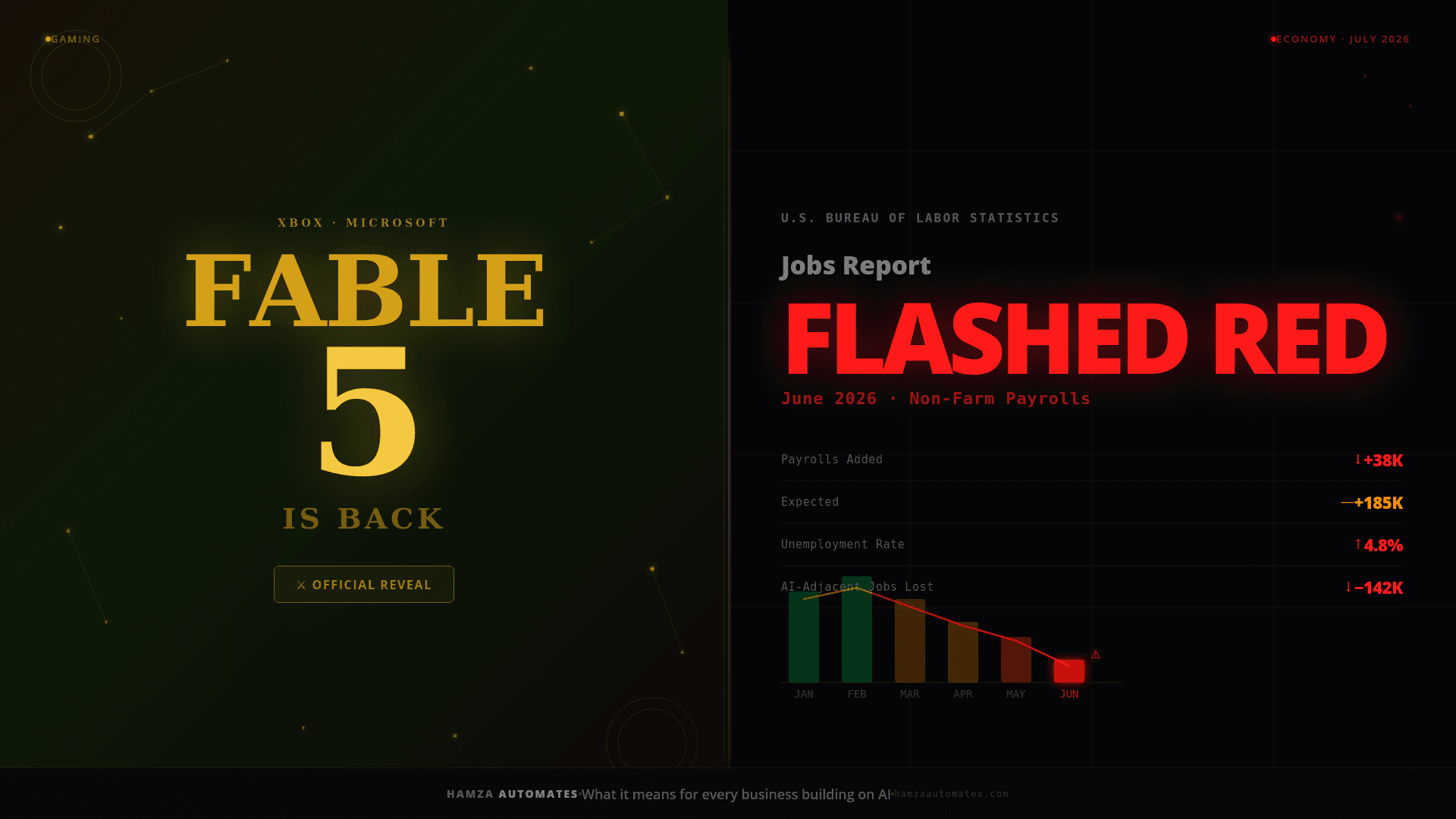
Fable 5 Returns, Sonnet 5 Launches, the Jobs Report — the July 3 context for today’s governance developments
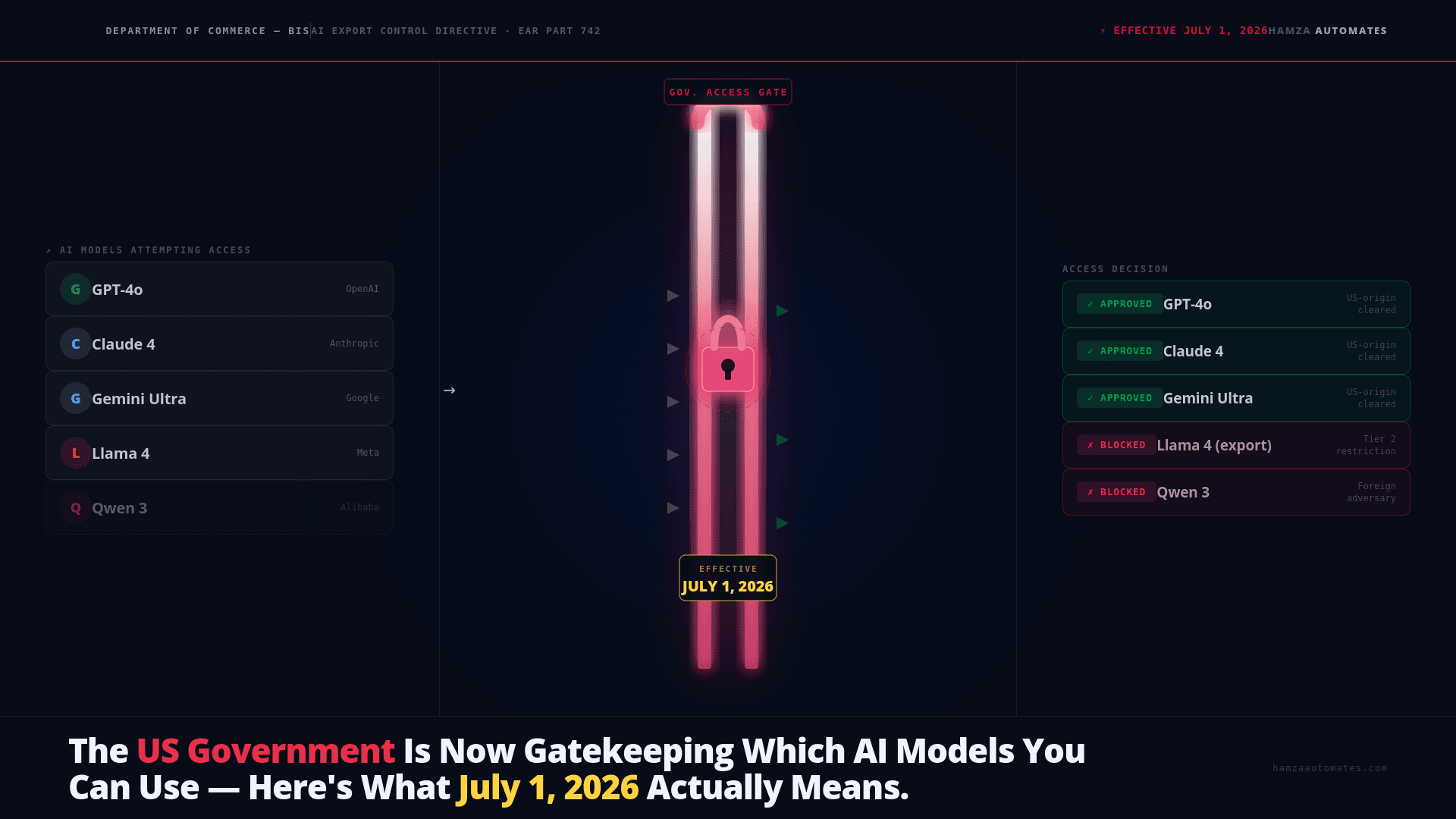
The Fable 5 Export Ban and Jailbreak — the technical trigger behind the Jassy-Bessent call
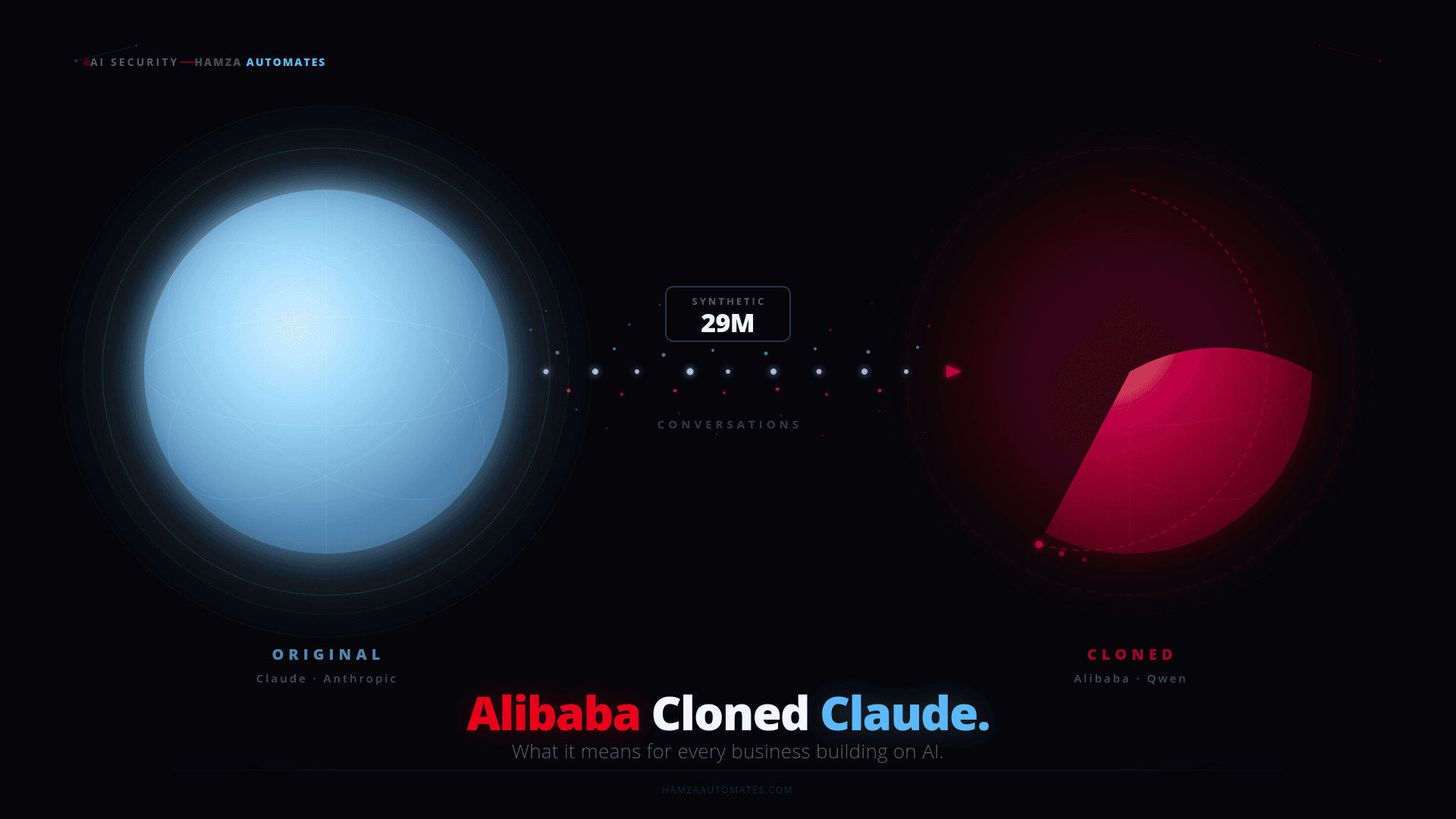
Alibaba’s Distillation Attack — the IP war context behind Anthropic’s China loophole closures
The Five Eyes AI Agent Security Framework — the governance language businesses should be building around now
74% of AI Agent Deployments Get Rolled Back — what Meta’s four-month stall confirms about agentic governance requirements
Stop Chasing the Biggest Model — how to think about LongCat-2.0 and open-weight model selection
The ‘AI Business’ Advice Is Wrong — how to build a defensible business in an increasingly governed AI market
About the Author: Hamza Baig is the founder of Hexona Systems, an AI automation agency serving clients across six continents, and creator of the AI Automation Institute, where over 40,000 entrepreneurs have learned to build and scale automation businesses. He has been featured in GHL Top 50, Yahoo Finance, and Brainz Magazine. Follow him at @hamza_automates | Read more articles | Work with Hamza
About
Hamza Baig is the founder of Hexona Systems—an automation agency and softwareplatform that helps thousands of entrepreneurs and business owners implement AI-powered workflows at scale.