Washington Just Threatened the Escape Hatch Everyone Was Counting On
Today is a deadline day, and most of the teams affected do not know it. That is the first story.





Three things landed in seventy-two hours. DeepSeek's legacy model names die today at 15:59 UTC with no grace period. The White House accused Moonshot of industrial-scale theft from Anthropic, and Treasury threatened sanctions three days before Kimi K3's weights go public. And Alphabet raised its 2026 capex to $205 billion while posting its first negative free cash flow in nearly two decades. Different stories, one message: the model layer under your business belongs to somebody else, and it moves on their calendar.
Today is a deadline day, and most of the teams affected do not know it. That is the first story. The second and third stories are about what happens to your options when the ground under the model layer shifts for reasons that have nothing to do with your architecture—a policy fight in Washington and a capex line in Mountain View.
Here is what happened, what is confirmed versus alleged, and the one architectural decision that determines whether any of it touches your Monday.
At 15:59 UTC Today, DeepSeek-Chat stops existing.
The most immediately actionable news of the week is not a launch. It is an expiry. Per DeepSeek's own V4 announcement and pricing page, the legacy model names deepseek-chat and deepseek-reasoner become fully retired and inaccessible after July 24, 2026 at 15:59 UTC. After that timestamp, any call using those names returns an error.
There is no soft landing. As Enterprise DNA put it, it is a hard cutoff: no grace period, no fallback. And the fix is one line of code.
What actually changes
The good news, if you catch it in time, is that this is one of the gentler migrations in recent memory. You are not switching models. You are naming the model you are already using.
Per the official mapping, since the V4 rollout in April both legacy names have been compatibility shims: deepseek-chat maps to the non-thinking mode of deepseek-v4-flash, and deepseek-reasoner maps to its thinking mode. The base URL, API key and OpenAI-compatible request format all stay the same.
- Replace deepseek-chat with deepseek-v4-flash, or deepseek-v4-pro for the higher-quality tier
- Thinking mode moved from a model name to a request parameter — send thinking: {"type": "enabled"} rather than selecting a separate reasoning model, with reasoning_effort tuning depth
- If you used deepseek-chat precisely because it was non-thinking and cheap, explicitly disable thinking after migrating or you will absorb unexpected token overhead
- Search your codebase, gateway configs and infrastructure-as-code — not just application code — for both legacy strings
The failure mode nobody plans for
One infrastructure engineer described the situation exactly right: pulling production logs on a Monday morning and counting fourteen thousand calls still hitting the deprecated name, months after the deprecation was announced. DeepSeek published the change. The calendar moved. Nobody on the on-call rotation forwarded the changelog to the people who actually own the integration.
That is the real story here, and it has nothing to do with DeepSeek. A vendor announced a breaking change with three months of notice, routed the old names to the new engine so nothing visibly broke in the meantime, and a large number of teams will still be surprised this afternoon — because the announcement landed in a changelog nobody owns, about a dependency nobody inventoried.
The deprecation was announced in April. The aliases kept working until today. That combination — visible notice, invisible consequence — is exactly how well-run teams walk into an outage with their eyes open.
There is a second, quieter trap worth naming. As TheRouter documented, DeepSeek's Anthropic-format endpoint can automatically map unsupported model names to deepseek-v4-flash. Which means a stale alias in a Claude Code or desktop workflow can silently leave you running Flash when you believed you were on Pro. No error. No alert. Just quietly different output quality against a config you thought you understood.
Silent downgrades are worse than loud failures. A 404 at 15:59 tells you exactly what is wrong. A model quietly serving a cheaper tier tells you nothing, and you find out weeks later when someone notices the quality drifted.
Washington Called It Theft — and Threatened the Open-Weight Escape Hatch
The second story is bigger, messier, and far less settled. It also lands three days before the most anticipated open-weight release of the year.
On Wednesday July 22, Michael Kratsios, director of the White House Office of Science and Technology Policy, posted on X that the United States had information that Moonshot AI distilled Anthropic's Fable for the development of its K3 model. Per Cryptopolitan's account, he alleged Moonshot built a sophisticated internal platform to conduct large-scale distillation against US models, allowing it to switch rapidly between access methods to avoid detection.
The framing is the part to notice. As The New Stack observed, Kratsios drew an explicit line: legitimate distillation to create smaller, more efficient models plays a vital role in the open innovation ecosystem, but large-scale, covert industrial distillation aimed at stealing proprietary US technology is unacceptable. By calling it theft rather than competitive practice, the administration signalled it could pursue tighter API restrictions and expanded export controls.
Treasury followed. Per TechCrunch, Secretary Scott Bessent warned that large-scale distillation could result in sanctions and other restrictions. Quartz reported the accusation also covers access to restricted Nvidia chips routed through third countries, and noted Reuters reporting that the State Department had directed embassies in April to highlight what it characterised as pervasive IP theft by Chinese AI firms, with Moonshot among those named.
The evidence problem
Now the caveat, and it is a substantial one. This is an accusation, publicly made, without publicly verifiable evidence attached — and researchers have pushed back hard on the timeline.
The arithmetic is the sticking point. As HNGN summarised the dispute, Fable 5 only became publicly accessible again on July 1, after export controls had suspended access, and Kimi K3 launched in mid-July. Multiple AI researchers have publicly disputed that distillation alone explains K3's capabilities, and a Moonshot employee argued publicly that the window was implausibly narrow. Training a 2.8-trillion-parameter model on distilled outputs in roughly two weeks is not a claim that survives contact with how training runs actually work.
Anthropic's position is more careful than the government's. Per the same reporting, Anthropic has not said it possesses evidence tying Kimi K3 specifically to distillation from Fable — though it did accuse Moonshot of the practice back in February, and has said Moonshot, DeepSeek and MiniMax together generated more than 16 million interactions with Claude using an estimated 24,000 fabricated accounts, in violation of its terms and regional access restrictions.
So: a documented history of terms-of-service violations at scale, an unproven specific claim about this model, a government treating the specific claim as established, and a sanctions threat attached. All three of those things are true at once, and an honest read holds them together rather than picking the convenient one.
The accusation arrived before the evidence. That does not make it false. It does mean the policy consequences may land faster than the proof does — and policy is what actually hits your stack.
Why this is a procurement problem, not a geopolitics problem
Here is why it belongs on your desk rather than a foreign-policy desk. Per TechCrunch, the episode has intensified a debate in Washington over the influx of Chinese open models, with some prominent voices arguing the US should restrict or effectively ban the use of Chinese open-weight models to preserve technological advantage and mitigate national-security risk.
Read that against the number I covered on July 10: 30 to 46 percent of US enterprise API tokens already route to Chinese models. That is not a hypothetical exposure. That is a substantial share of American enterprise inference already running on models that a policy conversation in Washington is now openly discussing restricting.
And note the compounding irony. The open-weight, self-hostable model has been the industry's answer to vendor risk all month — the escape hatch when a hosted provider's guardrails block legitimate work, when data cannot leave your environment, when a price triples. Washington just put that escape hatch on the table as something that might itself be foreclosed. The hedge acquired a risk of its own.
Alphabet's Answer to 'Is This Overbuilt?' Was $205 Billion
The third story is the money, and it points in the opposite direction from every efficiency headline of the last two weeks.
Alphabet reported Q2 on Wednesday, and the operating results were exceptional. Per CNBC, revenue came in at $119.80 billion against $116.93 billion expected, and the company raised full-year 2026 capital expenditure guidance to between $195 billion and $205 billion, up from $180 billion to $190 billion. Analysts had expected roughly $186 billion.
The cloud numbers are the ones that matter for anyone selling AI services. Per BigGo's earnings breakdown:
- Google Cloud revenue up 82% year-over-year to $24.8 billion, against $13.6 billion a year earlier
- Cloud operating margin more than tripled, expanding to 35.6%
- Contracted backlog swelled by more than $50 billion sequentially to $514 billion, roughly half expected to convert within 24 months
- Q2 capex of $44.9 billion, up 107% year-over-year, with about 60% going to servers and AI accelerators
- Free cash flow of negative $5.9 billion — the first quarterly outflow in nearly two decades
Markets did not celebrate. As The Next Web put it, the spending rather than the growth is what rattled investors: shares fell around 5 percent in extended trading, part of a familiar rhythm this season of clean beats undone by heavier-than-expected capex lines. Alphabet also said it would keep expanding rented third-party capacity as a bridge while its own data centres come online — a measure of how far demand is outrunning what it can build.
What the capex actually tells you
Strip out the market reaction and one signal remains, and it is the useful one: compute is scarce, demand is real, and it is getting more expensive to serve — not less.
That sits in direct tension with the efficiency story the same company told three days earlier when it shipped cheaper, more token-efficient Flash models. Both are true simultaneously, and the resolution is the whole insight. Per-token costs are falling. Total compute demand is rising faster. The unit price of intelligence is dropping while the aggregate bill climbs, because everyone is doing far more of it.
Cheaper tokens and a $205 billion capex line are not contradictory. They are the same fact seen from two ends: intelligence got cheap enough that everyone wants vastly more of it than the world can currently build.
For your business, that means the cost curve is not a reliable tailwind. Prices per token fall, then your consumption grows faster than the savings, and your bill goes up anyway. It is the same dynamic underneath the memory and compute crisis reshaping automation economics — and the only durable protection is using fewer tokens per unit of work, not waiting for the vendor to discount them.
The Spine Under All Three
A namespace deprecation, an IP accusation, and a capex guide. Three unrelated stories, until you notice they are all answers to the same question: who controls the layer your automation depends on?
Not you. In all three cases, not you. DeepSeek picked today's timestamp. Washington picks whether Chinese open weights stay legal to use. Alphabet decides what compute costs and how much exists. Your architecture is a tenant in all three of those buildings, and this week all three landlords sent notices.
This is the argument I have made in every form I can find: you do not have an AI problem, you have a systems problem. The teams that will not notice today are not the ones with better vendor relationships. They are the ones whose model layer is a configuration value rather than a load-bearing assumption.
Every team calling deepseek-chat from a config file fixes today's break in ninety seconds. Every team with it hardcoded across a dozen services spends the afternoon finding out where. Same news, two entirely different days.
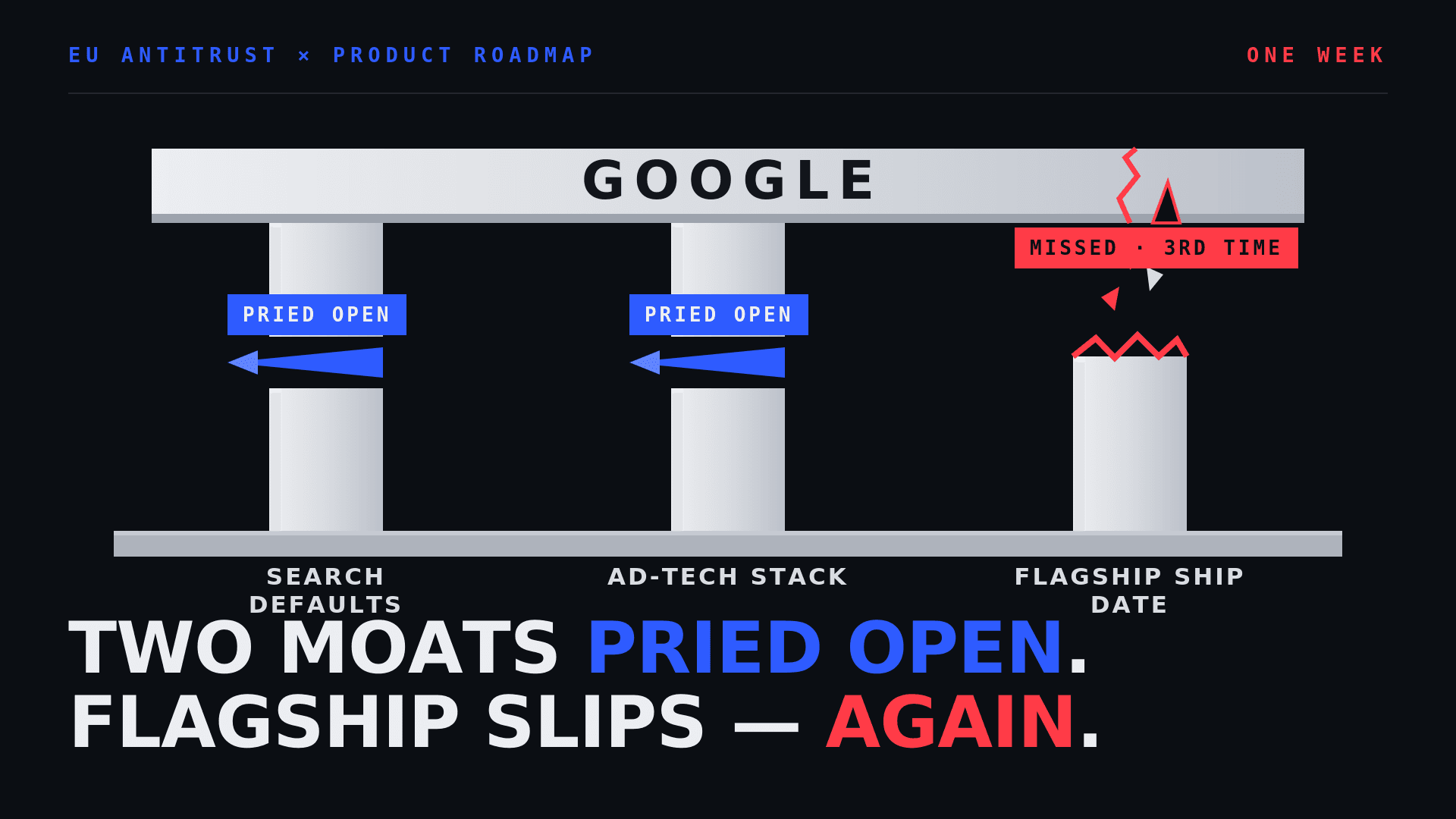
And notice the pattern across the whole month. A regulator opened Google's Android and search data. A flagship slipped three times. A breach forced defenders onto a self-hosted model because their vendor's guardrails locked them out. An open Chinese model topped a coding leaderboard, and now faces a sanctions threat. The model layer has been in continuous motion for four straight weeks. Anyone treating a specific model as a foundation rather than a component has been rebuilding all month.
What To Actually Do — Today, and This Quarter
1. Before 15:59 UTC: grep, don't assume
If you touch DeepSeek anywhere, search now — application code, gateway and router configs, infrastructure-as-code, notebooks, cron jobs, internal tools somebody built and forgot. The legacy strings hide in the places nobody inventories. Then update deliberately rather than doing a blind global replace, because the thinking-mode parameter change means a naive swap can change both your behaviour and your bill.
If you are reading this after the cutoff and something broke, the fix is still one line. The lesson is the audit you did not have.
2. Build a dependency inventory you actually maintain
Every external model, API and version string your automation depends on, in one place, with an owner's name attached and a review cadence. Not because inventories are fun, but because today demonstrated the cost of not having one: a three-month-old announcement that nobody routed to the person who could act on it. This is the unglamorous half of process ownership beating tool delivery — owning the process means owning the knowledge of what it rests on.
3. Make your model layer a config value, this quarter
Count how many workflows would break if a model string vanished, tripled in price, or became legally restricted. All three of those happened or were threatened this week. An abstracted model layer turns each into a config change. Without it, every one is a project. This is the single highest-return architectural work available to most teams right now, and it gets cheaper the earlier you do it.
4. Treat the open-weight hedge as a hedge, not a plan
Keep a capable self-hostable model vetted and ready — that advice stands, and this month made the case for it repeatedly. But Washington just showed that the open-weight option carries policy risk of its own. So diversify the hedge: know which open models you could run, from which jurisdictions, and what your fallback is if one category becomes restricted. Portability across several options is the actual protection. One escape hatch is a single point of failure wearing a disguise, and the security case for governance-first architecture applies to legal availability as much as to technical access.
5. Optimise tokens, not prices
Alphabet's capex says the compute bill is going up regardless of what happens to per-token pricing. Your protection is doing more with fewer tokens: task-model matching, the advisor pattern of cheap default with frontier escalation as the exception, and honest scrutiny of whether each workflow needs the autonomy it was given. Most tasks need a rule, not an agent, and a rule consumes no tokens at all.
The Number None of This Moves
A deprecation deadline, a sanctions threat and a record capex line all have one thing in common: not one of them changes your Automation Ratio — the percentage of AI-assisted outputs that ship without human correction.
Migrating from deepseek-chat to deepseek-v4-flash does not raise it. Switching jurisdictions does not raise it. Google spending $205 billion does not raise it. Only measuring what actually ships clean, per workflow, and fixing the process behind whatever does not, raises it. Everything in this article is context. That number is the outcome.
Eighty percent of executives still report no measurable AI ROI, and 74 percent of agent deployments still get rolled back. Neither statistic will be improved by anything that happened this week. Both would be improved by an afternoon spent measuring which of your workflows actually produce shippable output — which is why I keep ending here, and why almost nobody does it.
The endpoint is not the cheapest model or the safest jurisdiction. It looks like Bending Spoons — $2.57 million of revenue per employee, humans doing specification and judgment, machines doing execution. That architecture survives a deprecation, a sanction and a price rise identically: by not caring which machine is executing.
The Bottom Line
Today at 15:59 UTC, a number of production systems will start returning errors because a vendor retired two strings it announced it would retire three months ago. Nothing about that is unfair or surprising. It is simply what it looks like when your architecture depends on something you do not control and did not track.
Scale that failure up and you get the other two stories. A government may restrict a category of model that a third of American enterprise inference currently runs on. A hyperscaler is spending $205 billion because it cannot build capacity fast enough, and going cash-flow negative to do it. Both are versions of the same lesson at different altitudes: the layer underneath you is moving, and it will not consult you first.
You cannot control the model layer. You can control whether changing it costs you ninety seconds or a quarter. That choice is made in advance, in the architecture, on a quiet day — not today.
So do the boring things. Grep your codebase before the cutoff. Build the dependency inventory. Make the model a config value. Keep more than one escape hatch. Cut tokens rather than waiting for discounts. And measure the ratio, per workflow, so you know which parts of this actually matter to you. That is what systems-first, governance-first thinking buys: weeks like this one become a reading exercise instead of an incident.
Keep the near-term calendar visible while you work. Kimi K3's full weights are due July 27 into a materially more complicated legal environment than anyone anticipated when that date was set. Sonnet 5 introductory pricing expires August 31, with standard pricing and the tokeniser multiplier landing September 1. Fable 5's grace period ends September 30 before credits-only pricing on October 1. And the enterprise-platform moves will shape procurement more than any single headline here. Boring, disciplined moves compound. Deadline days only hurt the people who were not watching.
Frequently Asked Questions
What exactly breaks today, and how do I fix it?
The DeepSeek model aliases deepseek-chat and deepseek-reasoner become inaccessible after July 24, 2026 at 15:59 UTC — a hard cutoff with no grace period. Replace them with deepseek-v4-flash (or deepseek-v4-pro for the higher tier). Base URL, API key and request format are unchanged. Critically, thinking mode is now a request parameter rather than a separate model name, so disable it explicitly if you were relying on the cheap non-thinking behaviour.
Am I already on V4 without knowing it?
Yes. Per the official mapping, since the April rollout both legacy names have been compatibility shims routing to deepseek-v4-flash — non-thinking mode for chat, thinking mode for reasoner. So the underlying model already changed months ago. Today is a namespace change, not a model change, which is why the migration is shallow but the deadline is still real.
What did the White House actually accuse Moonshot of?
OSTP director Michael Kratsios alleged on July 22 that Moonshot distilled Anthropic's Fable to build Kimi K3, using a purpose-built internal platform and rotating access methods to evade detection, and separately that it obtained restricted Nvidia chips via third countries. Treasury Secretary Bessent threatened sanctions and export-control blacklisting. No publicly verifiable evidence has been released, and multiple researchers dispute the timeline given Fable 5 only returned to public access on July 1.
Should I stop using Chinese open-weight models?
Not on a tweet. But do stop treating them as a risk-free hedge. Some voices in Washington are arguing for restricting them outright, and roughly a third of US enterprise tokens already route there. The right response is portability across several options in different jurisdictions, plus escalating the provenance and legal-risk question to whoever owns legal risk in your organisation rather than absorbing it silently into a technical decision.
Does Alphabet's $205 billion capex mean AI is overbuilt?
The numbers argue the opposite on demand and raise real questions on returns. Cloud grew 82% to $24.8 billion with a $514 billion backlog, and Alphabet says it remains supply-constrained enough to rent third-party capacity as a bridge. But free cash flow went negative $5.9 billion and shares fell about 5%. Demand looks real; the question markets are asking is about the return timeline, not the existence of the demand.
How do I stop being surprised by deprecations like this?
Keep a maintained inventory of every external model, API and version string your automation depends on, each with a named owner and a review cadence, and subscribe those owners to the relevant changelogs. Then abstract your model layer so a version change is a config edit rather than a code change across services. The reason today catches teams is not that DeepSeek hid anything — it is that the announcement had no owner on the receiving end.
With prices falling, why worry about token efficiency?
Because per-token prices and total bills are moving in opposite directions. Alphabet's raised capex and negative free cash flow say aggregate compute demand is outrunning supply even as unit costs fall. Your protection is structural: match the model to the task, run cheap models as default with frontier escalation as the exception, and demote workflows that never needed an agent. A rule consumes no tokens, which makes it the cheapest possible model at any price.
Related Reading
Continue the analysis:
1. The AI Agent Platform War — why an abstracted model layer is the work that makes weeks like this survivable.
2. CNBC Confirms 30–46% of US Enterprise Tokens Flowing to Chinese Models — the exposure Washington's sanctions threat now sits on top of.
3. The Alibaba Distillation Attack: What It Means — the earlier chapter of the distillation fight now escalating into policy.
4. You Don't Have an AI Problem, You Have a Systems Problem — why the teams unaffected today have better architecture, not better vendors.
5. RAMageddon: The Memory Crisis Reshaping AI Costs — the compute economics behind a $205 billion capex line.
6. You Don't Need an Agent, You Need a Rule — the cheapest model at any price is the one you never call.
7. The Automation Ratio: The Metric That Predicts Survival — the number none of today's news moves.
About the Author
Hamza Baig is the founder of Hexona Systems, an AI automation agency operating across six continents, and the AI Automation Institute, where he has trained more than 40,000 entrepreneurs in practical AI systems design.
He has been featured in the GHL Top 50, Yahoo Finance and Brainz Magazine. His work focuses on the gap between what AI can do in a demo and what it reliably ships in production — the Automation Ratio, task-model matching, and governance-first architecture.
Read more analysis on the Hamza Automates blog, get in touch about your automation stack, or follow @hamza_automates on Instagram for daily breakdowns.
Sources: DeepSeek's official V4 release notes and pricing page via Developers Digest, Digital Applied, Enterprise DNA and TheRouter; Cryptopolitan, TechCrunch, The New Stack, HNGN and Quartz on the OSTP and Treasury statements; CNBC, The Next Web, MLQ and BigGo Finance on Alphabet's Q2 results. The distillation allegations are government claims without publicly released evidence and are disputed by multiple researchers; figures reflect reporting current as of July 24, 2026.
About
Hamza Baig is the founder of Hexona Systems—an automation agency and softwareplatform that helps thousands of entrepreneurs and business owners implement AI-powered workflows at scale.