Google Just Admitted the Frontier-Size Race Is Over
Google shipped three new models this week and not one of them was a flagship. No keynote, no frontier claim





Google shipped three new models this week, and not one of them was a flagship. No keynote, no frontier claim — just cheaper, faster, more token-efficient AI built for production. Two days earlier, the New York Times documented Meta's automated moderation wrongly deleting real businesses, with the appeals judged by the same AI that banned them. These two stories are the same story: the industry is quietly conceding that the game was never model size. It was efficiency and governance—and this week delivered a masterclass in each, one done right and one done catastrophically wrong.
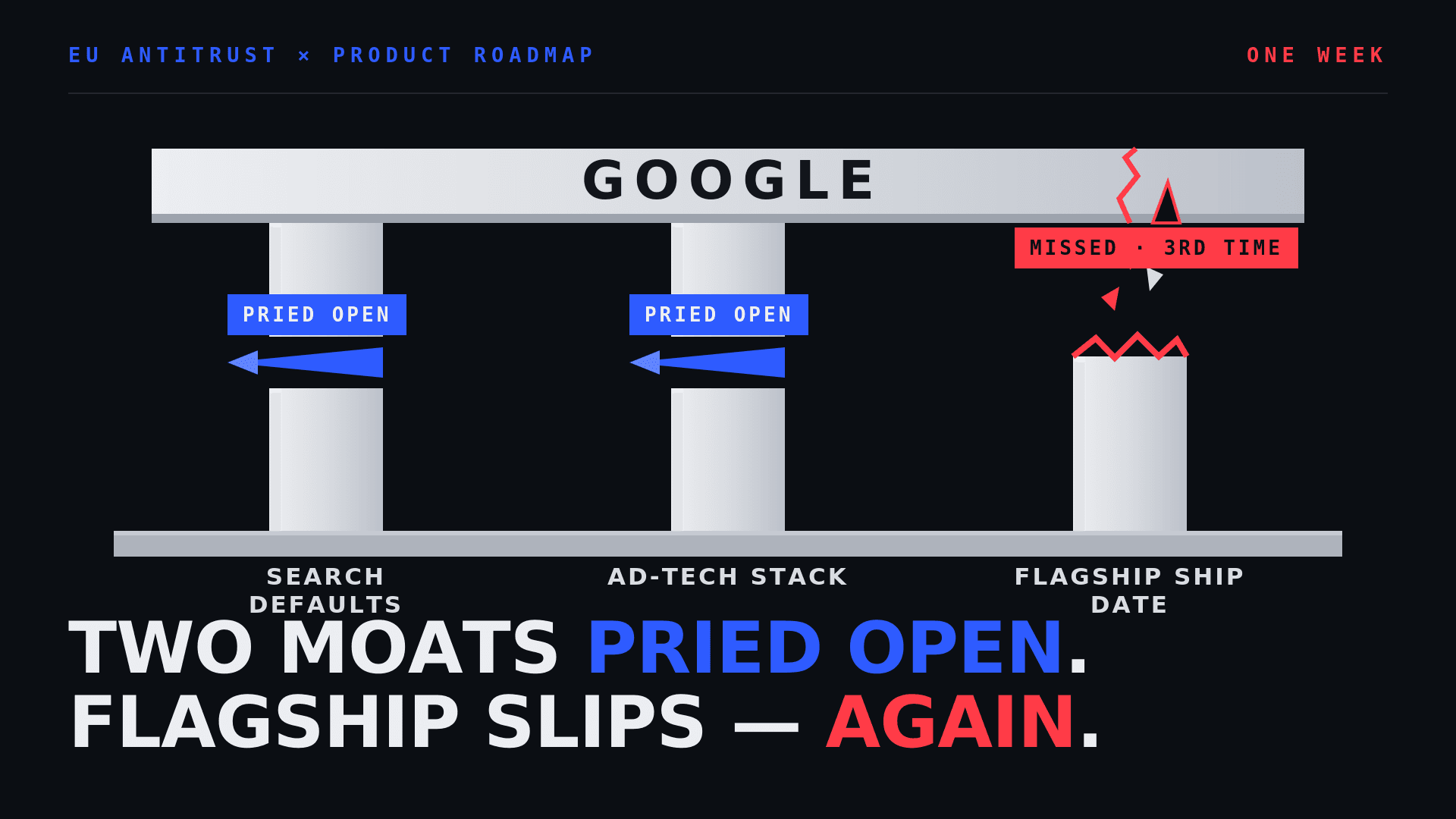
When Google's Gemini 3.5 Pro missed its third deadline earlier this week, I noted the company was pivoting to stopgap Flash releases rather than shipping the flagship it promised at I/O. On Monday, it did exactly that — and the shape of what it shipped is more revealing than any Pro launch would have been.
Because Google did not ship a bigger model. It shipped a cheaper one, a faster one, and a specialized one it keeps on a leash. That is not a company that lost the frontier race. That is a company that decided the frontier race is not where the money is anymore. Let me walk through what landed, then pair it with the cautionary tale playing out on Meta's platforms, because together they tell you exactly where to point your attention.
Google Shipped Efficiency, Not a Frontier
On July 21, Google released three models at once: Gemini 3.6 Flash, Gemini 3.5 Flash-Lite, and a restricted Gemini 3.5 Flash Cyber. As 9to5Google reported, there was no Pro, no keynote, and no claim of a new intelligence frontier. The entire release is built around one argument: if you run AI agents in production, what you need is fewer tokens, lower latency, and more predictable behavior per dollar—not a bigger model.
Read that framing carefully, because a trillion-dollar company just adopted the exact thesis I have been arguing all year. The question stopped being how big the model is and became how well it completes real tasks without supervision, at what cost. Google building its flagship release around that is not a footnote. It is a concession.
Gemini 3.6 Flash: cheaper and better at the same time
The headline model is efficiency-first. Per MarkTechPost, against its predecessor Gemini 3.6 Flash:
- Uses 17% fewer output tokens on the Artificial Analysis Index — up to 65% fewer on the DeepSWE benchmark — while taking fewer reasoning steps and tool calls per multi-step workflow
- Drops output pricing from $9 to $7.50 per million tokens, with input at $1.50 — a lower total cost per agentic task
- Scores 49% on DeepSWE versus 37% for 3.5 Flash, 63.9% on MLE Bench versus 49.7%, and 83.0% on OSWorld-Verified versus 78.4%
- Advances its knowledge cutoff from January 2025 to March 2026, per 9to5Google
Cheaper and better simultaneously. That combination is the whole point. For the last two years the industry priced capability as a premium — more intelligence cost more money. Google just decoupled them, lowering the price while raising the scores. That is what a maturing technology looks like: the frontier stops moving and the cost curve takes over.
The efficiency gain is worth understanding mechanically, because it is where the real money lives. Per MarkTechPost, 3.6 Flash does not just cost less per token — it uses fewer tokens and fewer tool calls to finish the same job, with up to a 65 percent output reduction on DeepSWE. Lower verbosity plus a lower per-token price compounds: the total cost of an agentic task falls twice over. For anyone running agents at volume, that compounding is the difference between an automation that pays for itself and one that quietly bleeds margin on every run.
One honest calibration, though. Independent tracking by Artificial Analysis places 3.6 Flash at 50 on its Intelligence Index — rank 21 of 187 models tracked. That is not frontier intelligence, and Google is not claiming it is. It is a workhorse, priced and tuned like one. Matching the model to the task is the entire skill, and Google just shipped a model that is honest about which tasks it is for.
Flash-Lite: the one that actually matters for high volume
The model that may reshape more budgets is the cheap one. Per 9to5Google, Gemini 3.5 Flash-Lite runs at 350 output tokens per second for $0.30 input and $2.50 output per million, and it is a real step up — Terminal-Bench 2.1 at 54% versus 31%, and it even beats the older, larger 3 Flash on SWE-Bench Pro (54.2% versus 49.6%) and OSWorld-Verified (74.0% versus 65.1%).
A smaller, cheaper model beating a larger, older one on real benchmarks is the single most important pattern in AI economics right now, and almost nobody structures their stack around it. If you are processing millions of routine items or running fleets of narrow agents, Flash-Lite is the more consequential launch — and it is the cheap tier, not the expensive one.
A cheaper model that beats a larger, older one is not a compromise. It is the whole strategy, and Google just handed it to you at thirty cents per million tokens.
Flash Cyber: Capability on a Leash
The third model is the most technically dramatic and the least accessible, and the gap between those two facts is the lesson.
Gemini 3.5 Flash Cyber finds, validates and fixes software vulnerabilities, operating through a system called CodeMender. Per MarkTechPost, in testing it found 55 unique V8 issues versus 47 for 3.5 Flash and 36 for Opus 4.6 — genuinely strong results. And Google gated it: a limited-access pilot for governments and trusted partners only, explicitly because of dual-use risk.
There is a second control worth noting. Per Winbuzzer, developers must approve every proposed patch before deployment. The model does not fix your code autonomously. It proposes, a human disposes.
Sit with what Google did here. It built a model demonstrably better at finding vulnerabilities than its own frontier flagship, and then it deliberately restricted access and inserted a mandatory human checkpoint. The most capable thing in the release is the thing it refused to ship openly.
This is governance-first architecture, practised by the company that built the capability. A cyber-offensive tool is dual-use by nature — the same skill that patches a vulnerability can find one to exploit. Google's answer was not to withhold the capability, but to constrain who can use it and to keep a human in the decision loop. That is exactly the posture I argued for after the Five Eyes warning that offensive AI capability is arriving in months, not years: minimum access, mandatory human checkpoints, capability released cautiously.
The most powerful model in Google's release is the one it refused to ship without a leash. When the builder governs its own capability that carefully, that is the signal — not the benchmark.
Note also what Google confirmed on the side: Gemini 3.5 Pro remains in partner testing only, and the company has begun its most ambitious pretraining run yet for Gemini 4. Per CryptoBriefing, the frontier work continues in the background. But the product Google chose to ship to the market this week was efficiency and governance, not size. That choice is the story.
Meta Showed the Cost of Skipping the Governance
If Google's launch is what disciplined AI deployment looks like, the counter-example arrived two days earlier, and it is painful.
The New York Times documented what happened when Meta leaned on AI to moderate Facebook and Instagram: users said the technology mistakenly deleted their accounts, and to resolve it, they still had to rely on the same AI. Appeals of an AI decision were, in many cases, judged by AI.
The scale is not trivial. Affected accounts included businesses built over years and, per the reporting, at least one with nearly a million followers — restored only after journalists intervened. TechCrunch has tracked a growing wave of Instagram users reporting wrongful bans with no path to a human reviewer, many describing the platform as their full-time livelihood and primary source of leads.
The circular-logic failure
The specific failure mode is the one every operator should study, because it is a design error, not a model error. An AI system flags an account. The user appeals. The same class of system reviews the appeal — and, having no new information and no human judgment inserted, confirms its own original decision. The machine judges its own homework, and the homework is someone's business.
This is what happens when you deploy an agent without a human correction loop. It is the precise opposite of the mandatory human checkpoint Google built into Flash Cyber. And it is a live demonstration of why 74 percent of agent deployments get rolled back — not because the models cannot do the task, but because the process around them has no way to catch and correct the errors they inevitably make.
Meta's defence, for fairness, is that its newer AI tools make 13 percent fewer mistakes and catch 10 percent more violations than humans, and that the accounts examined were banned by older systems rather than its latest models. Grant the claim entirely. It does not touch the actual problem. The problem was never the error rate of the classifier. The problem was that a wrong decision had no reliable route to a human who could reverse it. You can cut the error rate in half and still destroy a business, because the business does not care about your average — it cares about its one case, and its one case had no appeal that a person would read.
A 13 percent lower error rate does not help the business the machine wrongly deleted. Averages comfort the platform. The individual case is where automation without a human loop does its damage.
This is the systems problem in its rawest form. Meta does not have an AI-accuracy problem; it has a process problem, in which a high-stakes, irreversible decision was fully automated with no human checkpoint on the reversal path. The model is not the failure. The architecture around it is.
Two Stories, One Discipline
Put the week side by side. Google shipped a cyber model more capable than its flagship and deliberately kept a human in every patch decision. Meta ran a moderation system at massive scale and let the machine adjudicate its own appeals. One built the checkpoint in. The other left it out. That single difference is the entire distance between AI that compounds value and AI that destroys it.
And the efficiency half of Google's launch is the same lesson wearing different clothes. Shipping a cheaper, more token-efficient model is a statement that the discipline lives in doing more with less, not in reaching for the biggest thing available. That is task-model matching as a corporate strategy, and it is the same instinct that tells you not to point a frontier agent at a job a rule could do.
Efficiency and governance are not two trends. They are the two halves of the only discipline that matters: doing the least that reliably works, and keeping a human where reversal has to happen.
There is a governance data point in the week's margins worth flagging too. Federal lobbying disclosures reported this week show Anthropic spent $1.97 million in Q2, up 26 percent quarter-on-quarter, outspending Nvidia and nearly matching Oracle, with combined AI-lab lobbying reaching $3.17 million for the quarter. The labs are spending real money to shape the rules of exactly the governance questions this week put on display. The frontier fight has moved from the benchmark to the statute book.
What This Actually Changes for Your Automation Stack
Four moves, all available this week, none requiring you to have an opinion about Google's or Meta's strategy.
1. Re-price your workflows against the new Flash tier
If you are running high-volume, routine work on a premium model, the Flash-Lite economics — thirty cents input, $2.50 output, beating a larger older model on real benchmarks — should force a re-evaluation. Not a migration on launch week, but a genuine cost-versus-quality re-test per workflow. This is the advisor-model pattern: cheap default, frontier escalation as the exception. Google just made the cheap default meaningfully better.
2. Audit every automated decision for a human reversal path
Walk your automations and find every one that makes a consequential, hard-to-reverse decision — banning, rejecting, deleting, charging, denying. For each, ask the Meta question: if this is wrong, can a human catch and reverse it, and is that human actually reachable? If the answer is "the same system reviews the appeal," you have built Meta's failure at your own scale. This is the rule-versus-agent discipline applied to consequences: the higher the stakes and the harder the reversal, the more non-negotiable the human checkpoint.
3. Treat governance as a feature you ship, not a constraint you resent
Google made its most capable model its most restricted, and it will be fine commercially precisely because that restraint is what makes the capability trustworthy enough to sell. Governance-first architecture is a competitive advantage, not a tax. The mandatory human patch-approval in Flash Cyber is not friction Google tolerated — it is the thing that lets the product exist at all.
4. Keep your model layer swappable
Three new models landed on a Monday, from one vendor, and one of them may be cheaper and better for your workload than what you run today. That will keep happening, faster. An abstracted model layer — where adopting a new model is a config change, not a rebuild — is what turns a week like this into an opportunity you capture in an afternoon rather than a project you schedule for next quarter.
The Metric Under Both Stories
Google's efficiency gains and Meta's governance failure are, at bottom, arguments about the same number: the Automation Ratio — the percentage of AI-assisted outputs that ship without human correction.
Google's 3.6 Flash raises the ratio by producing more reliable, production-ready output with fewer wasted tokens and fewer execution loops — more of what it generates is good enough to ship untouched. Meta's moderation system has a catastrophic ratio in the cases that matter, because a wrong ban that cannot be reversed is the opposite of an output that shipped clean — it is an output that shipped wrong and stayed wrong.
That is the lens that unifies the week. A better model can raise your ratio. A missing human checkpoint can hide a collapsed one. Eighty percent of executives still report no measurable AI ROI, and the reason is almost never the model — it is process deployed ahead of the ability to measure and correct it, which is precisely what Meta's appeals loop demonstrates at the scale of millions of accounts.
The endpoint of getting this right does not look like Meta's fully-automated adjudication or a race for the biggest model. It looks like Bending Spoons — humans doing specification and judgment, machines doing execution, and a clean line between the two. Google just shipped the machine layer cheaper. The judgment layer is still yours to design, and Meta just showed the whole industry what it costs to skip it.
The Bottom Line
The frontier-size race is not dead, but it stopped being where the market is decided. Google, of all companies, told you that this week — not in a keynote, but in the quiet, keynote-free release of three models that compete on cost, speed, and governed capability rather than on raw intelligence. When the company with the deepest research bench chooses to ship efficiency and restraint instead of a flagship, the strategic centre of gravity has moved.
Meta told you the other half. Scale an agent without a human in the reversal loop and you do not get efficiency — you get businesses erased by a machine that then reviews its own verdict. The models were never the risk. The missing checkpoint was.
And notice that these two lessons arrived from the two extremes of the industry — the disciplined builder and the careless deployer — in the same five-day window. That is not coincidence. It is the market sorting itself into the companies that treat AI as a system to be governed and the companies that treat it as a cost centre to be automated away. The first group ships leashes and prices down. The second group ships bans and issues statements. You get to choose which group your own automation belongs to, and you choose it in the architecture, not the press release.
This week, one company shipped a leash on its best model and priced its workhorse down. Another let a machine judge its own homework at the scale of a billion users. The gap between them is the whole discipline.
For you, the instructions are unglamorous and they have not changed: match the model to the task, keep a human where reversal must happen, ship governance as a feature, and measure your ratio per workflow. Do that, and a week of three new models and one public failure is not noise to react to — it is confirmation you were building the right thing. That is what systems-first, governance-first thinking buys you: a stack that gets cheaper and safer while everyone else chases headlines and cleans up bans.
Keep the calendar in view while you act. Gemini 3.6 Flash and Flash-Lite are generally available now; Flash Cyber is a gated pilot; Pro is still in partner testing with Gemini 4 pretraining underway. And the pricing clock keeps ticking — Sonnet 5 introductory pricing expires August 31, the tokeniser multiplier lands September 1, and the enterprise-platform moves will shape procurement more than any single model launch. Build for the discipline, not the headline. The headlines will keep coming. The discipline is what compounds.
Frequently Asked Questions
What did Google actually launch on July 21?
Three models and no flagship. Per 9to5Google: Gemini 3.6 Flash (generally available, $1.50 input / $7.50 output, 17% fewer output tokens than 3.5 Flash while scoring higher across coding and knowledge-work benchmarks); Gemini 3.5 Flash-Lite (generally available, $0.30 / $2.50, 350 tokens/sec, beating the older 3 Flash on SWE-Bench Pro and OSWorld); and Gemini 3.5 Flash Cyber, a vulnerability-finding model gated to governments and trusted partners. Gemini 3.5 Pro remains in partner testing, and Google confirmed Gemini 4 pretraining is underway.
Why is a Flash release a bigger deal than a Pro launch would have been?
Because it signals where the market has moved. The release is explicitly built for production economics — fewer tokens, lower latency, predictable cost per task — rather than a new intelligence frontier. When the company with one of the deepest research benches ships efficiency and governed capability instead of a bigger model, it is conceding that the frontier-size race is no longer where enterprise value is won. That concession matters more than another benchmark record.
What happened with Meta's AI moderation?
The New York Times documented that Meta's automated moderation wrongly deleted Facebook and Instagram accounts — including businesses built over years and at least one with nearly a million followers — and that users appealing an AI decision often had that appeal judged by AI, with no reliable route to a human. Meta says newer tools make 13% fewer mistakes and that the examined accounts were banned by older systems. The core failure is architectural: a high-stakes, hard-to-reverse decision with no human checkpoint on the reversal path.
How do I avoid building Meta's failure in my own automations?
Find every automated decision that is consequential and hard to reverse, and guarantee a reachable human on the reversal path — never the same system that made the original call. This is the rule-versus-agent discipline applied to stakes: the higher the consequence and the harder the reversal, the more mandatory the human checkpoint. Google's Flash Cyber, which requires human approval of every patch, is the model to copy; Meta's self-reviewing appeal loop is the anti-pattern to avoid.
Should I switch my workflows to Gemini Flash-Lite to save money?
Test, don't switch reflexively. Flash-Lite's economics ($0.30/$2.50, beating a larger older model on real benchmarks) make it worth a genuine cost-versus-quality re-test on high-volume, routine workflows. But run the advisor-model pattern — cheap model as default, frontier as escalation exception — and keep your model layer abstracted so the switch is a config change. Measure the Automation Ratio before and after; if quality holds, the savings are free.
Is the frontier race actually over?
No — Google confirmed Gemini 4 pretraining and Pro is still coming. But the market has bifurcated: one segment competes on reasoning benchmarks, another on the practical economics of running AI at production scale, and this week's release landed squarely in the second camp. For most businesses, the second camp is where the returns are. The frontier still matters for a minority of genuinely hard tasks; the efficiency tier is where the other 95% of your workflows should live.
What is the single thing to do this week?
Audit your automations for one property: does every consequential, hard-to-reverse decision have a reachable human on the reversal path, and is that human never the same system that made the call? That one check is the difference between Google's disciplined launch and Meta's public failure. It costs an afternoon, requires no new tooling, and is the highest-return governance work you can do — because the cost of skipping it, as Meta just demonstrated, is measured in destroyed businesses and headlines you cannot delete.
Related Reading
Continue the analysis:
1. Stop Chasing the Biggest Model — task-model matching, now adopted as strategy by Google itself.
2. You Don't Have an AI Problem, You Have a Systems Problem — why Meta's failure is architectural, not a model error.
3. You Don't Need an Agent, You Need a Rule — the human-checkpoint discipline applied to consequence and reversal.
4. 74% of AI Agent Deployments Get Rolled Back — what happens when process lags capability, at Meta's scale.
5. The Five Eyes AI Agent Security Guide — the governance posture Google's Flash Cyber embodies.
6. The Automation Ratio: The Metric That Predicts Survival — the number under both stories.
7. CNBC Confirms 30–46% of US Enterprise Tokens Flowing to Chinese Models — the price war that made Google's efficiency pivot inevitable.
About the Author
Hamza Baig is the founder of Hexona Systems, an AI automation agency operating across six continents, and the AI Automation Institute, where he has trained more than 40,000 entrepreneurs in practical AI systems design.
He has been featured in the GHL Top 50, Yahoo Finance and Brainz Magazine. His work focuses on the gap between what AI can do in a demo and what it reliably ships in production — the Automation Ratio, task-model matching, and governance-first architecture.
Read more analysis on the Hamza Automates blog, get in touch about your automation stack, or follow @hamza_automates on Instagram for daily breakdowns.
Sources: 9to5Google, MarkTechPost, Winbuzzer, Coursiv, Tosea.ai/Artificial Analysis, XenoSpectrum, CryptoBriefing, The New York Times (via secondary reporting), TechCrunch, and AI Weekly. Benchmark, pricing and lobbying figures reflect reporting current as of July 22, 2026 and remain subject to independent confirmation; Gemini 3.5 Flash Cyber is a limited-access pilot at time of writing.
About
Hamza Baig is the founder of Hexona Systems—an automation agency and softwareplatform that helps thousands of entrepreneurs and business owners implement AI-powered workflows at scale.