Inside the AI Selloff — and Why Your Token Bill Is Rising Anyway
Seoul triggered its eighth circuit breaker of the year. Nvidia lost the world's-most-valuable-company crown. SK Hynix posted the best quarter in its history and fell 13% for it.





Seoul triggered its eighth circuit breaker of the year. Nvidia lost the world's-most-valuable-company crown. SK Hynix posted the best quarter in its history and fell 13% for it. Here is what actually happened, what was overreaction, and the one part that lands on your business.
The market repriced the entire AI hardware complex on a report about five machines. That does not mean the market is wrong. It means the market was already looking for a reason, and this week it found three.
If you build automations for a living, you probably watched this week's headlines with a specific anxiety: is the thing I have built my business on about to get more expensive, or less available, or both?
The short answer is that almost nothing that happened this week changes what you pay for AI in the next ninety days. The longer answer is more interesting, and there is one calendar item further down this article that matters far more to your margins than anything the KOSPI did.
What Actually Happened
The Seoul Session
On Tuesday 28 July, South Korea's benchmark KOSPI index closed down 10.84% at 6,023.66. The tech-heavy Kosdaq fell 7.72%. Samsung Electronics dropped 13.39% and SK Hynix sank 14.65% — the two companies that between them account for roughly half the index's weight.
The mechanics are worth spelling out, because they explain the velocity. A sell-side sidecar halted program trading at 9:06am local time. A Level 1 circuit breaker then halted all KOSPI trading for twenty minutes at 10:13am after losses held above 8% for more than a minute. A second breaker hit the Kosdaq at midday.
That was the eighth circuit breaker of 2026 and the fourteenth on record. Eight of the fourteen have happened this year. The KOSPI is now down roughly a third from its peak one month ago.
Japan's Nikkei 225 fell 3.95%. In the United States, the Nasdaq 100 dropped 1.8% and the Philadelphia Semiconductor Index posted a fourth straight losing session, its longest losing streak of the year.
But Look at What Did Not Fall
Here is the detail most coverage buried, and it changes the interpretation completely. On the same day, the Dow Jones Industrial Average rose 1.03%. The Nasdaq composite finished down only 0.22%.
Money did not leave the market. It left AI and went somewhere else. This was a rotation, not a crash — and a rotation is a story about relative valuation, not about whether the underlying technology works.
On Wednesday morning the KOSPI opened up 1.09% on bargain hunting, then gave it back within the hour. So this is not a clean rebound either. The market has not made up its mind.
Trigger One: China Started Building the Machines
The first and most consequential trigger arrived Monday. Reuters, citing The Information, reported that a state-backed Chinese company has begun manufacturing domestically developed immersion deep ultraviolet lithography machines — the class of tool long dominated by ASML.
Deliveries are expected this year to SMIC, Hua Hong and ChangXin Memory Technologies. ASML shares fell more than 7% on the report, their worst session since June.
Immersion DUV is the workhorse of modern chipmaking. It prints 28-nanometre features in a single exposure and can reach 7 nanometres through multipatterning, at a cost in yield and complexity. A domestic Chinese supplier for that tool is a genuine strategic shift, because it gives Chinese fabs an alternative if export restrictions tighten further — including for servicing and spare parts.
Now the Scale
Roughly five units are expected to ship in 2026. About twenty more in 2027.
For comparison, ASML expects to ship around 130 immersion systems in 2026, matching 2025, and told analysts on its July earnings call that it intends to increase immersion capacity by 30% in 2027 with another 30% under investigation for 2028.
Five machines against a hundred and thirty. The Chinese systems still have to prove consistent yields, sustained uptime and the precision that production requires; industry observers expect qualification testing to run for months, with broader fab deployment possibly beginning in 2027.
A market that erases a third of its value in a month over a five-unit production run is not responding to that production run. It is responding to what the run implies about a decade.
Morningstar's equity analyst on the region put it more bluntly than most, calling the selloff a knee-jerk reaction and overdone, and arguing the dominant position of global chipmaking leaders is unlikely to be meaningfully threatened.
I think that is right on the twelve-month view and probably wrong on the five-year one. The signal is not the five machines. It is that a capability the West assumed was a decade away has moved from prototype to production line. Markets price the derivative, not the level.
Trigger Two: CXMT Went Public and Broke Every Record
On Monday 27 July, ChangXin Memory Technologies debuted on Shanghai's STAR Market. Shares jumped 472% from the 8.66-yuan offer price to 49.50 yuan, giving the DRAM maker a market capitalisation of roughly 3.31 trillion yuan — about $489 billion, making it China's most valuable mainland-listed company.
The IPO raised up to 66.6 billion yuan, surpassing SMIC's 53.2 billion yuan record from 2020. Chinese regulators convened market participants over concerns that capital was draining out of other technology names to fund it.
CXMT is now the world's fourth-largest DRAM producer, behind Samsung, SK Hynix and Micron, and is developing high-bandwidth memory for AI training.
The Distinction Everyone Is Blurring
CXMT held roughly 7.7% of global DRAM revenue in the first quarter of 2026, around 9% of shipments, and about 11% of wafer capacity. The gap between the capacity share and the revenue share is the whole story: it reflects production potential rather than equivalent technological capability.
More importantly, CXMT competes today in conventional DRAM — the memory in ordinary servers, phones and laptops. Korea's lead in high-bandwidth memory, the stacked architecture that sits beside AI accelerators, protects its most advanced products. It does not protect the pricing of commodity DRAM.
So what the market actually repriced on Tuesday was Korean margin on conventional memory. That is a real and significant thing. It is not the same thing as AI demand falling, and conflating the two is the single most common error in this week's coverage.
If you followed the RAMageddon memory squeeze earlier this month, note the direction of travel here. More conventional DRAM supply from a new entrant is, eventually, downward pressure on the component that has been inflating device and server costs all year. For anyone renting compute rather than selling memory, that is not bad news.
Trigger Three: Nvidia's $600 Billion Question
The third trigger is the one that will still be argued about in a year.
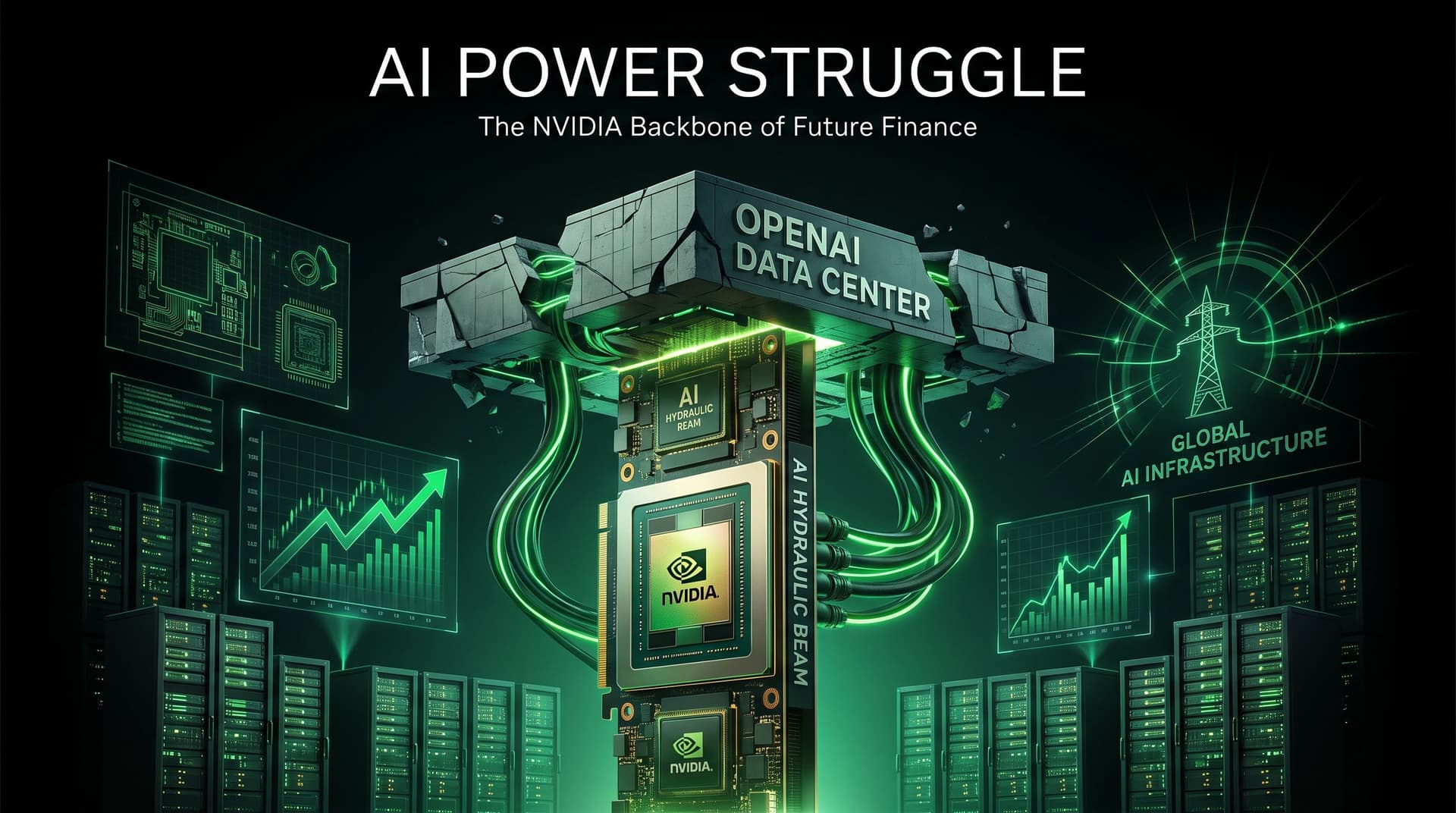
The Wall Street Journal and Bloomberg reported that Nvidia is in talks to backstop as much as $250 billion to help OpenAI lease computing power from a US data centre project — and, separately, to finance up to $350 billion of OpenAI's chip purchases. Combined, that is roughly $600 billion of Nvidia-supported financing for a single customer.
The project itself is remarkable on its own terms. A 10-gigawatt facility in southern Ohio, developed by SoftBank's SB Energy subsidiary, on a decommissioned uranium enrichment site on federal land. Total cost including chips could exceed $500 billion. Power is to come from a new $33 billion gas plant pledged by Japan, with the Commerce Department effectively controlling power allocation.
Why This Made People Nervous
The stated purpose of the guarantee is straightforward: OpenAI is a loss-making private company without an investment-grade credit rating, so the developer can raise debt on far better terms borrowing against Nvidia's balance sheet than against OpenAI's.
The problem is the size of that balance sheet relative to the promise. As of late April 2026, Nvidia's total assets stood at roughly $259.5 billion. A $250 billion guarantee is approximately the entire asset base. And Nvidia's own first-quarter fiscal 2027 filing caps disclosed total lease-guarantee exposure at $3.5 billion — meaning the contemplated commitment would be around seventy-one times its current disclosed guarantee book.
Investor Michael Burry summarised the structural objection in five words: around and around we go. Jensen Huang has consistently dismissed the circular-financing characterisation as preposterous, and Nvidia maintains it does not contractually require partners to spend the proceeds on Nvidia silicon.
An analyst quoted by Al Jazeera framed the market's real question well: if the AI ecosystem is as healthy as everyone says, why is a deal structured this way necessary at all?
Nvidia shares fell around 5%, and Apple reclaimed the title of world's most valuable company. Nvidia's credit default swap premiums widened.
The Honest Read
Vendor financing is not fraud and it is not new. Telecom equipment makers did it in the 1990s, and it worked until it very abruptly did not. The pattern becomes dangerous at the point where the vendor's reported demand can no longer be distinguished from the vendor's own lending.
Nobody outside these companies can currently make that distinction with confidence. That uncertainty is what is being priced, and no amount of strong earnings resolves it — which brings us to the most striking single data point of the week.
SK Hynix Posted Its Best Quarter Ever and Fell 13%
On Wednesday, SK Hynix reported second-quarter results that would have been unimaginable eighteen months ago:
- Revenue of ₩79.32 trillion, up 257% year on year.
- Operating profit of ₩60.54 trillion, up 557% — more than a sixfold increase.
- Net profit of ₩93.9 trillion, up more than thirteenfold, boosted by ₩63.3 trillion in investment asset gains largely tied to the completed sale of its Kioxia stake.
- First-half revenue crossing ₩100 trillion for the first time in company history.
- An operating margin in the region of 76%.
- Mass shipments of HBM4 begun in the quarter, HBM4E samples delivered, and long-term supply agreements finalised with around ten major customers.
The stock fell 13%.
The consensus estimate — LSEG's SmartEstimate, weighted toward analysts with the strongest recent records — had pegged operating profit at roughly ₩64 trillion. SK Hynix came in about ₩3.5 trillion light, primarily because HBM4 shipments arrived later in the quarter than expected, pushing revenue recognition out.
Management pushed back directly on the slowdown narrative. Guidance calls for 2026 capital expenditure at the high end of the previously guided ₩40 trillion range, full-year DRAM demand growth around 25%, NAND around 18%, and third-quarter DRAM shipments up roughly 10% sequentially. The company explicitly cited agentic AI extending memory demand from training into inference and long-term storage.
A 557% profit increase is now a disappointment. That single fact tells you more about where expectations sit than any index chart. The bar is no longer growth. The bar is acceleration.
That is the mechanism behind this entire week. When a sector is priced for acceleration, merely extraordinary results become bearish. It is the same dynamic that made TSMC's record quarter a muted event two weeks ago.
The Part That Actually Affects Your Business
Now the section I would actually read if I were you.
Here is what did not happen this week: no model got more expensive, no capacity was withdrawn, no automation platform changed its terms, and no evidence emerged that enterprise AI demand is falling. Every demand signal published this week — SK Hynix's guidance, Seagate's fiscal Q4 revenue up 48.5%, hyperscaler capex commitments — pointed the same direction.
What moved was the price of owning the companies that supply the boom. That is a shareholder event. If you are not a shareholder in Samsung, SK Hynix, ASML or Nvidia, this week's market action has approximately zero effect on your operating costs.
What Will Affect Your Costs Is Already on the Calendar
While everyone was watching Seoul, the pricing calendar kept moving. If you run production automations on frontier models, these dates matter more to your margins than the entire selloff:
- 31 August. Claude Sonnet 5 introductory pricing at $2 per million input and $10 per million output expires.
- 1 September. Sonnet 5 moves to standard pricing of $3 and $15, alongside a tokeniser multiplier in the 1.0 to 1.35x range. Read that carefully: the multiplier means your effective increase is larger than the headline rate change suggests.
- 30 September. The Claude Fable 5 grace period expires.
- 1 October. Fable 5 moves to credits-only at $10 and $50 per million tokens, charged on top of subscription.
For a workload built on Sonnet 5 today, the September change is a cost increase in the region of 50% before the tokeniser multiplier is applied. That is thirty-three days away. It is contractual, published, and entirely predictable — and in my experience most teams running automations on these models have not modelled it.
The market spent this week debating whether AI is a bubble. Meanwhile the actual, dated, unambiguous change to your unit economics is sitting in a pricing page nobody on your team has opened since March.
What To Do About It
1. Know Your Automation Ratio Before You Know Your Token Spend
The Automation Ratio — the percentage of AI-assisted outputs that ship without human correction — is the number that determines whether a price increase is an inconvenience or an existential problem.
At a high ratio, a 50% token increase is a rounding error against the labour you are not spending. At a low ratio, you are paying frontier prices for output a human rewrites anyway, and the increase compounds a cost you should not have been carrying.
This is why 80% of executives report no measurable AI ROI. They cannot answer this question, so they cannot tell whether their spend is an investment or a leak.
2. Audit Which Steps Actually Need a Frontier Model
Most production workloads contain a small number of genuinely hard steps and a large number of routine ones running on the same expensive model because that was easier to configure.
The advisor model architecture — a cheap, capable default with frontier escalation as the exception — is the highest-leverage change available before September. Given that 30 to 46% of US enterprise API tokens are already flowing to Chinese open-weight models, a great many teams have reached this conclusion ahead of you.
3. Own the Process, Not the Tool
Every business that panics about a model price change has the same underlying condition: it sold or built a collection of tools rather than ownership of a process.
If your value to a client is that you configured their AI, a price change is a crisis. If your value is that you own an outcome, the model underneath is an implementation detail you swap.
4. Stop Treating the Bubble Question as Actionable
Whether AI equities are overvalued is a genuinely open question that serious people disagree about. It is also, for an operator, almost entirely unactionable.
You cannot time it. You cannot hedge it. What you can do is build a business whose economics work at today's prices, next quarter's prices, and prices 50% higher than that — which is the same discipline that would have served you in any other year.
The Test That Cuts Through It
The most useful benchmark for all of this remains the Bending Spoons model: $2.57 million of revenue per employee, roughly 90% of pull requests AI-written, humans doing specification and judgment only.
Notice what is absent from that description. No claim about which model. No dependency on a particular vendor's pricing. No bet on the direction of the semiconductor cycle. It is a claim about process design.
A business built that way survives a 50% token increase, a vendor outage, a model deprecation and a market correction, because none of those things is load-bearing. A business built on "we use the best model" survives none of them.
Gartner still projects $206 billion in AI agent spending for 2026, and Anthropic reported profitability at roughly $47 billion ARR a fortnight ago. Both of those remain true after this week. The demand is real. The question was never whether the technology works — it is whether the equity prices assumed a rate of improvement that physics and capital will actually deliver.
That is a question for shareholders. Your question is narrower and more answerable: does your process still work at a higher price? If you cannot answer that today, that is the systems problem to fix this week — not the chart.
Frequently Asked Questions
Is the AI bubble popping?
Nobody knows, and be sceptical of anyone who says otherwise. What is observable: this was a rotation rather than a broad selloff, since the Dow rose on the same day the chip complex fell. Demand indicators published this week remained strong. What is genuinely uncertain is whether current equity valuations assumed a rate of improvement that is deliverable, and that will not be resolved by any single week's trading.
Will AI tools get cheaper because of this?
Not in the near term, and the published pricing calendar points the other way. Longer term, more conventional DRAM supply from a new entrant should ease component costs across servers and devices. But that is a multi-year effect on hardware, not a near-term effect on token prices.
Should I delay AI automation projects until this settles?
No — and this is the reasoning I would push back on hardest. Waiting for market clarity means paying today's labour costs while your competitors reduce theirs. The correct response to pricing uncertainty is to build automations whose economics survive a price increase, not to defer building.
How exposed am I if I built everything on one model provider?
More than you probably think, though the risk is commercial rather than technical. The realistic exposure is a pricing change you did not model or a deprecation on someone else's schedule. The mitigation is not multi-cloud complexity; it is knowing which of your steps could run on a cheaper model tomorrow, and having tested that they can.
Does China's lithography progress mean chip export controls have failed?
Too early to say, and the numbers argue for caution. Five machines this year against ASML's roughly 130 is not parity, and the Chinese systems still have to demonstrate yield and uptime in production. What it does establish is that a domestic alternative now exists, which changes the leverage of future restrictions even before it changes production volumes.
What is the single most useful thing to do this week?
Open your model provider's pricing page, find the dates your current rates change, and model what your automation costs look like afterwards. It takes under an hour and it is the only item on this list with a deadline.
Related Reading
RAMageddon: The Memory Crisis Driving AI Automation Costs — the DRAM squeeze that set up this week's repricing, and what it did to hardware costs.
The Automation Ratio Is the Only Metric That Predicts Survival — the number that determines whether a price increase is an inconvenience or a crisis.
Stop Chasing the Biggest Model — task-model matching and the advisor architecture, now with a September deadline attached.
The 'AI Business' Advice Is Wrong: Tool Delivery vs Process Ownership — why vendor pricing changes are fatal to one business model and irrelevant to the other.
Bending Spoons: $2.57M Revenue Per Employee — the clearest picture of what AI-first operations look like when the process, not the tool, is the asset.
80% of Executives Report No Measurable AI ROI — the measurement gap underneath most of the spending being repriced this week.
Anthropic Profitable at $47B ARR — the demand-side counterweight to the bubble argument, from a fortnight before the selloff.
About the Author
Hamza Baig is the founder of Hexona Systems, an AI automation agency serving clients across six continents, and the AI Automation Institute, a community of more than 40,000 entrepreneurs building with AI.
He has been featured in the GHL Top 50, Yahoo Finance and Brainz Magazine, and writes regularly on automation architecture, agent governance and the operational realities of AI deployment.
Read more analysis on the Hamza Automates blog, or get in touch to discuss an automation build.
Follow @hamza_automates on Instagram for daily automation breakdowns.
Note: this article is market analysis for context, not investment advice. Nothing here is a recommendation to buy or sell any security.
About
Hamza Baig is the founder of Hexona Systems—an automation agency and softwareplatform that helps thousands of entrepreneurs and business owners implement AI-powered workflows at scale.