Is an AI Automation Agency Worth It? An Honest Look
Is an AI automation agency worth starting? An honest look at real demand, rising competition, what the work involves, startup costs, risks, who it suits and a low-risk way to test it.





Search for “AI automation agency” and you’ll find two kinds of content: people promising you’ll make $30,000 a month by next quarter, and people saying the opportunity is already dead. Neither is very useful if you’re trying to decide whether to spend the next year of your life on it.
A quick disclosure first: I run an AI automation agency and I teach people to build them, so I have a bias. I’ll try to be as honest as I can about both the opportunity and the downsides, and I’ll tell you who I think should not start one. This guide answers whether an AI automation agency is worth starting: what the demand really looks like, what has changed, what the work involves, the costs and risks, and a low-risk way to find out if it’s for you.
Quick answer: Yes, for people willing to run it as a real service business: picking a niche, selling every week, delivering reliable systems and supporting them after launch. Demand from businesses is real and growing, and the tools are cheap. But competition has risen, buyers are better informed and generic offers like “I’ll build you a chatbot” are struggling. If you want quick, passive income, this is the wrong business.
The case for: demand is real
- Businesses are adopting AI agents fast. Gartner has predicted that up to 40% of enterprise applications will include task-specific AI agents by the end of 2026, up from less than 5% in 2025. Small and mid-sized businesses want the same benefits but rarely have anyone in-house to build them.
- The problems are timeless. Slow lead follow-up, missed calls, manual reporting, late invoices and messy onboarding existed long before AI. Businesses will keep paying to fix them, whatever the tools are called.
- Starting costs are low. A lean tool stack often costs roughly $100 to $300 a month, as I break down in The AI Automation Agency Tool Stack. There’s no inventory and no office required.
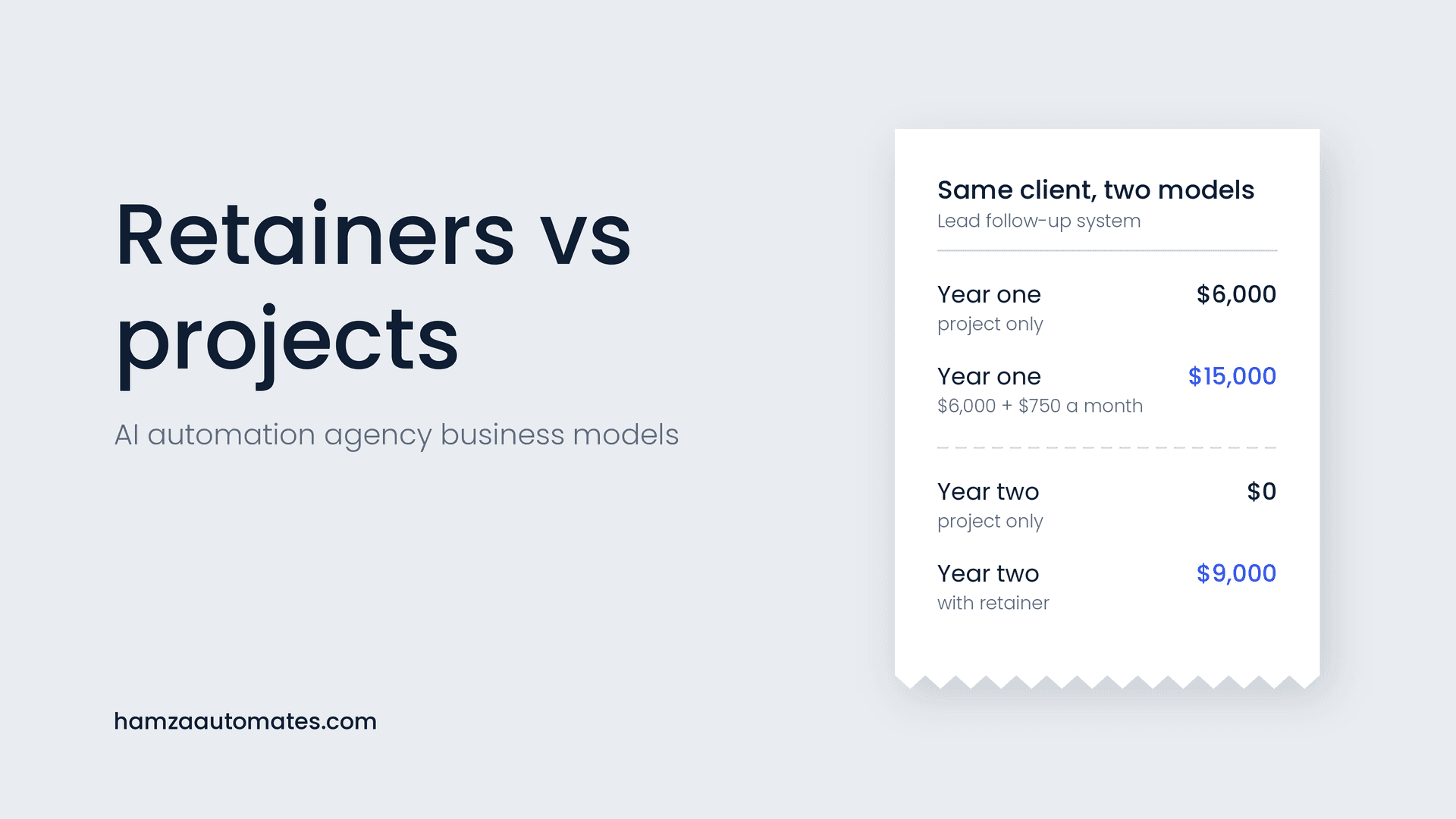
- Recurring revenue is possible. Systems need ongoing care, which supports retainers and more predictable income, as I explain in Retainers vs Projects.
The case against: what has changed
- More competition. Easier tools and lots of online courses mean many more people now offer automation services.
- More skeptical buyers. Many businesses have already been burned by AI projects that didn’t deliver. Gartner has warned about “agent washing” and predicted that over 40% of agentic AI projects will be canceled by the end of 2027. Buyers now ask harder questions, like the ones in my 10 questions to ask before you hire an AI automation agency.
- Simple builds are being built into software. CRMs, helpdesks and workspace tools increasingly include their own AI features, so a basic chatbot or summary tool is harder to sell on its own.
- The ground keeps moving. Models, prices and tools change constantly, so you’re never done learning, and switching providers is harder than it looks, as I covered in 89% Say They Could Switch AI Providers.
The pattern is clear: generic, tool-first offers are getting squeezed, while focused agencies that solve specific business problems and stand behind their work are doing well. I made this case in more depth in The ‘AI Business’ Advice Is Wrong.
Myths vs reality
Myth
Reality
“It’s passive income.”
It’s a service business. Clients need communication, delivery and support.
“The hard part is learning the tools.”
The hard part is finding clients consistently. Building is the easier skill to learn.
“AI does the work for you.”
AI is one component. Reliable systems need process design, testing, error handling and monitoring.
“You can sell to anyone.”
Agencies that pick a niche usually find clients faster and charge more.
“Build it and you’re done.”
Systems break when tools change. Maintenance is part of the job, and the business.
“A course guarantees income.”
Nothing guarantees income. Results depend on your skills, effort, market and luck.
What the work actually involves
A typical week in a small automation agency is a mix of roughly four jobs:
Job
What it involves
Skill it needs
Selling
Outreach, content, discovery calls, proposals; see How to Find Clients
Communication, persistence, handling rejection
Building
Mapping processes, building workflows, connecting AI, testing
Logical thinking, technical curiosity
Supporting
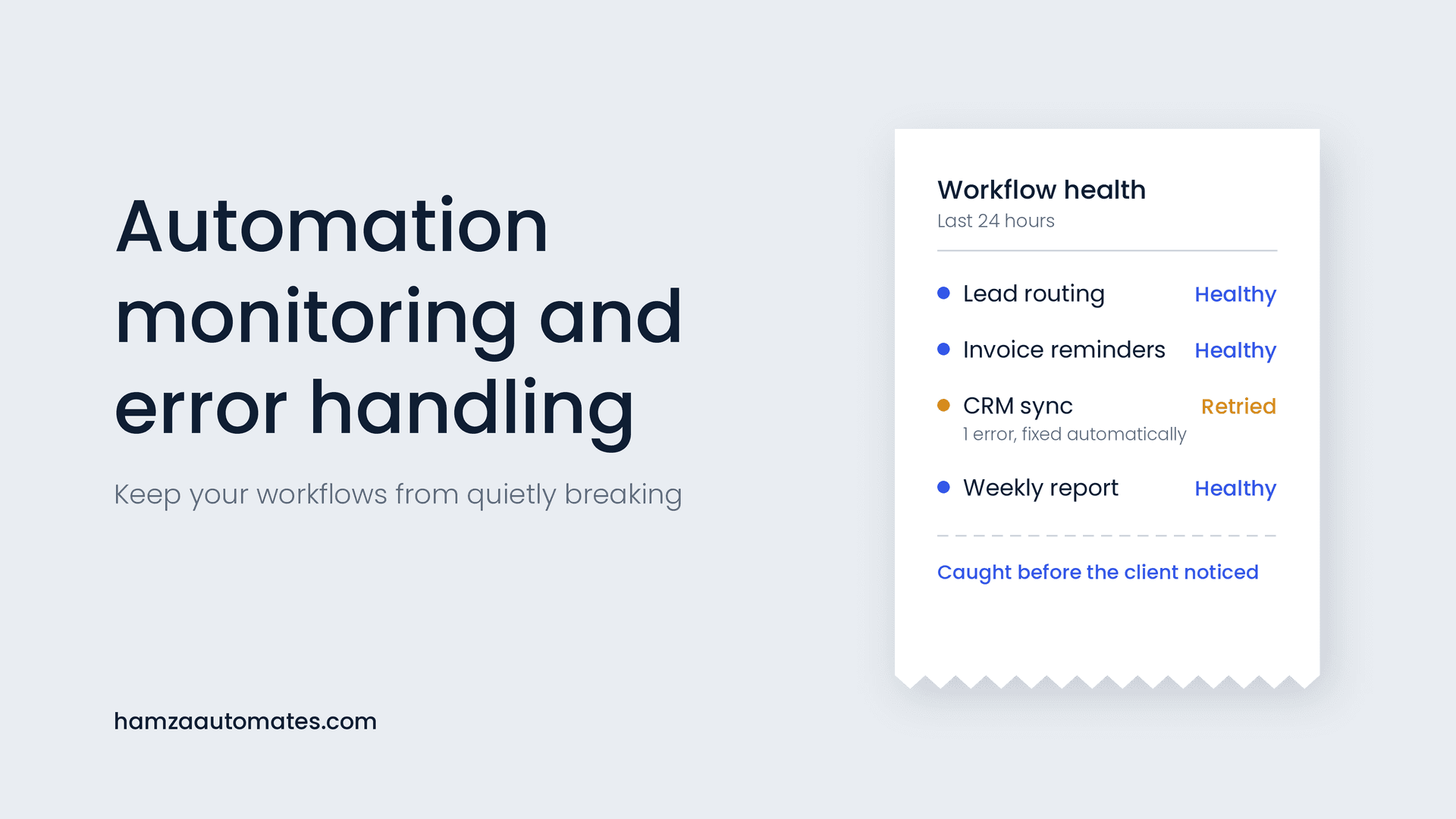
Fixing issues, monitoring, updating systems; see Automation Monitoring and Error Handling
Reliability, responsiveness
Running the business
Pricing, invoicing, contracts, admin, learning
Organization, basic financial discipline
If you only enjoy one of these, that’s fine, but plan for how the others get done, through a partner, a hire or a very focused offer.
The economics, honestly
Costs are low, but so is income at the start. Your first months usually involve building skills, demos and a pipeline before meaningful revenue arrives. Over time, the model that tends to work is a setup fee plus a monthly retainer. As an illustration from my pricing guide, ten clients on a $750 a month retainer would produce $7,500 a month in recurring revenue before any new projects. That’s an example of how the model works, not a prediction of what you’ll earn.
Be skeptical of anyone who promises specific income, including people selling courses. The FTC’s guidance on spotting business offer and coaching program scams is worth reading before you buy any program, mine included. Good programs teach skills and show realistic expectations; they don’t guarantee results.
Who it suits, and who it doesn’t
Probably a good fit if you…
Probably not a good fit if you…
Enjoy solving business problems, not just playing with tools
Mainly want passive income
Can talk to business owners and handle rejection
Strongly dislike selling and won’t partner with someone who sells
Have industry experience or contacts in a niche
Need a guaranteed income within weeks
Are comfortable learning new tools continuously
Want to learn one tool once and stop
Take responsibility for reliability and client outcomes
Prefer to hand work over and never support it
The main risks, and how to reduce them
Risk
How to reduce it
Not finding clients consistently
Pick a niche, build demos, do daily outreach and track your pipeline
Unreliable systems damaging trust
Build in error handling and monitoring; sell care plans
Liability for AI mistakes
Keep AI grounded in approved information, with clear handoffs; see A German Court Just Made Google Liable for AI Answers
Depending on one big client
Aim for several smaller retainers rather than one large one
Depending on one platform or model
Standardize, but design systems so tools and models can be swapped
Burnout
Productize offers, document processes and set clear retainer limits
Alternatives worth considering
- Freelancing first. Take a few projects on freelance platforms or through your network before calling yourself an agency. I compare the models from the buyer’s side in Agency vs Freelancer vs In-House.
- An in-house automation role. Many businesses now hire for automation and AI operations, a lower-risk way to build skills with a steady salary.
- Adding automation to an existing service. Marketing agencies, bookkeepers and IT providers can add automation to services they already sell.
- A productized offer or software. Package one proven system for one niche as a subscription.
A low-risk way to find out
You don’t need to quit your job to test this. Give yourself 30 to 60 days with a clear plan, part-time if needed:
Pick one niche and one problem.
Build one working demo of the solution and record a two-minute walkthrough.
Have real conversations with 20 to 30 business owners in that niche.
Try to sell one paid pilot at a fair price.
If owners recognize the problem and at least a few want to talk further, you have a signal worth pursuing. If nobody cares, change the niche or the problem before you change the plan. My 30-day client plan and step-by-step guide to starting an AI automation agency walk through this in detail.
Decision checklist
- I can name a specific niche and a costly problem it has.
- I’m willing to spend several hours a week on outreach, consistently.
- I can support myself while the business grows.
- I’m prepared to maintain and stand behind what I build.
- I’m comfortable with results that vary and aren’t guaranteed.
If you can tick all five, it’s worth testing. If not, one of the alternatives may be a better first step.
Want to test it with support?
This article is part of my guide to how to build an AI automation agency. The best low-cost starting point is our free Skool community, where more than 30,000 people building automation businesses share what’s working and what isn’t. If you decide to go further, my courses and programs and the AI Automation Accelerator cover building, selling and delivery in depth. And if you’re a business owner who’d rather have this built for you, see what we build as an AI automation agency.
Frequently asked questions
Is an AI automation agency still worth starting?
It can be, for people willing to treat it as a real service business: choosing a niche, selling consistently, delivering reliable systems and supporting them after launch. Generic offers and get-rich-quick approaches are struggling as competition rises and buyers become more informed.
How much does it cost to start an AI automation agency?
The tools are inexpensive; a lean stack often costs roughly $100 to $300 a month. The bigger investment is time: learning to build reliably, building demos and doing consistent outreach before revenue arrives.
Do I need to know how to code?
Not to start. Platforms like n8n, Make and Zapier let you build without code. Some technical comfort with APIs, data formats and debugging becomes important as projects get more complex.
How long does it take to make money?
There is no reliable timeline, and results vary widely. Some people land a first paid project within weeks; many take months. Be cautious of anyone, including course sellers, who promises specific income.
What is the biggest risk of starting an AI automation agency?
For most people it’s not being able to find clients consistently. Other risks include unreliable systems damaging client trust, depending on one platform or client, and AI pricing or capability changes making simple offers obsolete.
About the author: Hamza Baig is the founder of Hexona Systems, an AI automation agency and software platform, and the creator of the AI Automation Institute, where more than 30,000 students have learned to build with AI and automation. He has been featured in Yahoo Finance, CEO Weekly and Brainz Magazine. Follow him on X and LinkedIn.
About
Hamza Baig is the founder of Hexona Systems—an automation agency and softwareplatform that helps thousands of entrepreneurs and business owners implement AI-powered workflows at scale.