How to Find Clients for an AI Automation Agency
How to find clients for an AI automation agency: choosing a niche, building an offer and proof, the seven best client channels, outreach that works and a 30-day plan.





Learning to build automations is the easy part. Most people who start an AI automation agency can build a working n8n or Make workflow within weeks. Where they get stuck is the next step: finding businesses that will actually pay for it.
After years of running Hexona Systems and watching thousands of members of our community try to land their first clients, I’ve seen the same pattern. The ones who struggle offer “AI automation” to everyone. The ones who succeed pick one type of business, solve one painful problem, show proof and talk to a lot of the right people. This guide walks you through exactly how to find clients for an AI automation agency, step by step, with a 30-day plan at the end.
Quick answer: Pick one niche and one costly, repetitive problem it has. Package the fix as a specific offer, build a demo that shows it working, and start with your existing network and referrals. Then add targeted, personalized outreach to businesses in your niche, share your work publicly, and build partnerships with businesses that already serve your niche. Track your pipeline weekly: conversations, discovery calls, proposals and clients.
Why most new agencies struggle to find clients
- No niche. “We automate businesses with AI” gives a busy owner nothing to say yes to.
- Selling the technology. Business owners don’t buy n8n workflows or AI agents. They buy more booked appointments, faster follow-up and fewer hours of admin.
- No proof. Without a demo, case study or example, you’re asking a stranger to trust you with their operations.
- Too little volume. Ten messages a week won’t build a pipeline. Consistent daily activity will.
- Giving up too early. Most clients come from the second, third or fourth conversation, not the first.
Step 1: Pick a niche and a problem
A niche makes everything else easier: your offer is clearer, your outreach is more relevant, your demo is more convincing and referrals spread faster because business owners in the same industry talk to each other. I explain why focus is what makes an AI business defensible in The ‘AI Business’ Advice Is Wrong.
A good niche has four things: a costly, repetitive problem; businesses that can afford to fix it; owners you can reach easily; and a problem you can solve reliably. Here are some proven starting points:
For more offer ideas, see 12 AI agent use cases that pay for themselves. Pick a niche you understand or can reach through your network. A former real estate agent selling to real estate teams has a big head start; see my guide to marketing automation for real estate agencies for what that niche cares about.
Step 2: Turn it into a specific offer
Next, package your solution so a business owner can understand it in one sentence. Compare these two:
- Vague: “We help businesses automate their workflows with AI.”
- Specific: “We set up an AI receptionist for dental clinics that answers every call, books patients into your calendar and texts confirmations. Live in three weeks.”
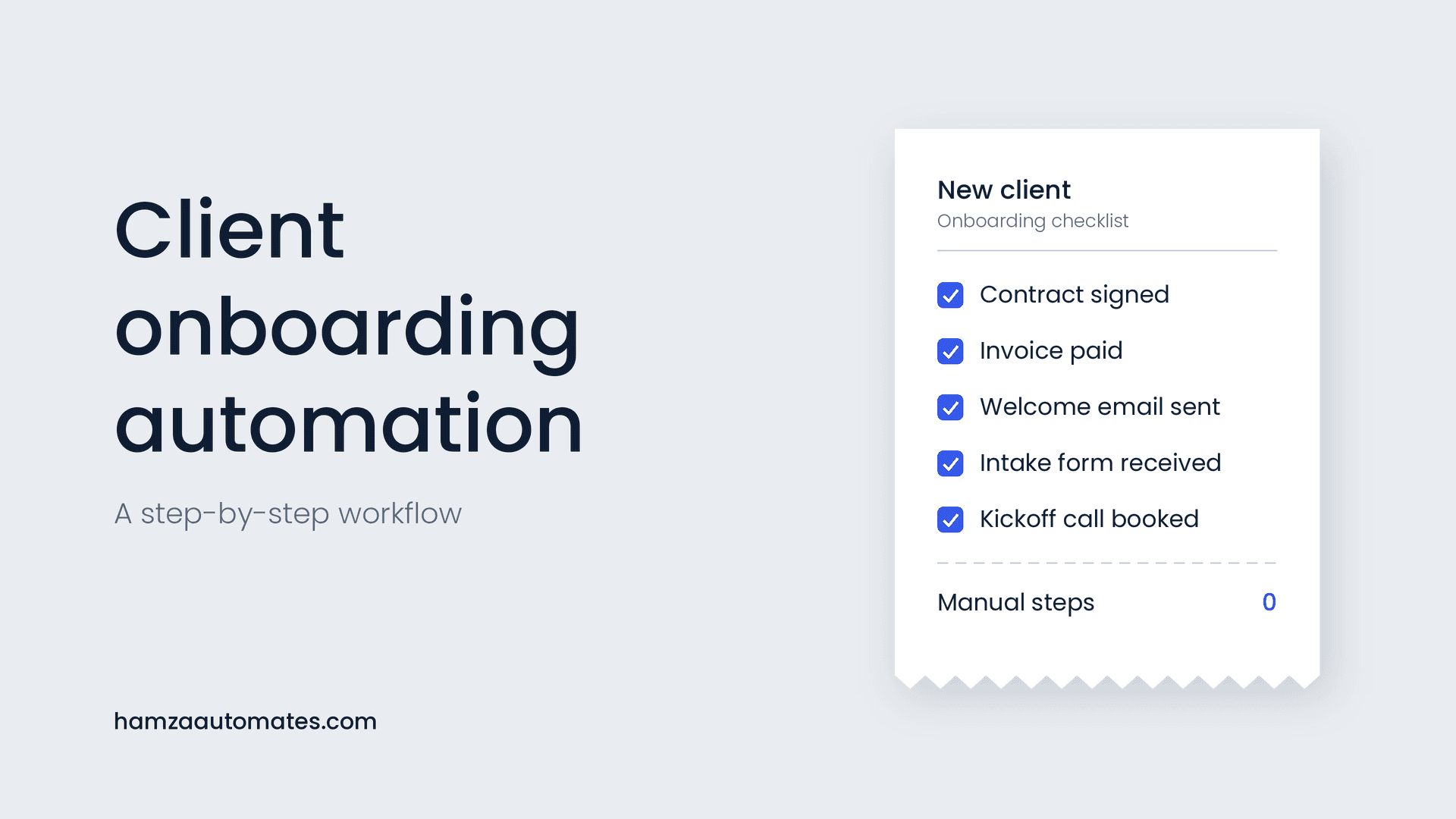
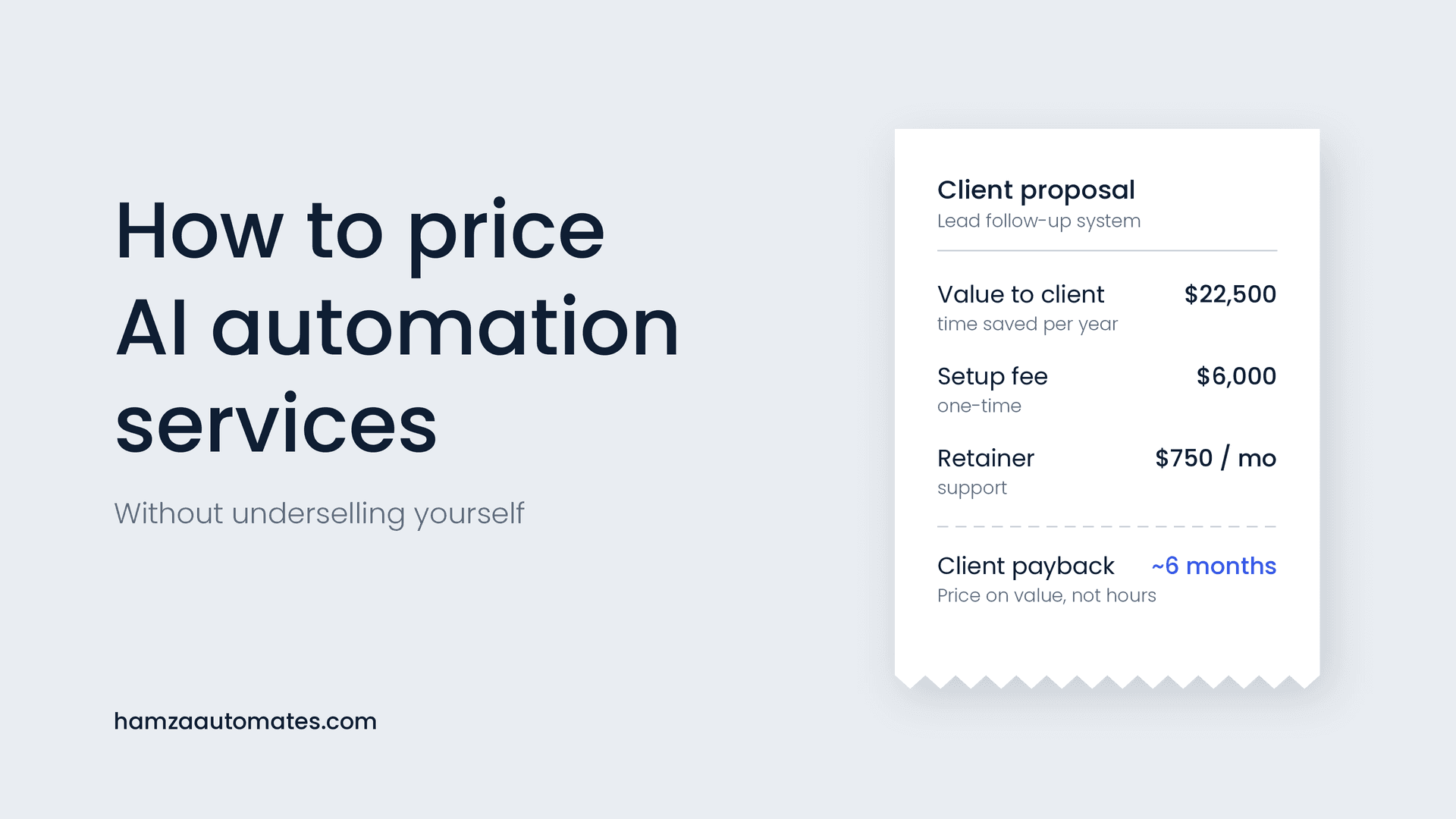
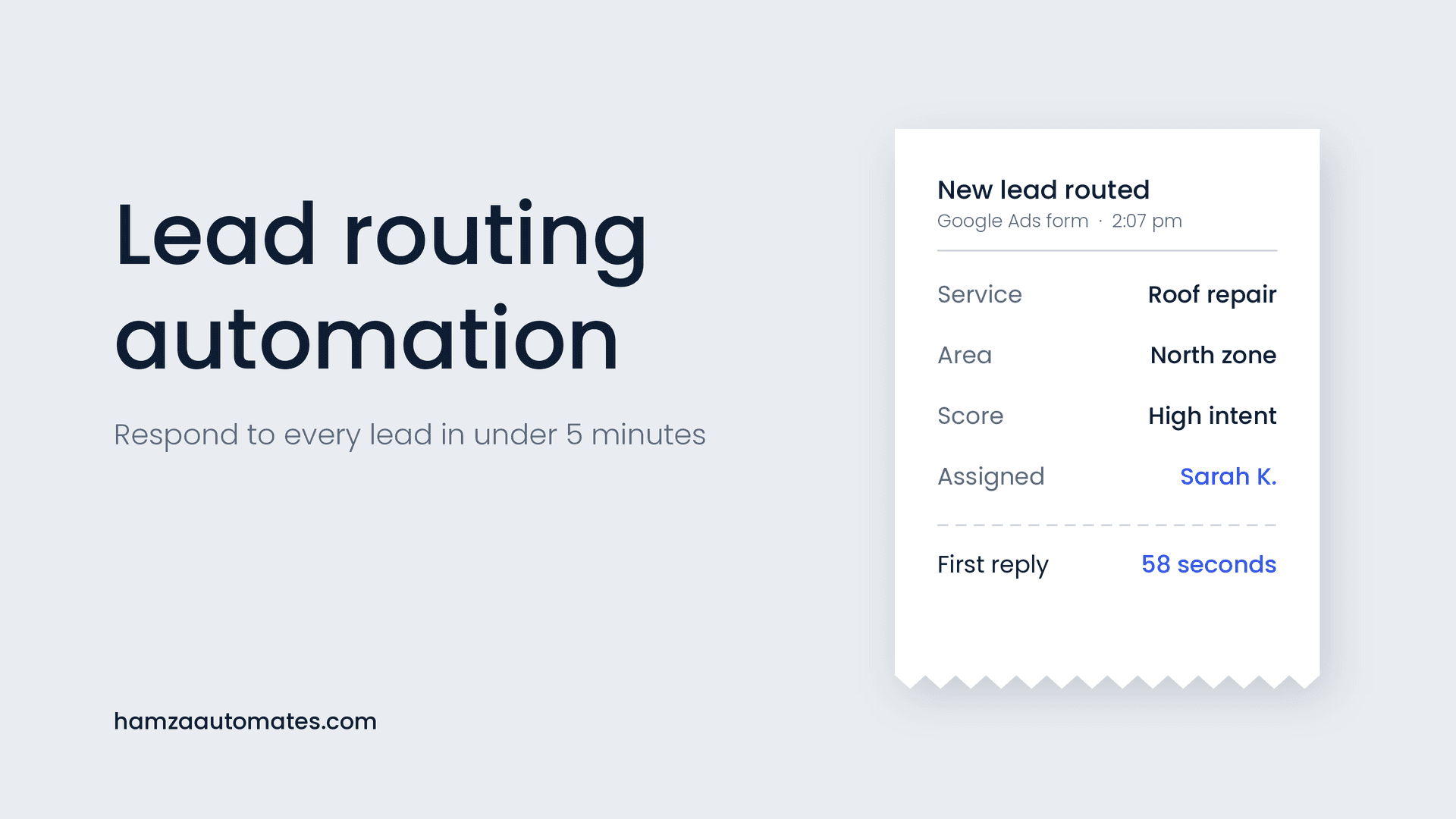
The specific version names the customer, the problem, the outcome and the timeline. It’s easy to say yes to and easy to refer. Build each offer around a system you can deliver repeatedly, such as an AI voice agent for appointments, a lead qualification chatbot, lead routing automation or client onboarding automation. Then price it on value, as I explain in How to Price AI Automation Services.
Step 3: Build proof before you have clients
You don’t need a client to show what you can do. Before your first outreach, build at least one of these:
- A working demo of your offer, built for a fictional business in your niche. A two-minute screen recording of it running is often your best sales asset.
- Automations for your own business: your own lead capture, follow-up and onboarding. If you can’t automate your own business, prospects will notice.
- A paid pilot with a friendly business, priced low but not free, in exchange for honest feedback, a testimonial and permission to share the results.
- Before-and-after numbers from any of the above: hours saved, response times, bookings.
Free work usually backfires: clients don’t value it, scope grows and you can’t use the result as a pricing reference. A discounted pilot with a clear scope and success measure is better for both sides.
Step 4: Choose your client channels
There’s no single best channel. Pick two or three that suit your niche and personality, and work them consistently for at least a few months.
Your network and referrals
Your first client is often someone who already knows you: a former employer, a friend who runs a business, a supplier, someone from a professional group. Write a list of 50 people, tell them specifically what you now do and for whom, and ask who they know. Most people won’t need it themselves, but many will know someone who does.
Targeted outreach
Outreach works when it’s narrow and personal. Send fewer, better messages to businesses in your niche, mention something specific about them, lead with the problem and offer something useful. Keep it short. Here’s an example:
Subject: Missed calls at [Clinic name]
Hi Dr. [Name], I called [Clinic name] at lunchtime yesterday and went to voicemail, which I imagine happens a lot on busy days.
I build AI receptionists for dental clinics that answer every call, book patients straight into your calendar and text them a confirmation. I recorded a two-minute demo of one handling a new-patient booking: [link].
Would it be useful if I showed you how it would work for [Clinic name]? Happy to keep it to 15 minutes.
[Your name]
Follow up once or twice, politely, then stop. If you send commercial email, follow the rules where your recipients are. In the U.S., the FTC’s CAN-SPAM compliance guide covers the basics, such as an honest subject line, your physical address and a working opt-out; rules in the UK, EU and elsewhere are stricter. This isn’t legal advice.
Content
Share what you build: short screen recordings of automations, before-and-after results, lessons from client work and answers to questions your niche asks. Content is slow to start but compounds; prospects who have watched your videos for weeks arrive at a discovery call already trusting you. LinkedIn and YouTube work well for B2B niches, while short video suits local service businesses.
Partnerships
Find businesses that already serve your niche but don’t build automations: marketing agencies, web designers, accountants, IT providers and software resellers. Offer to handle their clients’ automation work, with a referral fee or revenue share. Tool ecosystems help too. For example, n8n runs a creators program where builders publish workflow templates, which can bring visibility and inbound interest.
Step 5: Run discovery calls that convert
A discovery call isn’t a pitch. It’s where you find out whether the problem is real, costly and worth solving. Spend most of the call asking questions:
What happens today, step by step, and who does it?
How often does it happen, and how long does it take?
What does it cost when it goes wrong: missed leads, errors, late payments?
What have you already tried?
If this were fixed, what would be different in three months?
Those answers give you the numbers for a value-based proposal. Many buyers also check agencies against a list like my 10 questions to ask before you hire an AI automation agency, so be ready to show live work, explain running costs and confirm the client will own what you build. For more on turning conversations into revenue, see Selling AI Agents: Turning Automation into Revenue.
Step 6: Turn every client into the next one
- Measure results from day one, so you have numbers for a case study.
- Ask for a referral when the client sees their first result, not months later.
- Write a short case study with their permission: problem, solution, result.
- Offer a retainer so the relationship continues and you can find the next automation together.
- Expand within the account. Most clients have more processes worth automating once they trust you.
A 30-day plan to find your first clients
Week
Focus
Actions
Week 1
Niche and offer
Pick one niche and one problem; write a one-sentence offer; list 50 people in your network
Week 2
Proof
Build and record a demo; automate one part of your own business; contact your network list
Week 3
Outreach
Build a list of 100 businesses in your niche; send 10 to 20 personalized messages a day; post your demo publicly
Week 4
Conversations
Run discovery calls; send value-based proposals; follow up; contact two potential partners
Keep going after day 30. Track four numbers every week: conversations started, discovery calls, proposals sent and clients won. If conversations are low, increase outreach. If calls don’t turn into proposals, sharpen your niche or offer. If proposals don’t close, revisit your proof and pricing.
Common mistakes to avoid
- Leading with “AI.” Lead with the business outcome. Mention the technology only when asked.
- Copy-paste messages. Generic outreach gets ignored or reported as spam.
- Switching niches every two weeks. Give a niche at least a couple of months of real effort.
- Underpricing to win the first deal. It makes the next deal harder and the work less sustainable.
- Building before selling. Validate demand with conversations before you spend weeks on a complex product.
Get help finding your first clients
This article is part of my guide to how to build an AI automation agency, and my step-by-step guide to starting an AI automation agency covers the business model and tools in more detail. Inside our free Skool community, more than 30,000 people building automation businesses share outreach scripts, demos and wins. For a structured path with coaching, see my courses and programs or the AI Automation Accelerator. And if you’re a business owner who would rather have this built for you, see what we build as an AI automation agency.
Frequently asked questions
How do I get my first AI automation client?
Start with one niche and one specific problem, build a working demo, then reach out to your existing network and a short list of businesses in that niche with a personalized message. Many first clients come from people who already know you or from referrals.
What is the best niche for an AI automation agency?
The best niche is one where businesses have a costly, repetitive problem, can afford to fix it and are easy for you to reach. Clinics, home services, real estate, professional services and marketing agencies are common starting points.
Does cold outreach work for AI automation agencies?
It can, when it’s targeted at one niche, personalized and focused on a specific problem rather than AI in general. Keep messages short, offer something useful and follow the email and privacy rules in each country you contact.
Should I work for free to get my first case study?
A discounted pilot usually works better than free work. Agree a clear scope, a success measure and permission to use the results as a case study, so both sides take the project seriously.
How long does it take to land the first client?
It varies widely. With a clear niche, a demo and consistent daily outreach, many new agency owners have their first paid conversations within a few weeks, but there is no guaranteed timeline.
About the author: Hamza Baig is the founder of Hexona Systems, an AI automation agency and software platform, and the creator of the AI Automation Institute, where more than 30,000 students have learned to build with AI and automation. He has been featured in Yahoo Finance, CEO Weekly and Brainz Magazine. Follow him on X and LinkedIn.
About
Hamza Baig is the founder of Hexona Systems—an automation agency and softwareplatform that helps thousands of entrepreneurs and business owners implement AI-powered workflows at scale.