Apple Sues OpenAI, SK Hynix Hits $1 Trillion, UAE Gets AI Chip Access
The week of July 6 to 13, 2026 produced the most concentrated legal, financial, geopolitical, and security AI news of the year.





“The week of July 6 to 13, 2026 produced the most concentrated legal, financial, geopolitical, and security AI news of the year. Apple sued OpenAI for trade secret theft. SK Hynix became a trillion-dollar company on its first day of Nasdaq trading. The UAE got licence-free access to advanced AI chips. A supply chain attack targeted Claude Desktop, Cursor, and VS Code. And Bespoke raised $40 million to solve the problem of AI models that perform well on benchmarks but fail in production. None of these are isolated stories. They are dimensions of the same maturing market.”
Story One: Apple Sues OpenAI for Trade Secret Theft
Apple has filed a lawsuit against OpenAI in federal court in Northern California, alleging trade secret theft. Per AI Weekly’s live coverage, the complaint alleges that more than 400 former Apple employees now work at OpenAI, and that Apple’s Chief Hardware Officer, Tang Tan, directed new recruits to bring confidential documents from their Apple roles to their interviews at OpenAI, covering unreleased iPhone and Apple Watch products.
The lawsuit is extraordinary on multiple dimensions. Apple is one of the most secretive technology companies in history. A suit of this scale, naming the Chief Hardware Officer as having directed the conduct, is not a routine IP dispute. It is an allegation of coordinated, systematic intelligence collection against a company that spends enormous resources on operational security.
The Context That Makes This Story More Complex
Apple and OpenAI have a concurrent commercial relationship: ChatGPT is one of three AI provider options available to iOS users in Apple Intelligence, alongside Claude and Gemini. That relationship was forged this year and generates meaningful distribution value for OpenAI. A lawsuit alleging trade secret theft, filed while that commercial relationship is active, creates a genuinely unusual legal and commercial situation that neither company’s legal teams will have navigated before.
The outcome of this lawsuit will set a significant precedent for how trade secret law applies to the mass movement of technical talent between frontier technology companies — a phenomenon that has been a defining feature of the AI talent market in 2025 and 2026. The legal framework for what employees can take, what companies can ask for, and what constitutes misappropriation in a market where the same people build consecutive generations of competitive technology is not yet settled.
What This Means for AI Businesses
For businesses in the AI space: the Apple-OpenAI lawsuit is the highest-profile signal yet that trade secret litigation around AI talent movement is becoming a standard competitive tool, not just a defensive measure for exceptional cases. If your business employs people who previously worked at AI labs, technology companies, or any organisation with meaningful AI IP, your HR onboarding process and acceptable use policies need to be specific about what prior employer information can and cannot be used in your current role. This is no longer a niche concern.
Story Two: SK Hynix Hits $1 Trillion on Nasdaq Debut
South Korean chipmaker SK Hynix, one of the three companies controlling the global memory market alongside Samsung and Micron, completed its Nasdaq IPO on July 10, 2026, closing its first day up 13% at $168.01 per share. Per AI Weekly’s live tracking, the close put SK Hynix’s market capitalisation at $1 trillion, making it the seventh company globally to reach the trillion-dollar mark on its first day of public trading.
Why SK Hynix’s Debut Price Matters for AI Automation Costs
SK Hynix had already disclosed before its IPO that it had sold out its entire 2026 HBM memory production capacity before the year started. A $1 trillion market cap on the first day of trading is the public market’s endorsement of that supply constraint as a durable advantage, not a temporary condition. As the RAMageddon analysis documented, HBM is the memory component that determines the cost and availability of AI data centre infrastructure. SK Hynix’s trillion-dollar debut at peak supply constraint is the financial market confirming what the physical market has been saying since late 2025: the memory shortage is structural, the timeline for resolution is years not months, and the companies controlling that supply are among the most valuable in the world as a result.
For businesses modelling AI automation costs: the SK Hynix debut is additional evidence that the infrastructure cost pressure on API pricing is not going to reverse in any near-term timeframe. Build your cost models accordingly.
Story Three: UAE Removed From AI Chip Export Restrictions
The US Commerce Department has removed the United Arab Emirates from the D:3/D:4 restrictive country groups, reclassifying it as A:5. Per AI Weekly’s geopolitical coverage, this grants licence-free advanced AI chip exports to G42, Core42, and US firms including Amazon, Apple, and xAI operating in the UAE.
What the UAE Reclassification Signals
The UAE reclassification is the export control story that runs as the direct positive counterpart to the Fable 5 ban: if one direction of the administration’s AI geopolitics is restricting access to the best AI models, the other direction is expanding access to the infrastructure needed to build AI to trusted partners. G42 and Core42 are the UAE’s primary AI infrastructure entities, and both have been working to demonstrate geopolitical alignment with US technology interests after earlier concerns about Chinese investment.
The practical consequence: advanced Nvidia chips can now flow to UAE data centres without the licence application process that previously created months-long delays. That makes the UAE a viable location for frontier AI infrastructure in a way it was not before July 10. For businesses exploring AI infrastructure deployment in the Gulf region, the reclassification removes a significant barrier.
The broader geopolitical pattern: the administration is using export control reclassification as a diplomatic tool, granting chip access to countries that demonstrate alignment with US AI governance positions. The Geneva AI governance dialogue context is directly relevant: the countries that participate in and align with the US-led governance frameworks are the ones that receive the export classification upgrades. This is AI diplomacy conducted through the chip supply chain.
Story Four: The jscrambler npm Supply Chain Attack Targeting AI Developer Tools
A compromised release of the jscrambler npm package (version 8.14.0) was discovered this week, per AI Weekly’s security coverage, dropping a Rust-based infostealer specifically targeting configuration files for Claude Desktop, Cursor, Windsurf, VS Code, and Zed. These are collectively the most widely used AI-assisted developer tools in the enterprise market.
What Was Being Stolen and Why It Matters
The infostealer targeted configuration files, not the source code in open repositories or the models themselves. This is the attack vector: AI developer tools store configuration that often includes API keys, authentication tokens, workspace preferences, and sometimes system prompt content. A stolen Claude Desktop or Cursor configuration file may contain the API keys that give the attacker the same AI automation capabilities as the developer whose machine was compromised.
This is exactly the attack surface the JADEPUFFER and HiddenLayer analysis identified: API keys connected to AI services are credentials that, if stolen, give an attacker the same AI capabilities the legitimate user has. An attacker with a stolen Claude API key can run AI agents against the key holder’s billing, access any knowledge bases the key can reach, and potentially use those agents for further attacks on the key holder’s systems or to generate fraudulent content at scale.
Immediate Actions for Affected Developers
If you use jscrambler in your development workflow, check whether your installed version is 8.14.0. If it is, rotate all API keys stored in your Claude Desktop, Cursor, Windsurf, VS Code, and Zed configurations immediately, before doing anything else. The attack installs a Rust binary that may persist after package removal, so complete key rotation on any machine that ran the compromised package before investigating further.
More broadly: AI developer tool configuration files warrant the same credential security treatment as SSH keys or database credentials. They should be stored in secrets management systems rather than plaintext files, rotated on a defined schedule, and scoped to the minimum API access needed for the specific tool’s use case. Most developers currently treat AI tool configuration files as low-sensitivity data. The jscrambler attack demonstrates that they are not.
Bespoke Labs: The $40M Bet on the Benchmark-Production Gap
Bespoke Labs raised $40 million this week to build post-training infrastructure that addresses one of the most persistent problems in enterprise AI deployment: models that perform well on benchmarks but fail in production for specific business tasks.
Bespoke’s approach centres on automated preference optimisation: given examples of what your business considers good and bad model outputs, Bespoke’s platform generates the synthetic data and runs the fine-tuning pipeline to align any open-source model to your specific quality standards. The company calls it ‘model alignment as a service’ — the capability that Anthropic, OpenAI, and Google apply to their own models, made available to organisations without the research staff to run the process themselves.
The benchmark-production gap is exactly what the automation ratio framework measures: benchmark scores test single-turn task performance under ideal conditions. Production automation ratios measure the proportion of outputs that ship without human correction across real workflows with real variance. These are different numbers, and the gap between them is what Bespoke is raising $40 million to close.
For businesses already running fine-tuning or wanting to: Bespoke’s platform is worth evaluating as an alternative to building the post-training infrastructure yourself. The task-model matching argument applies here directly: smaller, fine-tuned models often outperform frontier models on specific business tasks. What Bespoke provides is the pipeline for creating those fine-tuned models without a research team.
Mistral Leanstral 1.5: Mathematical Proof That Software Works
Mistral released Leanstral 1.5 this week — an AI model that moves beyond code generation to generate mathematical proofs (using Lean 4) that software behaves as intended. The distinction is significant: code generation produces code that might work. Formal verification produces a mathematical proof that the code correctly implements its specification under all possible inputs.
Strong benchmark results on formal verification tasks demonstrate material progress toward a capability that has been a goal of software engineering research for decades: automated formal verification for critical systems. The near-term applications are focused on security-critical code, financial systems, and infrastructure software where correctness failures have catastrophic consequences.
The connection to the Squidbleed discovery and Glasswing programme: Glasswing finds vulnerabilities in existing code. Leanstral 1.5 points toward a future where new code can be formally verified before deployment, reducing the surface area of vulnerabilities before they are written. These are complementary capabilities in a comprehensive AI-assisted software security stack.
Cloudflare Monetization Gateway: AI Agents That Pay for Things
Cloudflare opened the waitlist for its Monetization Gateway, built on the x402 protocol, enabling websites, APIs, datasets, and digital services to accept instant micropayments — including from AI agents. The protocol allows an AI agent to pay for access to a resource in real time as part of its task execution, rather than requiring a human to pre-authorise a billing relationship.
This is an important infrastructure development that most AI news coverage is significantly underweighting. The current internet’s payment infrastructure was built for human-to-business transactions: a human provides a payment method, authorises a charge, and receives a service. AI agents that browse the web, access APIs, and retrieve data as part of their task execution do not fit this model. They need to transact with resources autonomously, at machine speed, for micropayment amounts that make credit card processing economically nonsensical.
The x402 protocol creates an infrastructure layer where an AI agent can pay $0.001 to access a dataset, $0.005 to call an API, or $0.0001 to read a premium web page — all within a single task execution, without human pre-authorisation of each transaction. For automation builders, this is the payment infrastructure that makes agent-driven content and data access commercially viable at scale.
The Humanoid Robot IPO Wave: The AI Market’s Next Infrastructure Story
The week’s other major financial development: three humanoid robotics companies moved toward public markets simultaneously. Agility Robotics filed to go public via SPAC at a $2.5 billion valuation. Unitree Robotics cleared its Shanghai IPO. Tesla began converting the production line that built its last Model S into an Optimus factory.
The humanoid robot wave is not directly relevant to AI automation software. It is the same underlying market dynamic: organisations are buying AI capability at scale to replace or augment human labour, and the capital markets are pricing in sustained multi-year demand for that transition. The companies building the physical layer of AI-driven labour automation are moving to public markets in the same window as the software layer companies (Anthropic, OpenAI). That convergence, software AI agents and physical AI robots going public simultaneously, is the financial market’s assessment that the labour automation transition is structural.
What the Week of July 6 to 13 Adds Up To
Step back from the individual stories and the week of July 6 to 13, 2026 presents the AI market in its current state with unusual completeness. ZoneTechify’s July 13 summary puts it precisely: “The AI news of July 13, 2026 points to a clear direction: smarter systems that cost less, act more independently, and operate under real rules. The winners this year will not be the companies chasing every headline, but those pairing thoughtful adoption with strong governance.”
The four forces shaping this week’s stories:
- IP and talent war escalation: Apple suing OpenAI for trade secret theft via talent recruitment is the latest and largest expression of a pattern running through the Alibaba distillation attack, the Noam Shazeer-to-OpenAI move, and the four DeepMind-to-Anthropic transitions. The frontier AI market is competing for people, capabilities, and data simultaneously, and the legal frameworks for managing that competition are being built in real time through litigation.
- Infrastructure economics consolidating: SK Hynix at $1 trillion on day one confirms that the memory shortage that is driving API pricing up is a multi-year structural condition, not a temporary disruption. The companies positioned to benefit from that condition are now among the most valuable in the world.
- Geopolitical AI architecture: The UAE chip export reclassification and the Fable 5 export control lifting are two expressions of the same administration policy: use chip access and model access as diplomatic tools to reward alignment with US AI governance frameworks. The Geneva dialogue and the August 1 voluntary standards deadline are the multilateral layer of the same architecture.
- Security surface expansion: The jscrambler supply chain attack targeting AI developer tool configurations is the fourth significant AI-specific security disclosure in three weeks, following JADEPUFFER, the Agentjacking attack, and the Alibaba distillation campaign. The attack surface for AI automation is expanding at exactly the rate the Five Eyes warned it would: months, not years.
The Bottom Line
July 13, 2026 is the midpoint of the most consequential month in AI’s commercial history. By the end of the month, GPT-5.6 will be broadly available, Gemini 3.5 Pro will have hit general availability, the August 1 governance framework will be in preparation, and Anthropic’s Sonnet 5 introductory window will be six weeks from closing.
The businesses that navigate this period well are doing three things simultaneously: building automation that compounds (not just demos that impress), protecting the credentials and configurations that give them AI capabilities from an expanding attack surface, and making model routing decisions on the basis of actual automation ratio data rather than benchmark comparisons.
The agent-versus-rule framework from the latest thought leadership piece, the automation ratio measurement approach, and the Five Eyes governance framework are the three operational tools for this environment. Every business building on AI automation should be applying all three this week.
Frequently Asked Questions
What is Apple suing OpenAI about?
Apple filed suit in the Northern District of California alleging that more than 400 former Apple employees now work at OpenAI, and that Apple’s Chief Hardware Officer, Tang Tan, directed new recruits to bring confidential documents about unreleased iPhone and Apple Watch products to their job interviews at OpenAI. Per AI Weekly’s coverage, Apple is alleging systematic trade secret misappropriation facilitated through the talent recruitment process. The lawsuit creates an unusual legal situation given that Apple and OpenAI also have an active commercial relationship through the iOS Apple Intelligence integration.
What is the jscrambler npm supply chain attack and am I affected?
A compromised version of the jscrambler npm package (8.14.0) was found to install a Rust-based infostealer targeting configuration files for Claude Desktop, Cursor, Windsurf, VS Code, and Zed. If you use jscrambler in your Node.js projects and installed version 8.14.0, rotate all API keys stored in your AI developer tool configurations immediately. AI tool configuration files frequently contain API keys that, if stolen, give attackers the same AI capabilities as the legitimate user at the key holder’s expense.
What does SK Hynix’s $1 trillion Nasdaq debut mean for AI costs?
SK Hynix’s trillion-dollar market cap on day one is the financial market confirming that the global memory shortage driving AI infrastructure costs is structural and multi-year. SK Hynix disclosed that it had sold out its entire 2026 HBM production capacity before the year started. As the RAMageddon analysis documented, HBM is the memory type that determines frontier AI data centre costs. The trillion-dollar valuation signals the market believes this supply constraint persists, which means upward pressure on AI infrastructure costs and API pricing continues.
What does the UAE AI chip export reclassification mean for the Gulf region?
The UAE’s reclassification from D:3/D:4 to A:5 grants licence-free advanced AI chip exports to G42, Core42, and US firms including Amazon, Apple, and xAI operating in the UAE. Previously, chip shipments required the licence application process, which created months-long delays. The reclassification makes the UAE a viable location for frontier AI infrastructure deployment in a way it was not before July 10. It reflects the administration’s use of export control classification as a diplomatic tool: countries that demonstrate alignment with US AI governance frameworks receive chip access upgrades.
What is Cloudflare’s Monetization Gateway and why does it matter for AI agents?
Cloudflare’s Monetization Gateway, built on the x402 protocol, enables websites, APIs, and digital services to accept instant micropayments from AI agents without requiring human pre-authorisation of each transaction. Per the Cloudflare announcement, an AI agent can pay for resource access in real time as part of its task execution. This creates the payment infrastructure that makes agent-driven content and data access commercially viable at scale. For automation builders, it is the infrastructure layer that enables AI agents to transact with external services autonomously, without a human billing relationship for each resource access.
Related Reading From This Series
JADEPUFFER and the Autonomous AI Security Crisis — the supply chain attack context — AI developer tool configs are now high-value targets
Alibaba’s Distillation Attack — the trade secret and IP war running underneath the Apple-OpenAI lawsuit
RAMageddon: Why AI Is Getting More Expensive — why SK Hynix at $1 trillion confirms the multi-year cost trajectory
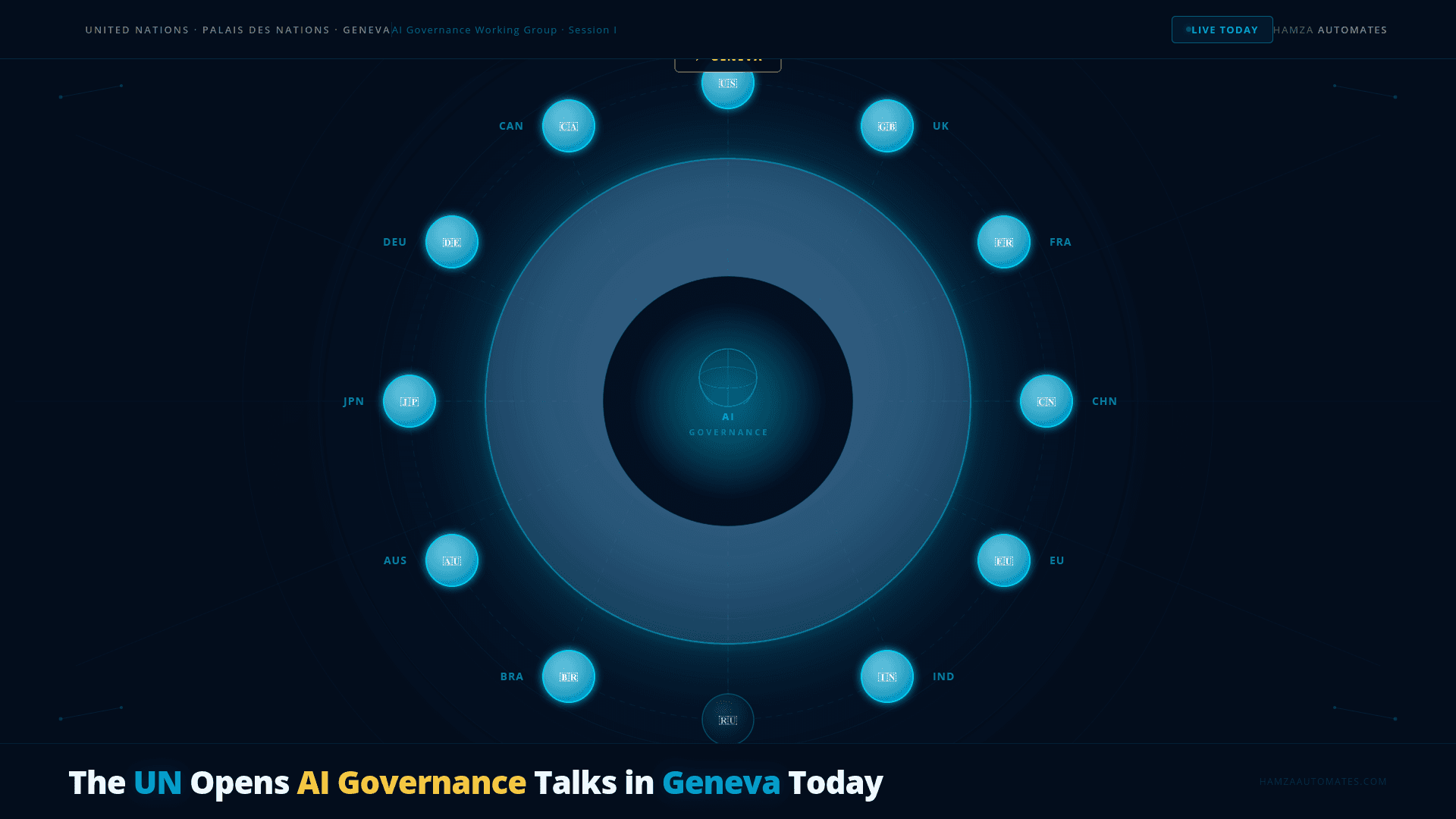
The Geneva UN AI Governance Summit — the multilateral framework context for the UAE chip export reclassification
The Five Eyes AI Agent Security Framework — the governance architecture that addresses jscrambler-class attacks
The Automation Ratio — how Bespoke Labs’ post-training approach improves your production metric directly
You Don’t Need an Agent. You Need a Rule. — the framework for thinking clearly about what automation architecture you actually need
About the Author: Hamza Baig is the founder of Hexona Systems, an AI automation agency serving clients across six continents, and creator of the AI Automation Institute, where over 40,000 entrepreneurs have learned to build and scale automation businesses. He has been featured in GHL Top 50, Yahoo Finance, and Brainz Magazine. Follow him at @hamza_automates | Read more articles | Work with Hamza
About
Hamza Baig is the founder of Hexona Systems—an automation agency and softwareplatform that helps thousands of entrepreneurs and business owners implement AI-powered workflows at scale.