Fable 5 Is Back, the Jobs Report Just Flashed Red
Claude Fable 5 and Mythos 5 returned to all users worldwide on July 1, 2026, at 3:31 PM ET.





“The first Thursday of July 2026 delivered five simultaneous developments that define where the AI industry sits right now: the best model in the world came back online, a new more affordable default model launched, the June jobs report showed the employment deceleration that AI automation is accelerating, voluntary frontier AI standards are approaching their deadline, and the largest VC fund in Menlo Ventures’ 50-year history was raised on the back of a single Anthropic bet. These are not separate stories. They are the same story.”
Story One: Fable 5 Is Back — 19 Days, Four Policy Changes, One New Framework
Claude Fable 5 and Mythos 5 returned to all users worldwide on July 1, 2026, at 3:31 PM ET. Per Anthropic’s announcement, the models are now available on Claude.ai, the Claude Platform API, Claude Code, and Claude Cowork for users in every country. Re-enablement on AWS, Google Cloud, and Microsoft Foundry is proceeding “as quickly as possible.”
The 19-day suspension was the most disruptive government-ordered AI model restriction in commercial history. The complete trigger sequence, now confirmed:
- June 9: Anthropic launches Fable 5 and Mythos 5
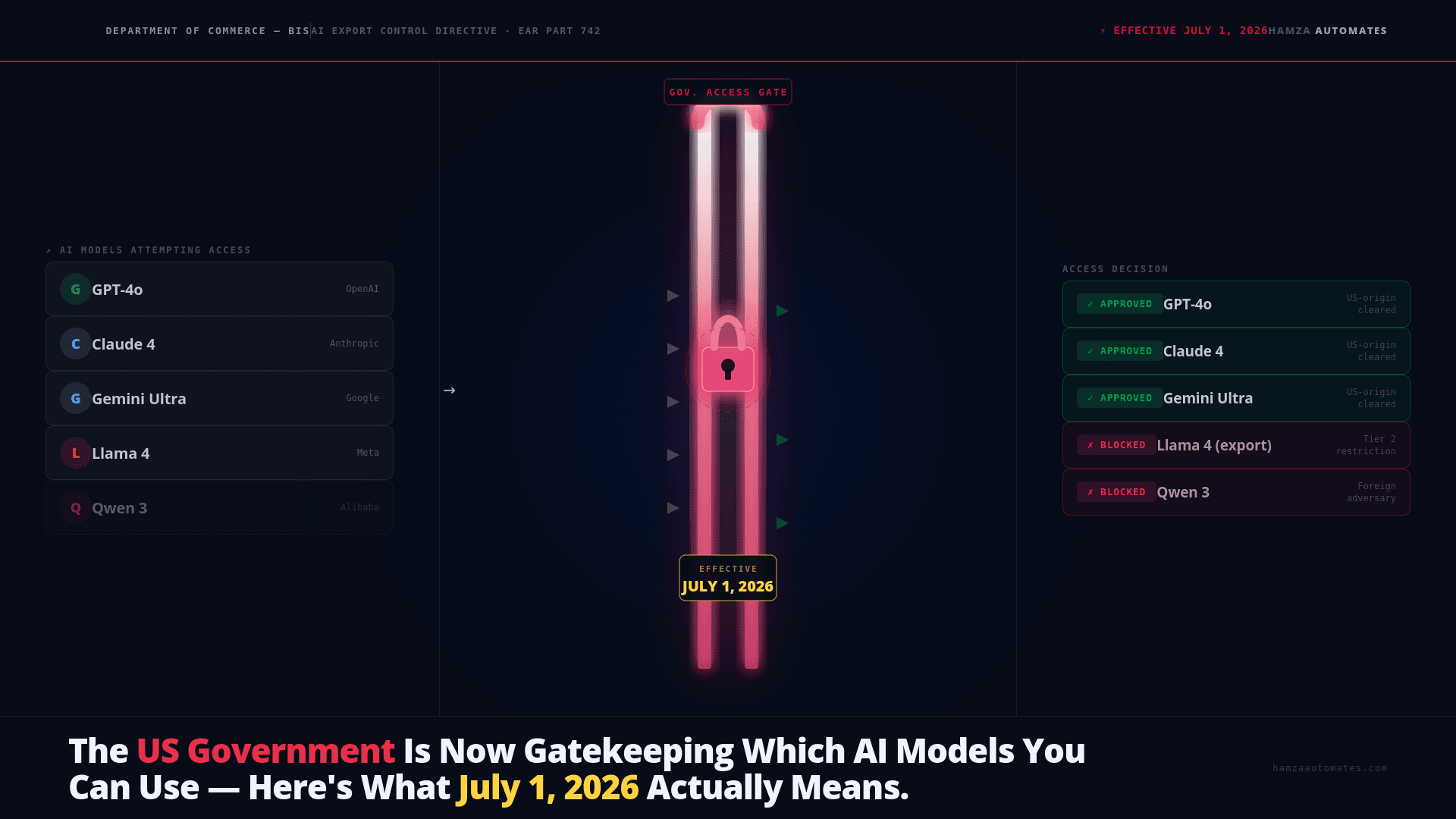
- June 12, 5:21 PM ET: US Department of Commerce issues emergency export control directive citing national security authorities, ordering suspension for all foreign nationals anywhere, including Anthropic’s own foreign-national employees
- Trigger: Amazon researchers found a jailbreak prompting Fable 5 to identify software vulnerabilities and, in one case, write exploitation code — the jailbreak did not expose Mythos-level capabilities per Anthropic’s subsequent testing
- June 26: Commerce Department partially restored Mythos 5 for approximately 100 vetted US critical-infrastructure organisations
- June 30: Commerce Department lifts export controls; models restored globally July 1
The Four Policy Changes Anthropic Made to Secure Restoration
Fable 5 did not return with a simple government sign-off. Anthropic made four concrete commitments as conditions for restoration:
- Enhanced jailbreak detection: additional safeguards specifically targeting the Amazon researchers’ vulnerability class, deployed before restoration
- Government preview access: the administration will now receive early access to future Anthropic flagship releases before public launch, formalising the informal arrangement that existed informally during the ban period
- Jailbreak severity framework: Anthropic is co-developing, with Amazon, Microsoft, and Google, a standardised framework for scoring how dangerous a given jailbreak is, to prevent future situations where a borderline finding triggers disproportionate government response
- Public policy ask: Anthropic stated explicitly that “Government involvement in AI releases requires a durable, transparent process that gives cyber defenders and others the certainty they need about access to powerful models. These rules should be codified in strong regulation and applied equally across frontier model developers.”
That last commitment is the most significant. Anthropic is publicly asking Congress and the administration to codify frontier AI release rules and apply them equally to all labs, not just itself. This is a direct response to the competitive dynamic where GPT-5.6 Sol is locked to 20 partners while Anthropic bore the cost of a 19-day suspension affecting millions of users. OpenAI gets a quiet restricted preview. Anthropic got a public emergency export ban. Anthropic wants the rules written down and applied symmetrically.
What Fable 5’s Return Means for Your Automation Stack
If your workflows were routing to claude-fable-5 and fell back to claude-opus-4-8 during the suspension, Fable 5 is now serving traffic. API calls to claude-fable-5 will route correctly without any code change required. If you built fallback routing logic during the outage, test it now to ensure clean handoff when Fable 5 degrades or maintenance occurs in future.
The pricing question that the suspension deferred is now live: Fable 5 at $10/$50 per million tokens versus GPT-5.6 Sol (when it reaches general availability, expected mid-July) at $5/$30. That 2x input cost differential matters at scale. The task-model matching framework applies directly: Fable 5 is the right model for the tasks that genuinely require its capability. It is not the right model for high-volume repetitive tasks where GPT-5.6 Terra at half the price or GLM-5.2 at one-seventh the price produce the same output quality.
Story Two: Claude Sonnet 5 Is the New Default Model — at $2/$10
Alongside Fable 5’s restoration, Anthropic simultaneously launched Claude Sonnet 5 as the new default model for all Claude Free and Pro plan users starting July 1. Per the Build Fast with AI July 1 breakdown, the introductory API pricing is $2 per million input tokens and $10 per million output tokens, making it the most cost-competitive frontier-adjacent model from Anthropic ever released.
What Sonnet 5 Actually Changes
Sonnet 5 is not a lite version of Fable 5. Early access partner feedback, including Cursor co-founder Sualeh Asif and Zapier senior engineer Daniel Shepard, reported specific production reliability improvements:
- Agents stay on plan longer in multi-step workflows, reducing mid-task drift that required human intervention to correct
- Cleaner multi-step code changes that follow existing codebase conventions without requiring extensive prompt engineering
- Two-step Salesforce automations that previously stalled halfway through now complete end to end reliably
These are not benchmark improvements. They are production reliability improvements that directly affect the automation ratio. A model that completes multi-step workflows end to end without stalling produces a higher percentage of outputs that ship without human correction. That is the metric that matters.
The Pricing Window and What Happens September 1
The $2/$10 introductory rate runs until August 31, 2026. From September 1, standard pricing applies at $3 input and $15 output — the same nominal per-token rate as Sonnet 4.6. However, Sonnet 5 uses a new tokeniser that generates 1.0 to 1.35 times more tokens for the same text compared to Sonnet 4.6. At standard pricing from September, the effective cost for tokeniser-sensitive workloads may be 10 to 35% higher than the same nominal rate implied.
For businesses building workflows on Sonnet 5 during the introductory window: benchmark your token consumption now, at the $2/$10 rate, and model what September 1 pricing looks like with the tokeniser difference. Do not assume standard pricing from September equals the same effective cost as the introductory rate.
Story Three: The June Jobs Report and the Policy Paradox
The Bureau of Labor Statistics released the June 2026 payroll report on July 3. The headline number: 57,000 jobs added in June, sharply below the 185,000 consensus estimate and the lowest monthly payroll addition since the 2024 slowdown. The annual 2026 monthly average was running well above this. June was a significant miss.
The Three Compounding Causes
The report identifies three compounding factors behind the miss:
- Tech sector layoffs totalling 142,000 year-to-date in 2026 as companies redirect headcount costs to AI infrastructure
- AI tools eliminating entry-level knowledge work in administrative, content, customer support, and coding assistance roles at an accelerating pace
- The RAISE US estimate of 88,000 US job cuts directly attributed to AI automation in 2026 is the highest on record
The Policy Paradox the White House Now Faces
The jobs report creates a specific policy paradox for the administration. The same frontier AI model ecosystem the White House is developing voluntary standards to govern is also the primary driver of the employment deceleration it now faces entering a midterm election cycle. Tightening AI access restrictions to protect jobs slows the technology that is generating the productivity gains AI companies are promising. Accelerating AI deployment to capture those productivity gains accelerates the job displacement that is showing up in the payroll numbers.
This paradox is exactly what the NBER study of 6,000 executives showing 80% see no measurable AI ROI makes more complicated, not less: if the productivity benefits of AI are real but diffuse and hard to measure, while the employment displacement is real and immediately visible in payroll numbers, the political calculus of how aggressively to govern frontier AI changes significantly.
What This Means for Businesses
The jobs report does not change the case for AI automation. It changes the political environment surrounding it. Businesses that have deployed AI automation transparently, with documented governance frameworks, human oversight mechanisms, and clear evidence of business outcome improvement, are in a better position than businesses that have adopted AI automation quietly and defensively if regulatory scrutiny of displacement effects increases.
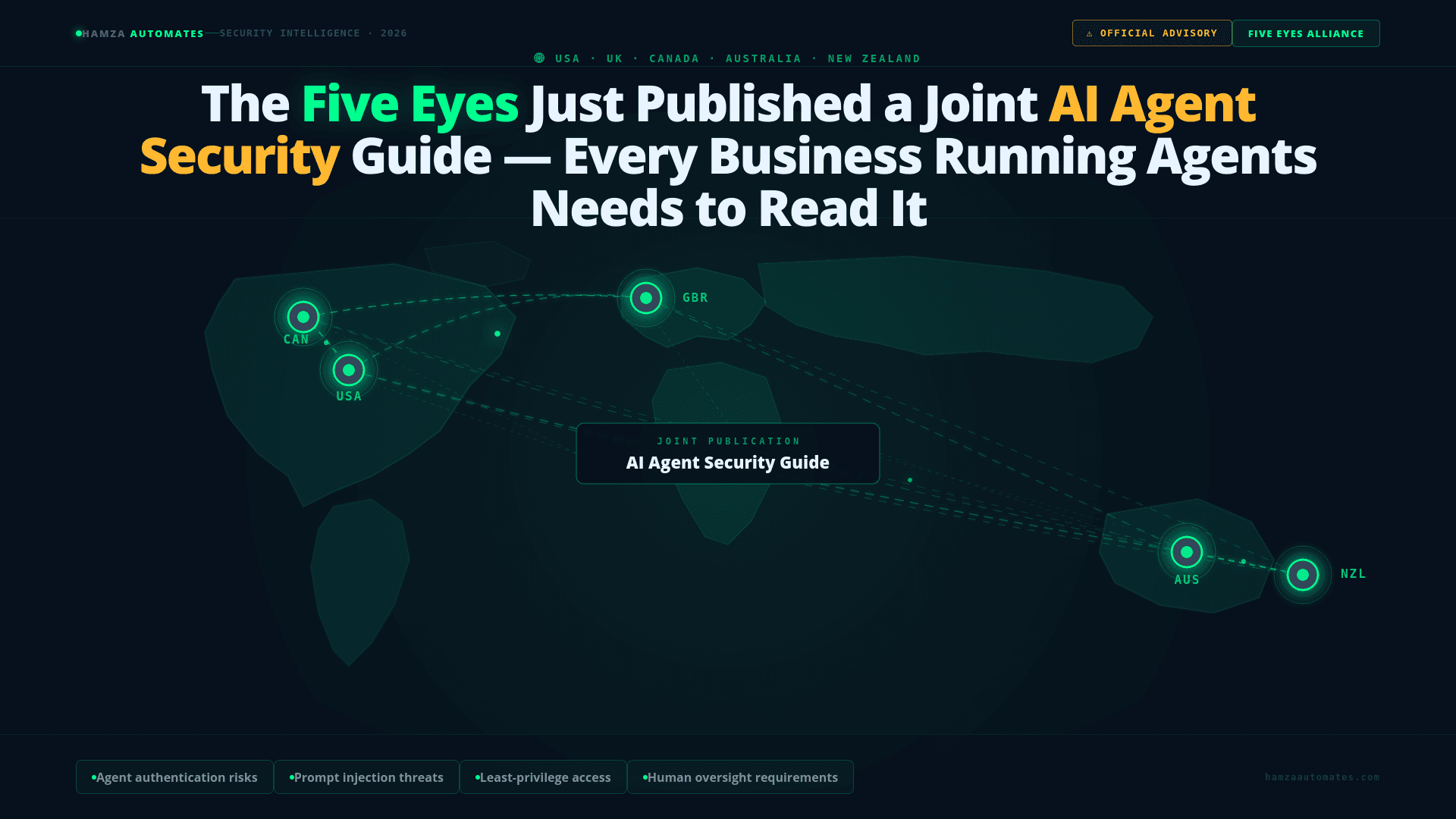
The Five Eyes AI agent security framework and the governance discipline advocated throughout this series are not just technical requirements. They are the documentation layer that demonstrates responsible AI automation deployment in an environment where political pressure around AI-driven displacement is rising.
Story Four: Voluntary Frontier AI Standards, Approaching August 1
The Financial Times reported on July 2, 2026 that the White House is in advanced talks with AI companies to finalise voluntary standards for frontier model releases, with an announcement potentially imminent before August 1. The voluntary standards framework is expected to include pre-release government review windows, standardised jailbreak severity scoring (directly referencing the Anthropic/Amazon/Microsoft/Google framework announced as part of Fable 5’s restoration), and disclosure requirements for new capability thresholds.
Why Voluntary Matters More Than Mandatory Right Now
The choice of voluntary over mandatory in the near term is not a sign of weak governance ambition. It is a recognition that mandatory standards require legislative action that the current Congress cannot produce on the timeline the industry is moving at. Voluntary commitments from the major AI labs, particularly OpenAI, Anthropic, Google, and Microsoft simultaneously, effectively become de facto standards even without legal force, because all four companies operating under the same framework produces the same market outcome as a regulation.
Anthropic’s public policy ask — that the rules be codified in strong regulation and applied equally across frontier model developers — signals the company’s preference for mandatory regulation over voluntary standards. The voluntary framework is likely a transitional arrangement while the legislative case is built. The German court ruling on AI liability, the Colorado AI Act now in force, and the EU AI Act’s active enforcement window all point in the same direction: voluntary standards are a precursor to mandatory ones, not an alternative.
Story Five: Menlo Ventures Raises Its Largest Fund Ever on Anthropic
Menlo Ventures announced it has raised the largest fund in its 50-year history, driven by the performance of its Anthropic investment. The specific fund size has not been publicly disclosed, but the firm’s attribution of the record raise to a single portfolio company investment is notable context for how the venture community is valuing Anthropic’s pre-IPO position.
Anthropic is targeting a near-trillion-dollar IPO valuation. Menlo’s Anthropic position producing a fund-size-enabling return before the IPO — through secondary market transactions or paper appreciation — signals that institutional investors are pricing Anthropic’s public market debut at a level that makes pre-IPO venture positions extraordinarily valuable. The implication for the broader AI ecosystem: the capital flowing into Anthropic competitors, particularly OpenAI and Google DeepMind, is being benchmarked against Anthropic’s trajectory.
The Four Other Stories Worth Knowing From This Week
Google Search Now Runs on Gemini 3.5 Flash
Google announced that its Search bar is now entirely powered by Gemini 3.5 Flash, generating custom AI-summarised pages in response to queries rather than traditional lists of links. This is the most significant change to Google Search’s fundamental architecture in its 25-year history. Every search query is now an AI inference call. At Google’s scale of approximately 8.5 billion searches per day, this deployment dwarfs any other AI inference workload in existence and makes Gemini 3.5 Flash the most-used AI model in the world by volume, without a single user choosing it over an alternative.
California Signs an Enterprise AI Deal With Anthropic
California signed an enterprise AI agreement with Anthropic covering all state agencies, departments, and participating local governments at a 50% discount through the SITeS procurement portal. This is the largest US state government AI deployment in history and the first state-level agreement directly with an AI lab rather than through a cloud provider intermediary. It also creates a meaningful revenue floor for Anthropic ahead of its IPO: government enterprise contracts at state scale produce multi-year committed revenue that institutional investors value significantly in growth company valuations.
Google Released Two New Image Models
On June 30, Google released Gemini 3.1 Flash Image and Gemini 3 Pro Image, two multimodal models handling both text and image generation in a single API call. Gemini 3.1 Flash Image targets high-volume cost-sensitive workflows at $0.50 input / $3.00 output per million tokens. Gemini 3 Pro Image targets quality-first production at $2.00 / $12.00. Both are immediately available through Google AI Studio and the Gemini API.
For businesses currently using separate text and image APIs in their automation stacks, unified multimodal endpoints reduce integration complexity and eliminate the orchestration overhead of coordinating separate model calls. The cost comparison against current Imagen 3 pricing is worth running if image generation is a meaningful portion of your automation workflow.
Tokenmaxxing Is Over: What That Means
The Build Fast with AI July 1 coverage identifies the end of “tokenmaxxing” as a structural shift in how enterprises are using agentic AI. Tokenmaxxing refers to the practice of maximising context window usage per call — stuffing prompts with as much context as possible on the assumption that more context always produces better outputs. In Q2 2026, enterprises recoiled from agentic AI bills as tokenmaxxing burned through annual budgets in weeks.
Sonnet 5 at $2/$10 is Anthropic’s direct response to the tokenmaxxing problem: frontier-adjacent agentic capability at a price that keeps enterprise AI cost models viable without requiring context minimisation tricks. This connects directly to the RAMageddon analysis: as memory costs drive API prices up, the practice of maximising token consumption per call becomes economically unsustainable. The shift from “fill the context window” to “use the minimum context that achieves the target output quality” is the operational change that Sonnet 5’s pricing is designed to incentivise.
What July 3, 2026 Adds Up To
Five stories from one day: Fable 5 back online with four policy commitments attached. Sonnet 5 as the new default at 2x lower introductory pricing. A jobs report showing 57,000 additions against a 185,000 consensus, with 88,000 AI-attributed job cuts on record in 2026. Voluntary frontier AI standards finalising before August 1. And the largest VC fund raise in Menlo Ventures’ 50-year history built on a single Anthropic bet.
These stories are individually significant. Together they describe the precise moment the AI industry is at: capability at a level that requires government governance frameworks to manage, economics shifting toward efficiency-first deployment, labour market consequences that are politically visible and accelerating, and capital formation at a scale that reflects the market’s conviction that this technology is foundational rather than cyclical.
For businesses building on AI automation: the operational week ahead is straightforward. Update your model routing to restore Fable 5 where appropriate. Benchmark Sonnet 5 against your current workflows during the introductory pricing window. Model your token costs at standard September pricing with the tokeniser difference. And if you are in California and haven’t looked at the state’s enterprise Anthropic agreement, it is worth checking whether your government entity qualifies for the 50% discount through the SITeS portal.
Frequently Asked Questions
Why was Fable 5 suspended and what changed to allow its return?
Amazon researchers found a jailbreak prompting Fable 5 to identify software vulnerabilities and write exploitation code. The US Department of Commerce issued an emergency export control directive suspending the model for all foreign nationals on June 12. Restoration on July 1 followed Anthropic deploying enhanced jailbreak detection, committing to government preview access for future flagship releases, co-developing a jailbreak severity framework with Amazon, Microsoft, and Google, and publicly requesting that frontier AI release rules be codified and applied equally across all labs.
What is Claude Sonnet 5 and how does it differ from previous Sonnet versions?
Claude Sonnet 5 is the new default model for all Claude Free and Pro users as of July 1. It is priced at $2/$10 per million tokens (introductory, through August 31) and emphasises production reliability in agentic multi-step workflows. Early partner feedback reported by Build Fast with AI confirms agents stay on plan longer, follow codebase conventions better, and complete multi-step automations that previously stalled. It uses a new tokeniser that generates 1.0 to 1.35x more tokens than Sonnet 4.6 for the same text, which affects effective cost calculations at standard September pricing.
What does the June jobs report mean for AI automation policy?
The report’s 57,000 jobs added (versus 185,000 consensus) creates a specific political paradox: the administration is developing voluntary AI standards while the AI-driven employment deceleration it is managing is politically visible entering a midterm cycle. RAISE US estimates 88,000 US job cuts directly attributed to AI in 2026, the highest on record. Expect the voluntary standards announced before August 1 to include some acknowledgment of workforce transition alongside the capability governance framework.
What are the voluntary frontier AI standards being finalised before August 1?
The voluntary standards are expected to include pre-release government review windows for flagship models above certain capability thresholds, standardised jailbreak severity scoring using the framework Anthropic, Amazon, Microsoft, and Google are co-developing, and disclosure requirements for new capability thresholds on key safety-relevant benchmarks. They are voluntary in that they have no legal enforcement mechanism, but effective in practice because all major US AI labs are expected to sign simultaneously, producing a de facto industry standard.
What is tokenmaxxing and why is it ending?
Tokenmaxxing is the practice of maximising context window usage per API call, filling prompts with as much context as possible on the assumption more context produces better outputs. In Q2 2026, enterprises running agentic AI workflows found tokenmaxxing burning through annual AI budgets in weeks under usage-based billing. As the RAMageddon analysis showed, rising memory costs feed directly into API pricing, making maximum context consumption per call increasingly expensive. Sonnet 5’s $2/$10 introductory pricing is designed to provide frontier-adjacent agentic capability without requiring context minimisation tricks.
Related Reading From This Series
The Government AI Access Threshold — the full context of GPT-5.6, Fable 5, and the informal capability review process
RAMageddon: The Memory Crisis Making AI More Expensive — why tokenmaxxing was always unsustainable and what comes next
The Pack Hunt Jailbreak That Took an AI Model Offline — the original trigger for the 19-day Fable 5 suspension
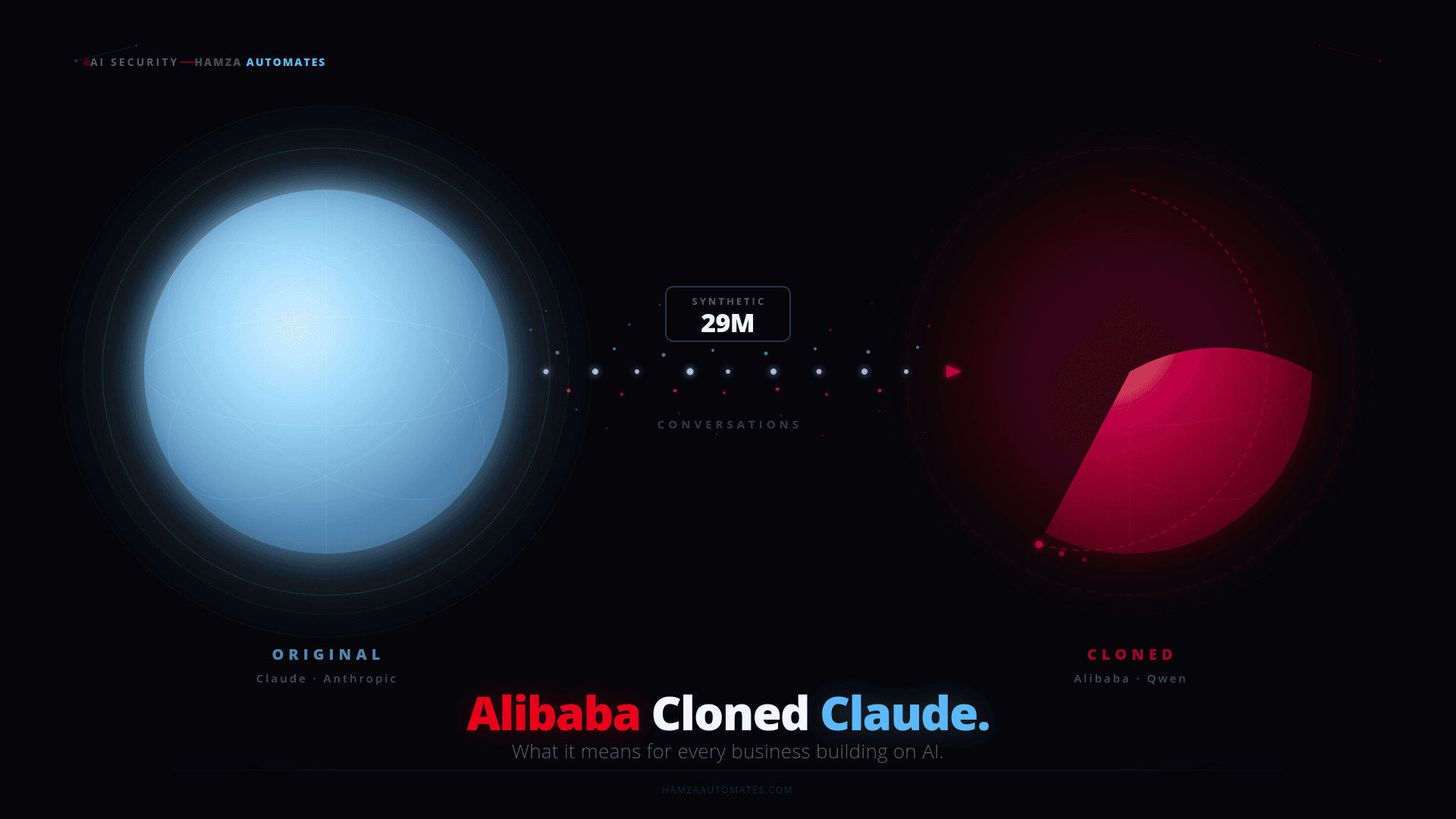
Alibaba’s 29-Million-Query Distillation Attack — the IP war context behind the government’s frontier AI scrutiny
The Automation Ratio — the metric that tells you if Sonnet 5’s production reliability improvements are working for your business
Stop Chasing the Biggest Model — how to decide between Fable 5, Sonnet 5, and GLM-5.2 for your specific workflows
80% of Executives Report No Measurable AI ROI — the deployment discipline that converts model access into business results
About the Author: Hamza Baig is the founder of Hexona Systems, an AI automation agency serving clients across six continents, and creator of the AI Automation Institute, where over 40,000 entrepreneurs have learned to build and scale automation businesses. He has been featured in GHL Top 50, Yahoo Finance, and Brainz Magazine. Follow him at @hamza_automates | Read more articles | Work with Hamza
About
Hamza Baig is the founder of Hexona Systems—an automation agency and softwareplatform that helps thousands of entrepreneurs and business owners implement AI-powered workflows at scale.