The US Government Is Now Gatekeeping Which AI Models You Can Use. Here’s What July 1, 2026 Actually Means.
July 1, 2026 opens what independent AI analysts are calling the most concentrated frontier model release window of the year: GPT-5.6 previewed and locked.





“There is now an informal, undocumented government capability threshold that determines which frontier AI models get released to the public and which get locked to approximately 20 White House-cleared partners. No published methodology. No advance notice to developers. No appeals process. And the businesses that understand this new reality are building very differently from the ones that don’t.”
The Most Concentrated Frontier AI Release Week in History Is Opening Right Now
July 1, 2026 opens what independent AI analysts are calling the most concentrated frontier model release window of the year: GPT-5.6 previewed and locked, Fable 5 partially restored, Gemini 3.5 Pro delayed to July but confirmed for this month. Three flagship models from the three dominant AI labs, all at different access states simultaneously. Understanding what is actually available, what is restricted, and why is now operationally important for any business building automation on these tools.
GPT-5.6: Three Models, an Informal Government Threshold, and Almost No Public Access
What GPT-5.6 Actually Is
OpenAI previewed GPT-5.6 on June 26, 2026 in three tiers. Per the most detailed public breakdown available:
- Sol: OpenAI's strongest model to date. 91.9% on Terminal-Bench 2.1 (Sol Ultra); 88.8% base Sol. Priced at $5 input / $30 output per million tokens — same price as GPT-5.5 with meaningfully better performance. Specialised for long-horizon coding, agentic security workflows, and frontier reasoning.
- Terra: Mid-tier, priced at half of GPT-5.5. Comparable performance to GPT-5.5 at lower cost. OpenAI’s explicit pricing pressure move against Gemini Pro and Claude Sonnet.
- Luna: Cheap-tier at $1 input / $6 output. Competes directly with Gemini 3.5 Flash, Claude Haiku, and DeepSeek V3.5 for high-volume background tasks.
Why It Is Locked to 20 Partners
GPT-5.6 Sol scored 96.7% on OpenAI’s internal Capture the Flag evaluation and crossed the Preparedness Framework’s “High” risk classification for cybersecurity capability. According to TechTimes’ analysis, the US government has applied an informal, undocumented capability threshold based primarily on cybersecurity benchmark performance. Models that cross this threshold are subject to government preview requirements and staged access controls before public release.
OpenAI called the arrangement “unsustainable” publicly, which is the strongest signal yet that the company views permanent per-model government approval as an operational and competitive liability. The company says it does not want this to become the permanent release process. The government has not published the threshold, the methodology, or a timeline for resolving the tension.
When Public Access Is Expected
Based on the Mythos 5 precedent (suspended June 12, partially restored June 27), the realistic public rollout timeline for GPT-5.6 is: early-to-mid July for ChatGPT Plus and Pro subscribers, mid-to-late July for API general availability. Sol Ultra, the higher-capability variant, is expected in August or later. Terra’s pricing pressure is already visible to competitors who can see what is coming even without API access.
Fable 5: Partially Restored, Restrictions Still in Place
A Commerce Department letter on June 26, per ExplainX’s restoration tracker, partially restored Mythos 5 access for approximately 100 US vetted critical-infrastructure organisations on June 27. Fable 5 — the public version of Mythos — remains offline for the general user base as of today, day 19.
The July 8 ID verification rollout via Persona (biometric and government-issued ID confirmation) is widely expected to be the mechanism for restoring Fable 5 access to verified US citizens without requiring the export control directive to be lifted entirely. Axios reported on June 27 that the Trump administration is close to lifting the restriction pending Pentagon and NSA sign-off. Prediction markets currently price full restoration before August 1 at approximately 68 to 71%.
The Pricing Question Fable 5’s Return Will Force
The competitive context Fable 5 returns into has changed significantly since June 12. As the head-to-head comparison analysis shows, Fable 5 at $10 input / $50 output per million tokens is facing GPT-5.6 Sol at $5 / $30 with comparable or stronger benchmark performance on coding. That is a 2x input price gap for a flagship-to-flagship comparison. Anthropic either reprices or Fable 5’s demand softens materially post-restoration. The pricing response from Anthropic is the most commercially consequential thing to watch in July 2026.
Gemini 3.5 Pro: The Only Frontier Model Without Government Access Restrictions
Google’s Gemini 3.5 Pro missed its June general availability target and is now confirmed for July. According to Bind AI’s detailed analysis, limited Vertex AI enterprise preview is live, with general developer access expected in the first two weeks of July.
Why Google’s Model Escaped the Threshold
The reason Gemini 3.5 Pro has not triggered the government’s informal review threshold is measurable. TechTimes’ analysis provides the benchmark comparison: Gemini 3.1 Pro, Google’s current production model, scored 70.7% on Terminal-Bench 2.1. GPT-5.6 Sol scored 88.8% base and 91.9% Sol Ultra. The 18-point gap on the specific benchmark the government appears to be watching explains why Google’s model has not drawn the same scrutiny. Gemini 3.5 Pro, when it launches, is expected to improve on 3.1 Pro but is not projected to close the cybersecurity performance gap that puts Sol in a separate risk category.
What Gemini 3.5 Pro Offers That Nothing Else Does Right Now
The confirmed differentiators for Gemini 3.5 Pro:
- 2,000,000 token context window — double Claude Opus 4.8 and most competitors. Currently no alternative at general availability offers this.
- Deep Think reasoning mode — Google’s equivalent of extended thinking, restricted to Ultra-tier subscribers
- Pricing expected at approximately $1.25-$2.50 input / $10-$15 output per million tokens, significantly lower than Fable 5 at $10 / $50
- No government access restrictions as of today
For developers building workflows that require 1M+ token context, Gemini 3.5 Pro is currently the only planned general-availability option. If your use case requires whole-monorepo analysis, book-length document processing, or multi-session agent state persistence, Gemini 3.5 Pro is the model to watch most closely this month.
The Informal Government Threshold: What No Published Methodology Means in Practice
The most significant structural development in the AI industry right now is not any specific model benchmark. It is the establishment of an informal, undocumented government capability threshold that governs which frontier AI models can be released to the public. As TechTimes’ analysis documents: the US government has not published a formal capability threshold. What exists is an informal, undocumented standard applied by executive agencies with no appeals process, no published methodology, and no advance notice to developers.
What This Means for AI Labs
Every frontier AI lab now faces a decision that did not exist twelve months ago: how do they optimise their model for capability without triggering an informal review threshold they cannot see, appeal, or predict? OpenAI calling the current arrangement “unsustainable” signals that this is already affecting their release planning. If building a more capable model requires a mandatory government preview period with no published timeline for resolution, that changes the incentive calculus for frontier development in ways that are not yet fully visible.
What This Means for Businesses Building on AI
For businesses building automation on frontier AI models, the informal threshold creates a new planning variable that was not in any vendor contract or risk assessment twelve months ago. As argued in the AI agent platform war analysis, the businesses that navigate this correctly are those building with model abstraction layers that allow swapping providers as access conditions change. The government access list for GPT-5.6 Sol currently contains approximately 20 organisations. If your business is not on that list, your workflows need to run on something else until Sol reaches general availability, probably mid-to-late July.
This is the practical application of the portable architecture principle discussed throughout this series, from the Fable 5 export ban coverage to the Alibaba distillation attack analysis: model access is a managed dependency, not a utility. Build accordingly.
What to Actually Build On Right Now
With three flagship models at different access states simultaneously, the clearest practical guidance available breaks down by use case:
- For production coding and agent work today: Claude Fable 5, available for verified users and partially restored for US vetted organisations. SWE-bench Pro leader at 80.3%. Use claude-fable-5 via API where available; fall back to claude-opus-4-8 where it is not.
- For long-context work (1M+ tokens): Gemini 3.5 Pro once it reaches general availability, expected first two weeks of July. Currently only available to Vertex AI enterprise preview customers.
- For high-volume cost-sensitive tasks: Gemini 3.5 Flash at $1.50/$9 per million tokens, or GLM-5.2 at $1.40 per million input tokens with MIT licence. Both generally available today.
- For OpenAI-ecosystem workflows: GPT-5.5 until GPT-5.6 Terra reaches API general availability, expected mid-to-late July. Do not commit to new 12-month contracts before the full GPT-5.6 pricing picture is clear.
- For any production workflow: Build behind a model router, use OpenRouter, Portkey, Helicone, or a thin internal wrapper. The week of July 1 to 7, review the third-party benchmarks for all three flagships and update your routing logic based on actual benchmark data, not pre-release speculation.
OpenAI’s GeneBench-Pro: The AI Science Story Running Underneath the Model Race
Separate from the access drama, OpenAI published GeneBench-Pro today: a research-level benchmark for judging AI agents in computational biology. The headline result is striking — GPT-5.6 Sol scores 31.5% on problems that take human experts 20 to 40 hours each to complete, at an inference cost of several dollars per problem versus thousands of dollars for human expert labour.
At 31.5% solve rate, AI agents are not yet replacing computational biologists. But the cost compression is the signal that matters: a problem worth thousands of dollars of human time costs dollars of AI inference. Even at 31.5% success, the economics of augmenting human researchers with AI agents have crossed a threshold. This pattern — AI at partial accuracy but transformative cost efficiency — is the same one driving adoption in legal research, financial analysis, code review, and document processing.
For businesses outside computational biology: the GeneBench-Pro story is a preview of the automation pattern that will reach your industry. Partial accuracy at transformative cost compression is often the right economic trade-off before full accuracy is achievable. As the automation ratio framework argues, the question is not whether AI is perfect at a task. The question is whether the accuracy level and the cost structure produce better business outcomes than the status quo. For many tasks, 31.5% AI accuracy plus human review costs less and produces better throughput than 100% human effort.
The Bottom Line on July 1, 2026
The first day of Q3 2026 opens with the most complex frontier model access picture in the history of commercial AI. The best coding model (GPT-5.6 Sol) is locked to 20 government-cleared organisations. The model that was best until six weeks ago (Fable 5) is partially restored. The model with the largest context window (Gemini 3.5 Pro) missed its June date and is coming in July. And all three are racing against an informal government capability threshold that no published methodology describes and no appeals process governs.
The businesses that are building correctly in this environment share one characteristic: they are not waiting for the model access situation to stabilise before building. They are building with abstraction layers that make model-swapping a routing decision, not a code rewrite. They are measuring automation performance against business outcomes, not benchmark scores. And they are treating government access restrictions as a structural risk category in their AI vendor dependency analysis, not an edge case that happened once.
Q3 2026 will deliver GPT-5.6 general availability, Gemini 3.5 Pro general availability, and most likely full Fable 5 restoration. It will also deliver the next model family from Anthropic, which is expected to be announced before the IPO. The week of July 1 to 7 is the right moment to review your model routing architecture, update your cost models for the new pricing tiers, and position your automation stack to take advantage of a frontier capability leap when it lands — rather than scrambling to adapt after the fact. The five-step no-code automation workflow guide and the automation ratio framework are the right tools for building that review into your operations this week.
Frequently Asked Questions
What is GPT-5.6 and when can I access it?
GPT-5.6 is OpenAI’s newest flagship, launched in three tiers: Sol (frontier capability, $5/$30 per million tokens), Terra (mid-tier, half GPT-5.5 price), and Luna (cheap-tier, $1/$6). Per OpenAI’s stated timeline, early-to-mid July is the expected window for ChatGPT Plus/Pro subscriber access, with API general availability in mid-to-late July. Sol Ultra, the highest-capability variant, is expected August or later. Access is currently limited to approximately 20 White House-cleared trusted partners under an informal government access arrangement.
Why is GPT-5.6 Sol locked behind government access controls?
Sol scored 96.7% on OpenAI’s internal Capture the Flag cybersecurity evaluation and crossed the Preparedness Framework’s “High” risk classification. The US government applied an informal, undocumented capability threshold — based primarily on cybersecurity benchmark performance — that requires a government preview period before public release. No formal methodology or appeals process exists. OpenAI has publicly called the arrangement “unsustainable.”
When will Gemini 3.5 Pro be generally available?
Google missed its June 2026 general availability target. Gemini 3.5 Pro is confirmed for July 2026, with limited Vertex AI enterprise preview currently live. General developer API access is expected in the first two weeks of July. The model offers a 2-million-token context window — double any currently generally available alternative — and Deep Think reasoning mode for Ultra-tier subscribers.
Has Claude Fable 5 been restored?
Partially. As of June 27, 2026, Mythos 5 was partially restored for approximately 100 vetted US critical-infrastructure organisations via a Commerce Department letter. Fable 5 — the public version — remains offline for general users. The July 8 ID verification rollout via Persona is expected to restore access for verified US citizens. Full general restoration is priced by prediction markets at 68 to 71% probability before August 1.
What should my business use for AI automation right now given the access restrictions?
Build behind a model router (OpenRouter, Portkey, or a thin internal wrapper) and use: Claude Fable 5 where available for coding/agent work; Gemini 3.5 Flash or GLM-5.2 for high-volume cost-sensitive tasks; GPT-5.5 for OpenAI-ecosystem workflows until GPT-5.6 Terra reaches API GA. Do not commit to new 12-month single-vendor contracts before the full Q3 pricing picture is clear. The portable architecture principle covered throughout this series is the structural protection against the access volatility July 2026 is demonstrating.
Related Reading From This Series
The Pack Hunt Jailbreak and Fable 5 Export Ban — the full context behind why Fable 5 went offline
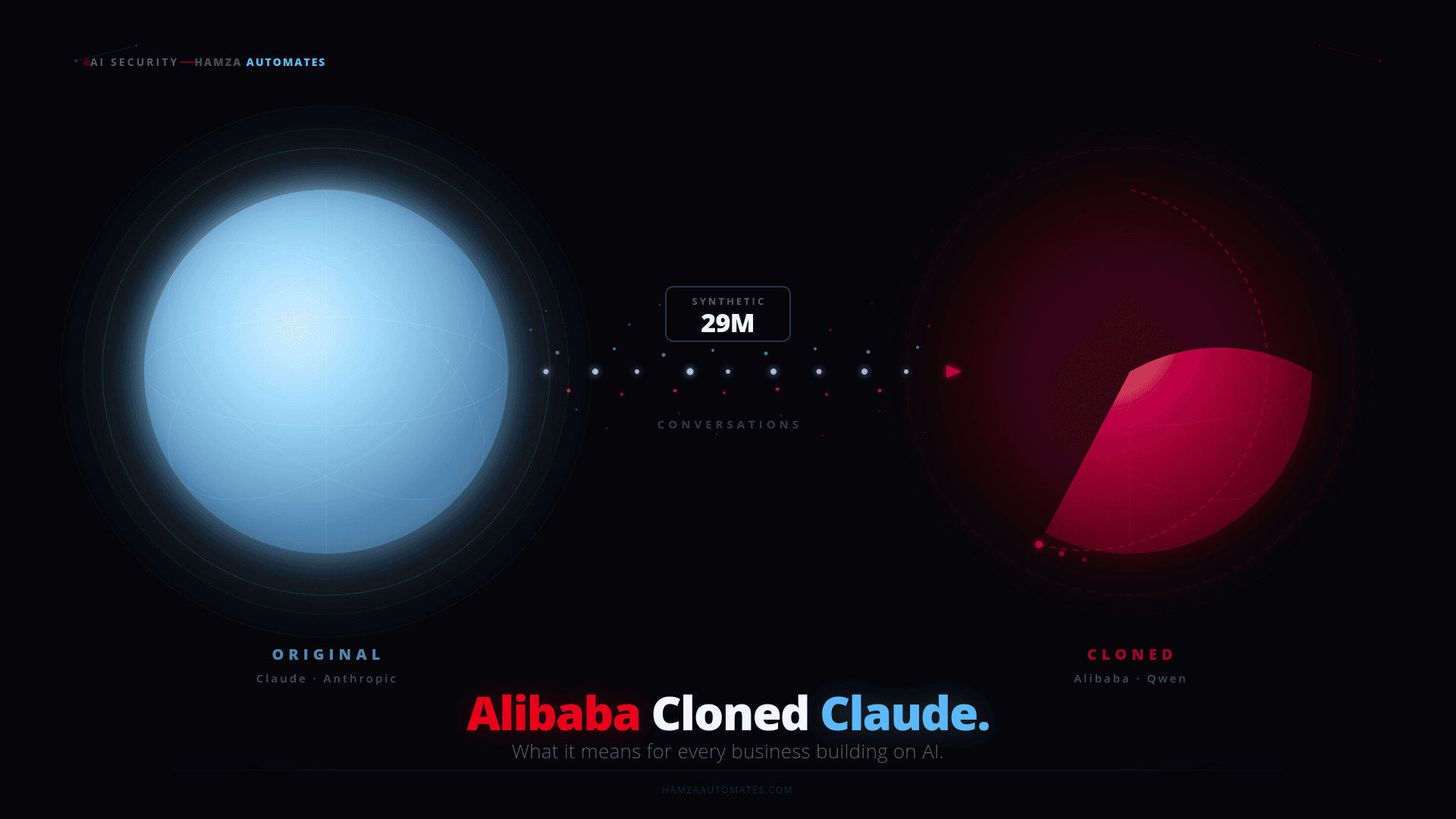
Alibaba’s 29-Million-Query Distillation Attack — how model IP theft connects to access restriction
SpaceX Buys Cursor, ChatGPT Below 50%, Colorado AI Act — the Q2 2026 close and what it signals for Q3
The AI Agent Platform War — why portable architecture matters more than ever
Stop Chasing the Biggest Model — task-model matching in a market where the best model keeps going offline
The Automation Ratio — the only metric that predicts whether your AI investment is compounding
The No-Code Automation Workflow Guide — how to build automation that survives model access changes
About the Author: Hamza Baig is the founder of Hexona Systems, an AI automation agency serving clients across six continents, and creator of the AI Automation Institute, where over 40,000 entrepreneurs have learned to build and scale automation businesses. He has been featured in GHL Top 50, Yahoo Finance, and Brainz Magazine. Follow him at @hamza_automates | Read more articles | Work with Hamza
About
Hamza Baig is the founder of Hexona Systems—an automation agency and softwareplatform that helps thousands of entrepreneurs and business owners implement AI-powered workflows at scale.