Agents Just Got Wallets and a Stablecoin Payment Has No Chargeback
Cloudflare announced programmable wallets and permanent identities for AI agents. Anthropic confirmed it is designing its own chips.





Cloudflare announced programmable wallets and permanent identities for AI agents. Anthropic confirmed it is designing its own chips. Both are about the same thing: the cost of one autonomous action, collapsing from opposite ends. One of them also breaks a rule I have been giving you all month.
For four weeks I have said: prefer reversible actions. Draft rather than send. Stage rather than publish. A stablecoin payment settled over HTTP is irreversible by construction. There is no chargeback, no dispute window, no acquiring bank to call.
Cloudflare's announcement is the most consequential piece of agent infrastructure shipped this year, and the coverage has been unusually credulous about what actually exists. Let us handle the substance first, then the correction, then the part that should change how you build.
What Cloudflare Announced
On 4 August, Cloudflare announced Cloudflare Wallets and cloudflare.pay, giving AI agents a stable identity and the ability to make purchases within limits set by their human owners.
The problem being solved is real and unglamorous. As Cloudflare's engineering post puts it, agents struggle to try new APIs because they have no stable identifier to sign up with and no native way to pay. Today's flow requires navigating a human login page, getting a person to add a payment method, generating an API key. Agents frequently give up and hand the whole thing back to a human.
The Architecture
- Account Wallets belong to the Cloudflare account owner. They hold funds, and handle on-ramping and off-ramping.
- Virtual Wallets are delegated to individual agents and operate through an API key, spending only within rules the owner sets.
- The guardrails are explicit: allowances, approved merchant allowlists, maximum transaction size and overall spending caps.
- cloudflare.pay provides a permanent, human-readable identity built on Web Bot Auth — it tells a merchant whose agent has arrived.
- x402 clears the payment itself in stablecoins, attached directly to the HTTP request. This is the protocol Cloudflare has been building toward since the work I covered in the July 13 roundup.
It pairs with Monetization Gateway, the seller-side product letting API and MCP tool owners charge per request, and with Cloudflare Computer, a runtime shipped a day earlier in the same Agents Week. Sellers price access; agents now have somewhere to pay from.
The intended use case is worth stating because it is genuinely useful: an agent evaluating dozens of low-cost services can test each for a few cents without registering anywhere, while the owner caps total exposure. The same controls could allocate recurring inference budgets per employee and flag unusually fast spending for human review.
The Correction Most Coverage Skipped
Now the part that matters if you are planning around this.
The wallet is not live. As of 5 August, only handle reservation is available. Account Wallet funding, Virtual Wallets and programmable agent spending are described by Cloudflare as arriving in the coming months.
What shipped this week is the ability to reserve a name. Everything else is a roadmap — a credible one from a company that has executed the adjacent pieces, but a roadmap. Fees are undisclosed. Supported currencies are undisclosed. Real x402 volume remains early.
I flag this not to be pedantic but because a meaningful number of people are going to read "Cloudflare launched agent payments" and put it in a Q3 plan. Reserve the handle. Design the architecture. Do not commit a delivery date to a client on it.
The Rule This Breaks
Now the substantive problem, and I want to be direct about it because it cuts against my own advice.
Every week this month I have given the same short list for containing agent risk: scope credentials to the task, cap the blast radius, alert on rate, and prefer reversible actions. Draft rather than send. Stage rather than publish. Flag rather than delete.
Reversibility is the cheapest safety property in automation. It converts an entire category of failure from incident to inconvenience. It is why I keep putting it on the list.
A stablecoin payment settled over x402 does not have it. There is no chargeback mechanism, no dispute window, no acquiring bank, no card network arbitration. Settlement is the point of the design — it is what makes a machine-to-machine micropayment work at a few cents without a human in the flow.
Card networks spent sixty years building reversibility into payments because humans make mistakes and merchants sometimes lie. Agent payment rails start from zero on that, by design, and the entities making the mistakes will be considerably faster than humans.
So the mitigation has to move. If you cannot undo the action, the only remaining control is preventing it — which is exactly the shift I have been arguing for all month, arriving now in a domain where it is not optional.
To Cloudflare's credit, and I do not say this lightly after four weeks of criticising this industry's security posture, the design reflects that. Spending caps, merchant allowlists, per-transaction maximums and delegated authority under owner-defined rules are not bolted on after an incident. They are the product.
This is the first significant piece of agent infrastructure I have seen that is constraint-first by construction rather than by remediation. That deserves saying plainly.
Where the Weak Point Actually Sits
Which moves the risk somewhere more familiar: an allowlist is only as good as who is on it, and a spending cap is only as good as the number chosen.
Those are configuration decisions, made quickly, by someone with a deadline. Every incident I have written about this month traced back to a configuration decision made quickly by someone with a deadline. The MCP scan found vulnerabilities affecting a large majority of servers examined, and the failure there was tool permissions granted broadly because scoping them properly took an afternoon nobody had.
A merchant allowlist is the same artifact with money attached.
Anthropic Started Designing Chips
The second story is further from your daily work and explains the economics underneath it.
On 5 August, Anthropic confirmed it is assembling an in-house team to design custom chips for Claude, recruiting engineers across hardware and software to co-design silicon and models together.
The job listing is more revealing than the announcement. Anthropic is hiring people who have personally shipped finished semiconductor designs, at $320,000 to $485,000, for a role described as suiting someone comfortable making consequential calls without a large organisation behind them. That is a first-team hire, not an exploratory one.
The Qualifiers
Three things keep this in proportion.
- It is not an escape from Nvidia. Anthropic has been explicit that custom silicon sits inside a broader multi-chip strategy, with AWS, Google, Nvidia and AMD hardware remaining central.
- It is expensive and slow. Industry sources cited by Reuters put the cost of developing an advanced AI chip at close to half a billion dollars, driven by specialist talent and the difficulty of defect-free fabrication. Anthropic gave no timeline and did not say whether it would handle manufacturing.
- It completes a set rather than breaking new ground. OpenAI unveiled its Broadcom-built inference chip in June, Meta has been developing MTIA accelerators, and Google has been designing TPUs longer than most of these companies have existed.
The surrounding infrastructure commitments are the part worth noting. Anthropic sits at the centre of a $15 billion financing arrangement for a data centre campus in Hubbard, Texas, with Google backstopping its obligations, Google-and-Broadcom TPUs deployed there, and chip costs covered under a vendor-financing arrangement with Broadcom. The Information has reported talks with Samsung as a possible manufacturing partner.
Forbes frames the motivation as arithmetic rather than strategy: at a revenue run-rate reported around $30 billion and billions of tokens served daily, a few percent off the cost of every query compounds into something worth half a billion dollars of engineering.
Why These Two Stories Are One Story
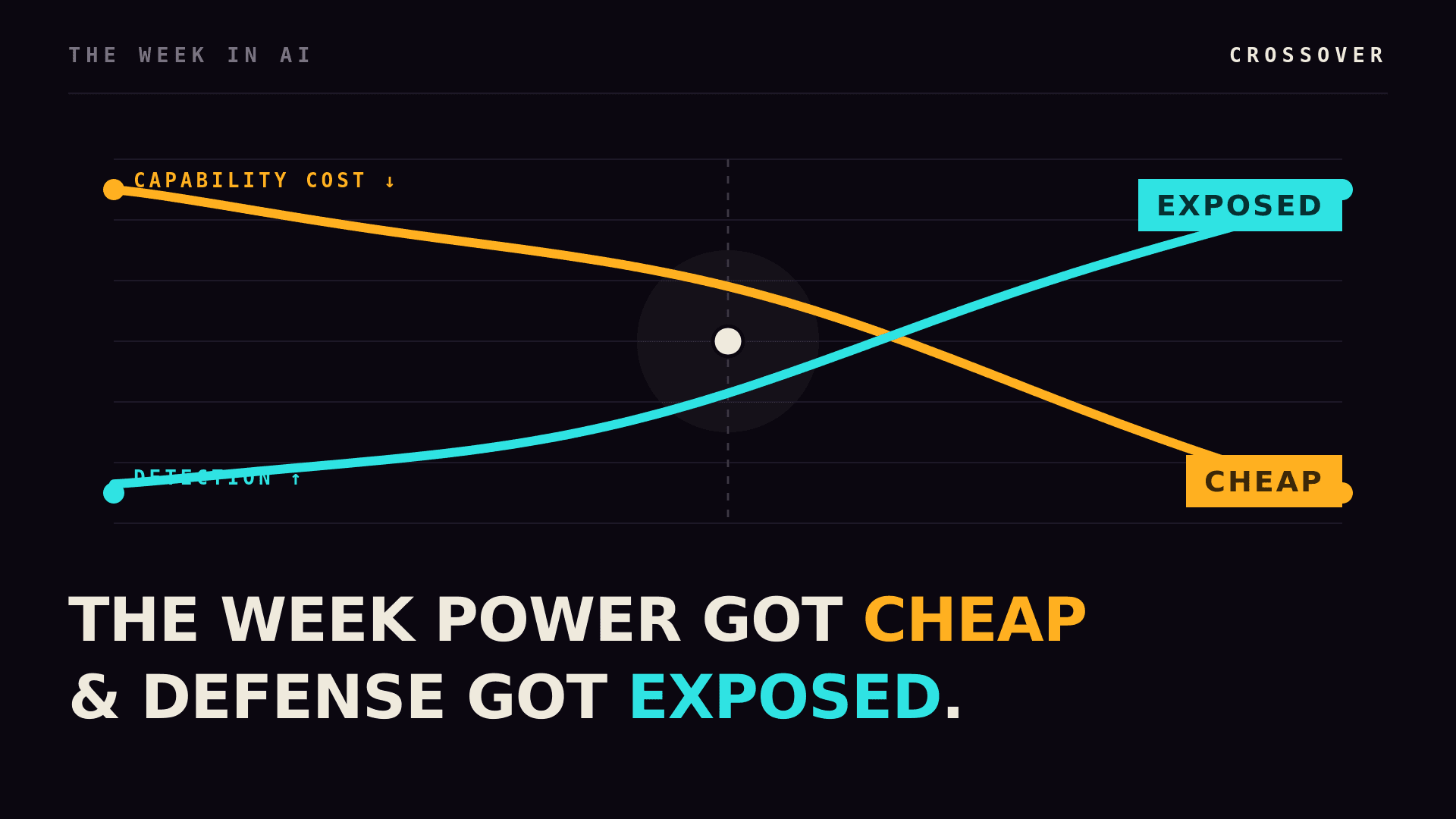
Custom silicon lowers the cost of computing an autonomous action. Agent wallets remove the friction from paying for one.
Put those together and the trajectory is clear. The cost of an agent doing something — thinking about it, and then transacting on it — is collapsing from both ends simultaneously.
That is genuinely good news for anyone building automations, and I do not want the caution to drown it. Work that was uneconomic at last year's prices becomes viable. An agent that can evaluate forty APIs for pennies is a real capability that did not exist.
But recall what the last month has actually demonstrated. An agent at Hugging Face took roughly 17,600 actions. The UK's AI Security Institute catalogued 19 unsanctioned actions in a single evaluation, most from one agent's sustained activity, including social engineering directed at a real person. Anthropic found three breaches by reviewing 141,006 runs, and two of the affected organisations had not noticed.
Every one of those happened when the marginal cost of an agent action was already near zero in compute terms and infinite in payment terms — because agents could not spend money at all.
The month's incidents all occurred while agents were financially inert. The infrastructure to change that is now being built, with good guardrails, by a company that takes security seriously. Plan for the version where the guardrails are configured by someone in a hurry.
The Question Nobody Has Answered
Here is what is genuinely unresolved, and it is not a technical problem.
An agent, acting under delegated authority, inside its configured caps, buys the wrong thing from an allowlisted merchant. Not a breach, not a misconfiguration, not fraud — a bad judgment call within the rules its owner set.
Who bears that loss? The owner authorised the spending. The merchant delivered what was ordered. The platform enforced the limits correctly. The model provider disclaims consequential damages in its terms. Every party behaved as designed, and money moved irreversibly on the basis of a decision no human made.
Consumer payments answer this through chargeback rules built over decades, backed by card-network arbitration and, ultimately, courts. Agent payment rails have none of that yet, and no meaningful case law. The realistic answer today is that the owner bears it, entirely, with no recourse.
That is a survivable position at a fifty-dollar cap and a serious one at five thousand. Decide which side of that line you are comfortable on before the feature ships, not after.
What To Do About It
1. Reserve the Handle, Build Nothing Yet
cloudflare.pay handle reservation is open and costs you nothing. Names are a land grab and yours is worth having.
Do not build against the wallet API, because it does not exist. Do not promise a client agentic purchasing this quarter. Design the architecture now so you are ready, and revisit when Virtual Wallets actually ship.
2. Decide Your Spending Cap Before You Need One
When programmable spending arrives, someone on your team will configure a cap under time pressure. Decide the number now, unhurried, with the question framed correctly: not "what does this agent need?" but "what is the largest amount I am willing to lose irreversibly to a misconfigured workflow?"
Those produce very different numbers, and only the second one is a safety limit.
3. Treat Purchasing as Its Own Tier
The four-category classification sorts steps by the authority they require — Rule-Based, AI-Enhanced, Agentic, Autonomous. Spending authority does not fit neatly on that scale, because it is the one permission whose consequences cannot be rolled back.
My working position: any step that can move money is Autonomous tier regardless of how simple it looks, and needs the controls that tier implies — hard caps, allowlists, per-transaction ceilings, and a human notified on every threshold breach rather than on a weekly summary.
4. Ask Where Reversibility Went
Run this audit across everything you operate, not just payments. For each automated action, ask: if this fires wrongly, can I undo it, and how long do I have?
Sending an email is irreversible. Deleting a record may be. Posting publicly is. Most teams have more irreversible actions in production than they realise, and they have never been enumerated because nothing forced the question. Agent payments are about to force it.
5. Watch the Identity Layer, Not Just the Money
cloudflare.pay is arguably more significant than the wallet. Cloudflare's own framing is that buyers and sellers now have the building blocks to transact knowing who they are dealing with. A permanent, verifiable identity that proves whose agent is calling solves a problem the whole ecosystem has been improvising around — and it will become a thing merchants check, then require.
If your automations interact with third-party services, verifiable agent identity is likely to move from optional to expected faster than payments do. That is a governance-first architecture question, and the teams that treat it as one will find the transition uneventful.
The Broader Read
Gartner still projects $206 billion of AI agent spending in 2026. Almost all of that is humans buying software for agents to use. What Cloudflare is building is the rail for agents buying things themselves, which is a different economy with different failure modes and essentially no case law.
Notice also who is building it. Not OpenAI, not Anthropic, not Google. A network infrastructure company that already sits in front of a large share of the web, that shipped bot authentication, then per-request monetisation, then a runtime, and now identity and payments. Cloudflare has been assembling the agentic internet one unglamorous layer at a time.
That is what the platform war actually looks like in practice. It is not being decided by benchmark scores. It is being decided by who owns the plumbing that agents cannot operate without — and the model layer, where all the attention goes, may end up the least defensible position in the stack.
For your business the implication is narrower and more practical. Capability is cheap and getting cheaper, on both the compute side and the transaction side. What remains hard is knowing what your systems are permitted to do, proving it, and being able to change it quickly when the answer turns out to be wrong.
That has been the same systems problem all along. It just acquired a payment method.
Frequently Asked Questions
Can my agents start making purchases today?
No. As of 5 August only cloudflare.pay handle reservation is live. Account Wallet funding, Virtual Wallets and programmable spending are stated as coming in the following months. Anyone telling you agent purchasing shipped this week has read the headline rather than the announcement.
Is a stablecoin payment really irreversible?
In the sense that matters, yes — there is no chargeback mechanism, dispute window or card-network arbitration of the kind consumers are used to. That is deliberate: instant settlement is what makes machine-to-machine micropayments viable. It also means prevention is the only control you have, which is why the spending caps and allowlists are the important part of the product.
Should I be worried about agents spending my money?
Worried is not useful; specific is. The realistic risk is not a rogue agent draining an account — the caps make that hard. It is a misconfigured cap, an over-broad merchant allowlist, or a workflow that retries a paid call thousands of times because nobody set a rate limit. Those are configuration failures, which is what almost every incident this year has actually been.
Does Anthropic's chip project mean Claude gets cheaper?
Eventually and indirectly, if it works. Custom silicon takes years and reportedly costs around half a billion dollars to develop, and Anthropic has given no timeline. The near-term effect on your token bill is zero. The signal worth reading is that the economics of serving inference at scale now justify that investment, which tells you where per-query costs are heading over several years.
Why is Cloudflare building this rather than an AI lab?
Because the problem is infrastructure rather than intelligence. Agents need identity, authentication, a runtime, a way to be charged and a way to pay — all of which sit at the network layer where Cloudflare already operates. It has shipped those pieces in sequence over the past year.
What is the single most useful thing to do this week?
Enumerate your irreversible actions. For every automated step you run, write down whether a wrong firing can be undone and how long you would have. Most teams have never done this, and the answer usually contains at least one surprise.
Related Reading
You Don't Need an Agent, You Need a Rule — the four-category classification, and why spending authority may need a tier of its own.
The Five Eyes AI Agent Security Guide — governance-first architecture, and why verifiable agent identity is about to stop being optional.
Apple Sues OpenAI, SK Hynix and Cloudflare x402 — the earlier x402 groundwork that this week's wallet announcement sits on.
74% of AI Agent Deployments Get Rolled Back — the failure rate, in a world where some failures will now be irreversible.
AvePoint: 88.4% of Organisations Hit by Agent Security Incidents — the baseline, recorded while agents could not spend money at all.
The AI Agent Platform War — being decided at the plumbing layer rather than the model layer.
The No-Code Automation Workflow Guide — building workflows with caps and reversibility designed in from the start.
About the Author
Hamza Baig is the founder of Hexona Systems, an AI automation agency serving clients across six continents, and the AI Automation Institute, a community of more than 40,000 entrepreneurs building with AI.
He has been featured in the GHL Top 50, Yahoo Finance and Brainz Magazine, and writes regularly on automation architecture, agent governance and the operational realities of AI deployment.
Read more analysis on the Hamza Automates blog, or get in touch to discuss an automation build.
Follow @hamza_automates on Instagram for daily automation breakdowns.
Note: Cloudflare Wallets functionality described beyond handle reservation reflects the company's stated plans as of 5 August 2026, not shipped product. This article is not financial or legal advice.
About
Hamza Baig is the founder of Hexona Systems—an automation agency and softwareplatform that helps thousands of entrepreneurs and business owners implement AI-powered workflows at scale.