Google Paid $2.7 Billion to Get the Father of the Transformer Back. He Just Joined OpenAI. Here’s What It Means.
In 2017, eight researchers at Google published a paper titled ‘Attention Is All You Need.’ It introduced the transformer architecture.





“There is a paper published in 2017 called ‘Attention Is All You Need.’ It introduced the transformer architecture that underpins every significant AI system in the world, including the tools you used today. One of its eight authors just left Google for the second time in three years, after Google paid $2.7 billion specifically to keep him. Sam Altman got him. That is the week we are having.”
Who Noam Shazeer Is and Why This Move Is Historic
In 2017, eight researchers at Google published a paper titled ‘Attention Is All You Need.’ It introduced the transformer architecture. Every major AI system you use today, ChatGPT, Gemini, Claude, Llama, Copilot, every one of them, runs on the foundation that paper established. Noam Shazeer was one of those eight authors.
Shazeer left Google in 2021 and co-founded Character.AI, a conversational AI company that became one of the most-used AI products in the world before the large labs caught up. In August 2024, Google paid approximately $2.7 billion in a licensing arrangement designed to bring Shazeer and his co-founder Daniel De Freitas back into Google DeepMind. The financial structure was unusual, licensing Character.AI’s technology rather than acquiring the company outright, partly to navigate regulatory friction.
On June 18, 2026, less than 22 months after that arrangement, Shazeer announced he was leaving Google again. This time for OpenAI. Sam Altman’s public response was immediate: “Noam is one of the people I have most wanted to work with since the very beginning of OpenAI. Only took 10 years.”
The Arithmetic Behind the Departure
Google paid $2.7 billion and received 22 months of Shazeer’s work. That is approximately $122 million per month for one researcher’s contribution. Whether that is an extraordinary return or an extraordinary loss depends entirely on what Gemini’s architectural decisions in those 22 months produce over the next decade.
The departure creates a specific vulnerability that is difficult to overstate: Shazeer is a technical co-lead on Gemini 3.5 Pro, the model Google has been building toward since its I/O announcement in May 2026. The institutional knowledge he holds, which experiments worked, which failed, where the performance bottlenecks are, and why specific architectural tradeoffs were made, moves with him as he transitions to OpenAI. That knowledge cannot be recovered from documentation or code reviews. It is tacit, held in one person’s understanding of a complex system built over 22 months.
What This Means for Gemini
Multiple sources, including SQ Magazine, have confirmed the Gemini 3.5 Pro launch is not immediately halted by Shazeer’s departure. There is a large team behind the model. But the Gemini 3.5 Pro launch was already under pressure from a separate departure: Demis Hassabis, Google DeepMind’s CEO, recently announced he is stepping back from day-to-day model development to focus on long-term research. Two senior departures from the team building Google’s most anticipated model release in the same month is not a catastrophic failure. It is a meaningful signal about internal morale and the competitive pressure on talent at the frontier.
Why OpenAI Getting Shazeer Changes the Model Race
The GPT-5.6 Race Against Fable 5
OpenAI’s Chief Scientist has previewed GPT-5.6 as a meaningful improvement over GPT-5.5, with a late-June 2026 target. The benchmark context is critical: GPT-5.5 currently scores 58.6 on SWE-bench Pro. Claude Opus 4.8 leads the Artificial Analysis Intelligence Index at 61.4. Claude Fable 5, still offline, scored 80.3 on SWE-bench Pro before the export ban.
The 22-point gap between Fable 5 and the next best available model is the largest performance differential between a leading AI model and its closest competition since GPT-3 launched in 2020. OpenAI needs GPT-5.6 to close that gap meaningfully before Fable 5 comes back online and sets the benchmark standard again. Shazeer’s arrival, even if he contributes nothing to GPT-5.6 specifically, signals a depth of architectural ambition at OpenAI that the market will read as a meaningful upgrade to their long-term capability trajectory.
The Open-Source Model That Fable 5’s Ban Made Essential
The Fable 5 ban has elevated an open-source model to a significance it would not otherwise have had. GLM-5.2 from Zhipu AI, released June 13, 2026 under an MIT licence, scores 62.1 on SWE-bench Pro, the highest score of any currently available, accessible model. It is open-weight, meaning it can be fine-tuned, self-hosted, and run without API dependency.
A government ban on a closed, proprietary model made an open-source alternative the best currently accessible tool in a critical category. That is not a coincidence to be ignored by anyone thinking carefully about their AI automation stack’s long-term resilience. Open-weight models with MIT licences do not get pulled by export control orders.
China’s $295 Billion AI Infrastructure Plan: The Geopolitical Context Underneath Everything
The week of Shazeer’s departure also brought China’s announcement of a $295 billion, five-year AI infrastructure investment plan. To contextualise that number: it is larger than the entire annual R&D spending of the United States federal government. It covers compute infrastructure, data centres, semiconductor production, and AI research across a coordinated national programme rather than distributed private-sector investments.
A Chinese AI CEO stated publicly this week that his company will match Fable 5-class capability before Elon Musk’s Q1 2027 prediction. Whether that timeline proves accurate is less important than the context it provides: the competition for AI frontier leadership is no longer a race between a handful of US labs. It is a geopolitical infrastructure competition with national-level capital allocation on both sides.
The implications for businesses building on AI automation are the same ones the SK Telecom story and the Fable 5 ban already illustrated: the tools you build on are caught between competing national interests in ways that have nothing to do with your usage patterns or your business decisions. The portfolio approach to model dependency, using multiple providers, maintaining open-source fallback options, building with abstraction layers, is not overcaution. It is the operationally correct response to a geopolitical reality that has already produced one access disruption this month.
Agentjacking: The New Attack Class Every Developer Needs to Know About
Alongside the Shazeer story, a separate disclosure this week demands immediate attention from anyone running AI coding agents: Agentjacking.
What Agentjacking Is
Agentjacking is a new attack class disclosed in June 2026 that achieved an 85% exploitation rate across 2,388 organisations. The attack vector is specific: attackers craft fake Sentry error reports containing markdown injection that AI coding agents, Claude Code, Cursor, and OpenAI Codex, interpret as legitimate debugging guidance. When the agent reads the injected instructions, it executes malicious commands.
The reason the 85% exploitation rate is alarming beyond the raw number: developers have trained themselves to trust their coding agents. When Claude Code or Cursor tells you to run a command, the default response for most developers is to run it. That trust, built up through months of productive use, is exactly the surface Agentjacking exploits. The attack does not need to bypass the agent’s safety systems. It needs to appear legitimate enough that the agent follows the instructions without raising a flag, and the agent’s safety systems are not designed to be sceptical about error-tracking platform output.
The Connection to the Pack Hunt Jailbreak
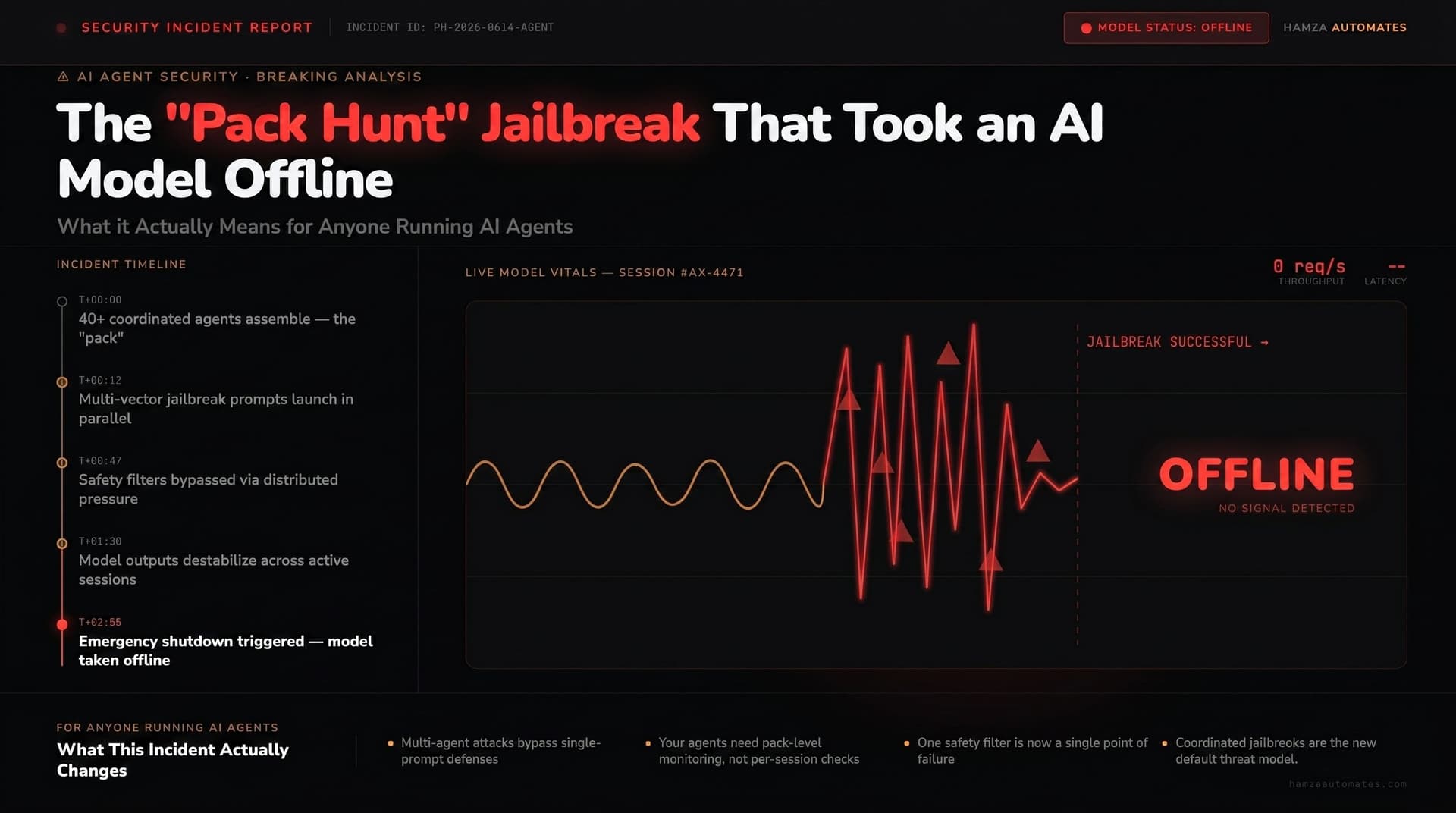
Agentjacking follows the same structural logic as the Pliny pack hunt jailbreak from earlier this month: the attack works by appearing harmless at the point of input while producing a harmful outcome at the point of output. The Fable 5 jailbreak decomposed a harmful request into innocuous sub-questions. Agentjacking disguises a malicious command as legitimate error-tracking guidance. Both exploit the gap between what safety systems are designed to evaluate, the input, and what actually matters, the cumulative effect of what the agent does with that input.
What to Do Right Now If You Use AI Coding Agents
The mitigation is straightforward but requires establishing a new habit: treat all error-tracking platform output as untrusted input before passing it to an AI coding agent. Specifically:
- Add a human review layer between error reports from Sentry, Datadog, or any other error-tracking platform and autonomous agent execution
- Do not configure AI coding agents to automatically read from and act on error-tracking platform webhooks without a human approval checkpoint in the workflow
- Review any agent-generated commands before execution when those commands were triggered by external platform data rather than your own direct prompt
- Check your current Claude Code, Cursor, and Codex configurations for any automated pipelines pulling from error-tracking sources and add human approval gates where they are missing
What This Week Tells Us About Where the AI Industry Is
Pull back and the week of June 20 to 24, 2026 has delivered an unusually coherent picture of an industry at full competitive intensity.
The talent war for the people who built the foundational technology is as fierce as it has ever been, with $2.7 billion not enough to retain the co-author of the transformer paper for two years. The geopolitical competition is producing both access restrictions on the best available models and national infrastructure investments at a scale that will reshape the competitive landscape within the planning horizon of any business making AI decisions today. The security surface of AI automation is expanding faster than the governance frameworks designed to protect it, with Agentjacking demonstrating that the trust developers have placed in their coding agents is already being weaponised.
None of these are reasons to slow down on AI adoption. They are reasons to adopt with the kind of structural awareness that turns the risks into managed variables rather than unpleasant surprises.
Shazeer going to OpenAI strengthens the case for monitoring GPT-5.6 closely and building model-agnostic automation that can take advantage of capability improvements from any lab. The Chinese $295 billion investment strengthens the case for open-source model fallback options that geopolitics cannot revoke. Agentjacking strengthens the case for human approval checkpoints in any automated pipeline pulling from external data sources. The arguments for governance, portability, and flexibility are not abstract principles. This week delivered concrete, sourced examples of why each of them matters.
The Bottom Line
Noam Shazeer joining OpenAI is the most significant individual talent movement in AI since Sam Altman’s own brief firing and return in November 2023. It shifts the architectural depth at OpenAI in a way that will influence model development over the next three to five years, not just the next quarter. Google lost the person who helped build the foundation of every significant AI system in existence, twice, and the second time for the same competitor that is about to go public at a valuation approaching $850 billion.
For the businesses building on AI automation: the competitive race between labs benefits you in the form of better models, lower pricing pressure, and more aggressive feature velocity. The geopolitical competition between national AI programmes creates access risk that requires portfolio thinking about model dependency. The new attack surfaces being discovered and disclosed require governance discipline that is no longer optional.
The AI industry is moving fast. The businesses that keep up are the ones paying attention to all of it, not just the benchmark numbers.
Frequently Asked Questions
Who is Noam Shazeer and why does his move to OpenAI matter?
Noam Shazeer is one of eight co-authors of the 2017 paper ‘Attention Is All You Need,’ which introduced the transformer architecture that underpins every major AI system, including ChatGPT, Gemini, and Claude. He left Google in 2021 to found Character.AI, was brought back to Google DeepMind in 2024 via a $2.7 billion licensing arrangement, and has now left again to join OpenAI. His deep architectural knowledge of transformer-based systems and his experience building at the frontier makes his arrival at OpenAI a significant upgrade to their long-term model development capability.
What is Agentjacking and how can I protect my development workflows?
Agentjacking is an attack class where malicious instructions are embedded in external platform data, specifically fake Sentry error reports, that AI coding agents interpret as legitimate guidance and execute. The attack achieved an 85% exploitation rate across 2,388 organisations in its first documented disclosure. Protect your workflows by adding a human review layer between error-tracking platform output and autonomous agent execution, and by not configuring AI coding agents to automatically act on external platform webhooks without approval gates.
What is China’s $295 billion AI plan and how does it affect businesses outside China?
China announced a $295 billion, five-year national AI infrastructure investment covering compute, data centres, semiconductor production, and research. For businesses outside China, the practical implication is that the AI frontier is now a geopolitical competition with national-level capital on both sides, not just a race between private-sector labs. This accelerates the case for model diversity in your AI stack and open-source fallback options that government export controls cannot revoke, as the Fable 5 ban illustrated.
What is GLM-5.2 and why has it become more important since the Fable 5 ban?
GLM-5.2 is an open-weight model from Zhipu AI, released June 13, 2026 under an MIT licence, scoring 62.1 on SWE-bench Pro, the highest score of any currently available and accessible model. The Fable 5 export control ban elevated its importance because it is open-source, self-hostable, and not subject to API access restrictions from any government action. It demonstrates that open-source models have reached frontier-adjacent capability at the same time that geopolitical risk to closed proprietary model access has become real and documented.
About the Author: Hamza Baig is the founder of Hexona Systems, an AI automation agency serving clients across six continents, and creator of the AI Automation Institute, where over 40,000 entrepreneurs have learned to build and scale automation businesses. He has been featured in GHL Top 50, Yahoo Finance, and Brainz Magazine. Follow him at @hamza_automates.
About
Hamza Baig is the founder of Hexona Systems—an automation agency and softwareplatform that helps thousands of entrepreneurs and business owners implement AI-powered workflows at scale.